

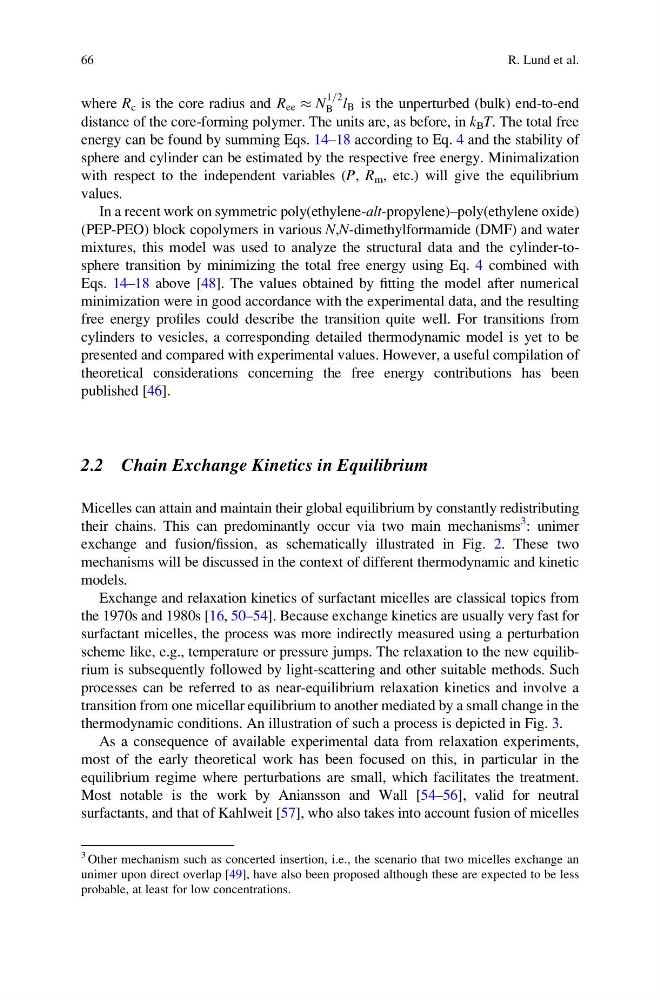
where R c is the core radius and R ee % N
1=2
B l B is the unperturbed (bulk) end-to-end
distance of the core-forming polymer. The units are, as before, in k B T. The total free
energy can be found by summing Eqs. 14–18 according to Eq. 4 and the stability of
sphere and cylinder can be estimated by the respective free energy. Minimalization
with respect to the independent variables (P, R m , etc.) will give the equilibrium
values.
In a recent work on symmetric poly(ethylene-alt-propylene)–poly(ethylene oxide)
(PEP-PEO) block copolymers in various N,N-dimethylformamide (DMF) and water
mixtures, this model was used to analyze the structural data and the cylinder-tosphere transition by minimizing the total free energy using Eq. 4 combined with
Eqs. 14–18 above [48]. The values obtained by fitting the model after numerical
minimization were in good accordance with the experimental data, and the resulting
free energy profiles could describe the transition quite well. For transitions from
cylinders to vesicles, a corresponding detailed thermodynamic model is yet to be
presented and compared with experimental values. However, a useful compilation of
theoretical considerations concerning the free energy contributions has been
published [46].
2.2 Chain Exchange Kinetics in Equilibrium
Micelles can attain and maintain their global equilibrium by constantly redistributing
their chains. This can predominantly occur via two main mechanisms
3
: unimer
exchange and fusion/fission, as schematically illustrated in Fig. 2. These two
mechanisms will be discussed in the context of different thermodynamic and kinetic
models.
Exchange and relaxation kinetics of surfactant micelles are classical topics from
the 1970s and 1980s [16, 50–54]. Because exchange kinetics are usually very fast for
surfactant micelles, the process was more indirectly measured using a perturbation
scheme like, e.g., temperature or pressure jumps. The relaxation to the new equilibrium is subsequently followed by light-scattering and other suitable methods. Such
processes can be referred to as near-equilibrium relaxation kinetics and involve a
transition from one micellar equilibrium to another mediated by a small change in the
thermodynamic conditions. An illustration of such a process is depicted in Fig. 3.
As a consequence of available experimental data from relaxation experiments,
most of the early theoretical work has been focused on this, in particular in the
equilibrium regime where perturbations are small, which facilitates the treatment.
Most notable is the work by Aniansson and Wall [54–56], valid for neutral
surfactants, and that of Kahlweit [57], who also takes into account fusion of micelles
3 Other mechanism such as concerted insertion, i.e., the scenario that two micelles exchange an
unimer upon direct overlap [49], have also been proposed although these are expected to be less
probable, at least for low concentrations.
66
R. Lund et al.
1=2
B l B is the unperturbed (bulk) end-to-end
distance of the core-forming polymer. The units are, as before, in k B T. The total free
energy can be found by summing Eqs. 14–18 according to Eq. 4 and the stability of
sphere and cylinder can be estimated by the respective free energy. Minimalization
with respect to the independent variables (P, R m , etc.) will give the equilibrium
values.
In a recent work on symmetric poly(ethylene-alt-propylene)–poly(ethylene oxide)
(PEP-PEO) block copolymers in various N,N-dimethylformamide (DMF) and water
mixtures, this model was used to analyze the structural data and the cylinder-tosphere transition by minimizing the total free energy using Eq. 4 combined with
Eqs. 14–18 above [48]. The values obtained by fitting the model after numerical
minimization were in good accordance with the experimental data, and the resulting
free energy profiles could describe the transition quite well. For transitions from
cylinders to vesicles, a corresponding detailed thermodynamic model is yet to be
presented and compared with experimental values. However, a useful compilation of
theoretical considerations concerning the free energy contributions has been
published [46].
2.2 Chain Exchange Kinetics in Equilibrium
Micelles can attain and maintain their global equilibrium by constantly redistributing
their chains. This can predominantly occur via two main mechanisms
3
: unimer
exchange and fusion/fission, as schematically illustrated in Fig. 2. These two
mechanisms will be discussed in the context of different thermodynamic and kinetic
models.
Exchange and relaxation kinetics of surfactant micelles are classical topics from
the 1970s and 1980s [16, 50–54]. Because exchange kinetics are usually very fast for
surfactant micelles, the process was more indirectly measured using a perturbation
scheme like, e.g., temperature or pressure jumps. The relaxation to the new equilibrium is subsequently followed by light-scattering and other suitable methods. Such
processes can be referred to as near-equilibrium relaxation kinetics and involve a
transition from one micellar equilibrium to another mediated by a small change in the
thermodynamic conditions. An illustration of such a process is depicted in Fig. 3.
As a consequence of available experimental data from relaxation experiments,
most of the early theoretical work has been focused on this, in particular in the
equilibrium regime where perturbations are small, which facilitates the treatment.
Most notable is the work by Aniansson and Wall [54–56], valid for neutral
surfactants, and that of Kahlweit [57], who also takes into account fusion of micelles
3 Other mechanism such as concerted insertion, i.e., the scenario that two micelles exchange an
unimer upon direct overlap [49], have also been proposed although these are expected to be less
probable, at least for low concentrations.
66
R. Lund et al.