

prerequisite for a dynamic equilibrium. However, for block copolymers characterized
by a vanishingly small cmc, the question is: how can equilibrium be expected to be
achieved?
As has been increasingly recognized over the last decade, block copolymer
micelles are often characterized by exceedingly slow kinetics and, consequently,
equilibrium is not necessarily achieved on a global scale. The system is then nonergodic and the structure is thus generally path dependent, i.e., dependent on the
sample preparation method [3–6]. This has significant implications in both nanotechnological and biomedical applications as the system is no longer just determined by
thermodynamics (i.e., the global minimum in the parameter landscape), but rather by
the kinetic pathways and the stability of the metastable state, in particular towards
intramicellar reorganization processes. Recently, this property has been utilized to
gain control over the nanostructures via kinetic control [5, 7–9] whereby the morphology and chemical composition can be manipulated via their non-equilibrium
growth mechanism, etc. Kinetic control also represents a convenient methodology to
use these “trapped” metastable states in order to create various non-equilibrium
nanostructures that would otherwise not form under equilibrium conditions. While
in equilibrium, most systems form either spherical, cylindrical, or vesicular
structures; however, a notable computer simulation study [10] has shown that exotic
(metastable) structures such as toroidal as well as intertwined and perforated shapes
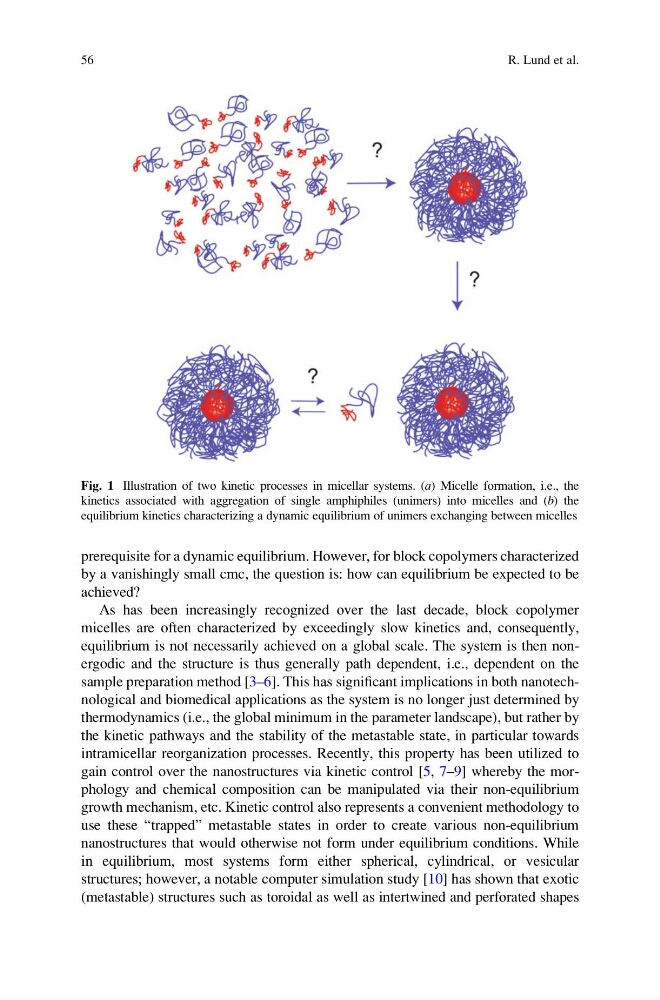
Fig. 1 Illustration of two kinetic processes in micellar systems. (a) Micelle formation, i.e., the
kinetics associated with aggregation of single amphiphiles (unimers) into micelles and (b) the
equilibrium kinetics characterizing a dynamic equilibrium of unimers exchanging between micelles
56
R. Lund et al.
by a vanishingly small cmc, the question is: how can equilibrium be expected to be
achieved?
As has been increasingly recognized over the last decade, block copolymer
micelles are often characterized by exceedingly slow kinetics and, consequently,
equilibrium is not necessarily achieved on a global scale. The system is then nonergodic and the structure is thus generally path dependent, i.e., dependent on the
sample preparation method [3–6]. This has significant implications in both nanotechnological and biomedical applications as the system is no longer just determined by
thermodynamics (i.e., the global minimum in the parameter landscape), but rather by
the kinetic pathways and the stability of the metastable state, in particular towards
intramicellar reorganization processes. Recently, this property has been utilized to
gain control over the nanostructures via kinetic control [5, 7–9] whereby the morphology and chemical composition can be manipulated via their non-equilibrium
growth mechanism, etc. Kinetic control also represents a convenient methodology to
use these “trapped” metastable states in order to create various non-equilibrium
nanostructures that would otherwise not form under equilibrium conditions. While
in equilibrium, most systems form either spherical, cylindrical, or vesicular
structures; however, a notable computer simulation study [10] has shown that exotic
(metastable) structures such as toroidal as well as intertwined and perforated shapes
Fig. 1 Illustration of two kinetic processes in micellar systems. (a) Micelle formation, i.e., the
kinetics associated with aggregation of single amphiphiles (unimers) into micelles and (b) the
equilibrium kinetics characterizing a dynamic equilibrium of unimers exchanging between micelles
56
R. Lund et al.