

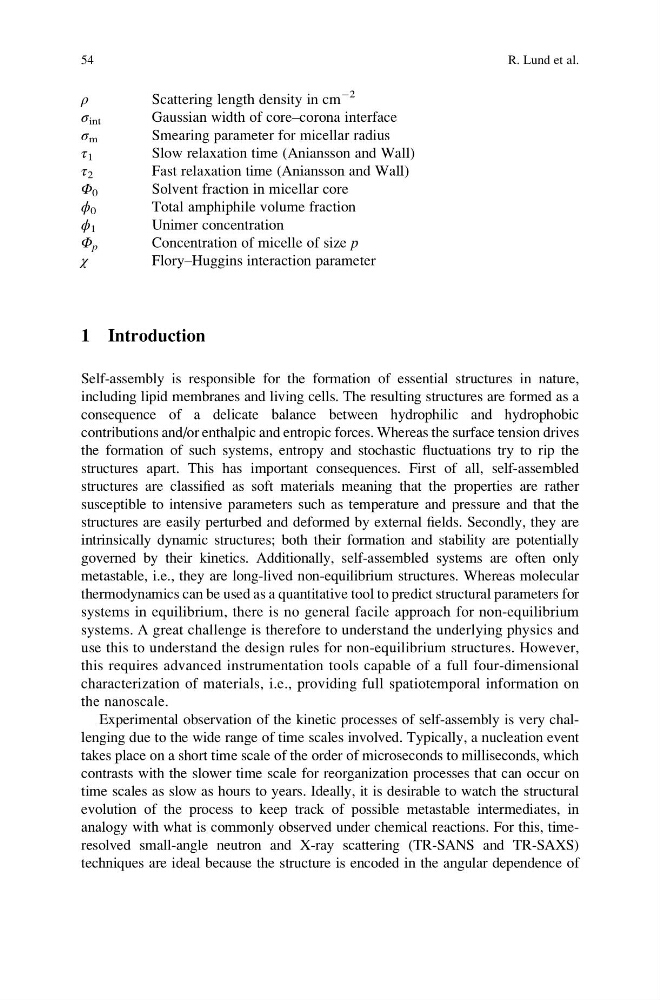
ρ
Scattering length density in cm
À2
σ int
Gaussian width of core–corona interface
σ m
Smearing parameter for micellar radius
τ 1
Slow relaxation time (Aniansson and Wall)
τ 2
Fast relaxation time (Aniansson and Wall)
Φ 0
Solvent fraction in micellar core
ϕ 0
Total amphiphile volume fraction
ϕ 1
Unimer concentration
Φ p
Concentration of micelle of size p
χ
Flory–Huggins interaction parameter
1 Introduction
Self-assembly is responsible for the formation of essential structures in nature,
including lipid membranes and living cells. The resulting structures are formed as a
consequence of a delicate balance between hydrophilic and hydrophobic
contributions and/or enthalpic and entropic forces. Whereas the surface tension drives
the formation of such systems, entropy and stochastic fluctuations try to rip the
structures apart. This has important consequences. First of all, self-assembled
structures are classified as soft materials meaning that the properties are rather
susceptible to intensive parameters such as temperature and pressure and that the
structures are easily perturbed and deformed by external fields. Secondly, they are
intrinsically dynamic structures; both their formation and stability are potentially
governed by their kinetics. Additionally, self-assembled systems are often only
metastable, i.e., they are long-lived non-equilibrium structures. Whereas molecular
thermodynamics can be used as a quantitative tool to predict structural parameters for
systems in equilibrium, there is no general facile approach for non-equilibrium
systems. A great challenge is therefore to understand the underlying physics and
use this to understand the design rules for non-equilibrium structures. However,
this requires advanced instrumentation tools capable of a full four-dimensional
characterization of materials, i.e., providing full spatiotemporal information on
the nanoscale.
Experimental observation of the kinetic processes of self-assembly is very challenging due to the wide range of time scales involved. Typically, a nucleation event
takes place on a short time scale of the order of microseconds to milliseconds, which
contrasts with the slower time scale for reorganization processes that can occur on
time scales as slow as hours to years. Ideally, it is desirable to watch the structural
evolution of the process to keep track of possible metastable intermediates, in
analogy with what is commonly observed under chemical reactions. For this, timeresolved small-angle neutron and X-ray scattering (TR-SANS and TR-SAXS)
techniques are ideal because the structure is encoded in the angular dependence of
54
R. Lund et al.
Scattering length density in cm
À2
σ int
Gaussian width of core–corona interface
σ m
Smearing parameter for micellar radius
τ 1
Slow relaxation time (Aniansson and Wall)
τ 2
Fast relaxation time (Aniansson and Wall)
Φ 0
Solvent fraction in micellar core
ϕ 0
Total amphiphile volume fraction
ϕ 1
Unimer concentration
Φ p
Concentration of micelle of size p
χ
Flory–Huggins interaction parameter
1 Introduction
Self-assembly is responsible for the formation of essential structures in nature,
including lipid membranes and living cells. The resulting structures are formed as a
consequence of a delicate balance between hydrophilic and hydrophobic
contributions and/or enthalpic and entropic forces. Whereas the surface tension drives
the formation of such systems, entropy and stochastic fluctuations try to rip the
structures apart. This has important consequences. First of all, self-assembled
structures are classified as soft materials meaning that the properties are rather
susceptible to intensive parameters such as temperature and pressure and that the
structures are easily perturbed and deformed by external fields. Secondly, they are
intrinsically dynamic structures; both their formation and stability are potentially
governed by their kinetics. Additionally, self-assembled systems are often only
metastable, i.e., they are long-lived non-equilibrium structures. Whereas molecular
thermodynamics can be used as a quantitative tool to predict structural parameters for
systems in equilibrium, there is no general facile approach for non-equilibrium
systems. A great challenge is therefore to understand the underlying physics and
use this to understand the design rules for non-equilibrium structures. However,
this requires advanced instrumentation tools capable of a full four-dimensional
characterization of materials, i.e., providing full spatiotemporal information on
the nanoscale.
Experimental observation of the kinetic processes of self-assembly is very challenging due to the wide range of time scales involved. Typically, a nucleation event
takes place on a short time scale of the order of microseconds to milliseconds, which
contrasts with the slower time scale for reorganization processes that can occur on
time scales as slow as hours to years. Ideally, it is desirable to watch the structural
evolution of the process to keep track of possible metastable intermediates, in
analogy with what is commonly observed under chemical reactions. For this, timeresolved small-angle neutron and X-ray scattering (TR-SANS and TR-SAXS)
techniques are ideal because the structure is encoded in the angular dependence of
54
R. Lund et al.