

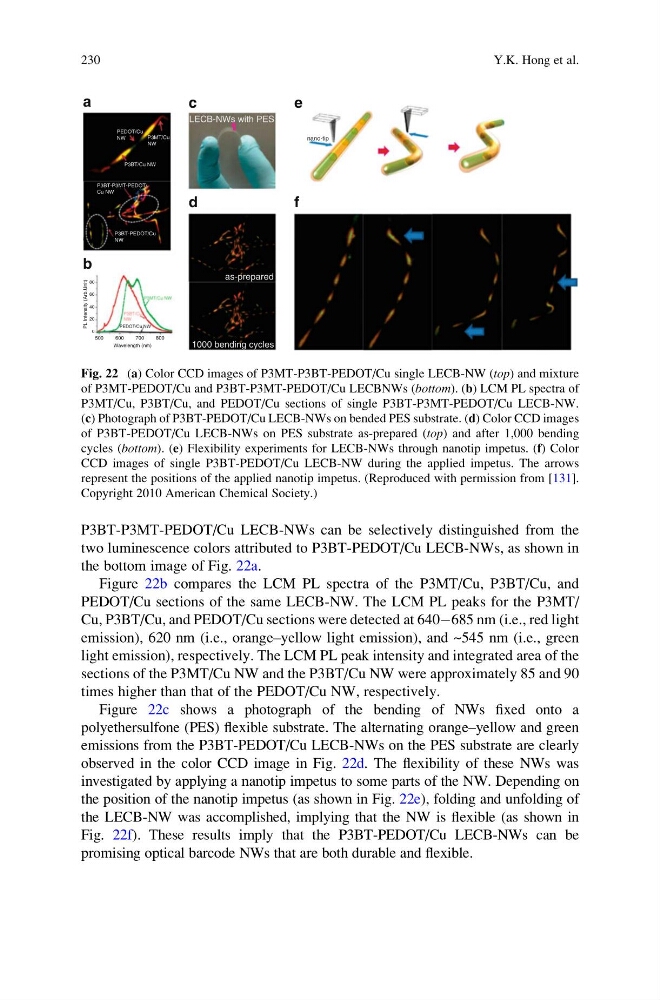
P3BT-P3MT-PEDOT/Cu LECB-NWs can be selectively distinguished from the
two luminescence colors attributed to P3BT-PEDOT/Cu LECB-NWs, as shown in
the bottom image of Fig. 22a.
Figure 22b compares the LCM PL spectra of the P3MT/Cu, P3BT/Cu, and
PEDOT/Cu sections of the same LECB-NW. The LCM PL peaks for the P3MT/
Cu, P3BT/Cu, and PEDOT/Cu sections were detected at 640À685 nm (i.e., red light
emission), 620 nm (i.e., orange–yellow light emission), and ~545 nm (i.e., green
light emission), respectively. The LCM PL peak intensity and integrated area of the
sections of the P3MT/Cu NW and the P3BT/Cu NW were approximately 85 and 90
times higher than that of the PEDOT/Cu NW, respectively.
Figure 22c shows a photograph of the bending of NWs fixed onto a
polyethersulfone (PES) flexible substrate. The alternating orange–yellow and green
emissions from the P3BT-PEDOT/Cu LECB-NWs on the PES substrate are clearly
observed in the color CCD image in Fig. 22d. The flexibility of these NWs was
investigated by applying a nanotip impetus to some parts of the NW. Depending on
the position of the nanotip impetus (as shown in Fig. 22e), folding and unfolding of
the LECB-NW was accomplished, implying that the NW is flexible (as shown in
Fig. 22f). These results imply that the P3BT-PEDOT/Cu LECB-NWs can be
promising optical barcode NWs that are both durable and flexible.
800
PEDOT/Cu NW
700
Wavelength (nm)
600
500
PL Intensity (Arb.Unit)
0
20
40
60
80
e
c
a
f
d
b
nano-tip
P3BT-P3MT-PEDOT/
Cu NW
P3BT-PEDOT/Cu
NW
P3BT/Cu NW
P3MT/Cu
NW
PEDOT/Cu
NW
1000 bending cycles
as-prepared
LECB-NWs with PES
Fig. 22 (a) Color CCD images of P3MT-P3BT-PEDOT/Cu single LECB-NW (top) and mixture
of P3MT-PEDOT/Cu and P3BT-P3MT-PEDOT/Cu LECBNWs (bottom). (b) LCM PL spectra of
P3MT/Cu, P3BT/Cu, and PEDOT/Cu sections of single P3BT-P3MT-PEDOT/Cu LECB-NW.
(c) Photograph of P3BT-PEDOT/Cu LECB-NWs on bended PES substrate. (d) Color CCD images
of P3BT-PEDOT/Cu LECB-NWs on PES substrate as-prepared (top) and after 1,000 bending
cycles (bottom). (e) Flexibility experiments for LECB-NWs through nanotip impetus. (f) Color
CCD images of single P3BT-PEDOT/Cu LECB-NW during the applied impetus. The arrows
represent the positions of the applied nanotip impetus. (Reproduced with permission from [131].
Copyright 2010 American Chemical Society.)
230
Y.K. Hong et al.
two luminescence colors attributed to P3BT-PEDOT/Cu LECB-NWs, as shown in
the bottom image of Fig. 22a.
Figure 22b compares the LCM PL spectra of the P3MT/Cu, P3BT/Cu, and
PEDOT/Cu sections of the same LECB-NW. The LCM PL peaks for the P3MT/
Cu, P3BT/Cu, and PEDOT/Cu sections were detected at 640À685 nm (i.e., red light
emission), 620 nm (i.e., orange–yellow light emission), and ~545 nm (i.e., green
light emission), respectively. The LCM PL peak intensity and integrated area of the
sections of the P3MT/Cu NW and the P3BT/Cu NW were approximately 85 and 90
times higher than that of the PEDOT/Cu NW, respectively.
Figure 22c shows a photograph of the bending of NWs fixed onto a
polyethersulfone (PES) flexible substrate. The alternating orange–yellow and green
emissions from the P3BT-PEDOT/Cu LECB-NWs on the PES substrate are clearly
observed in the color CCD image in Fig. 22d. The flexibility of these NWs was
investigated by applying a nanotip impetus to some parts of the NW. Depending on
the position of the nanotip impetus (as shown in Fig. 22e), folding and unfolding of
the LECB-NW was accomplished, implying that the NW is flexible (as shown in
Fig. 22f). These results imply that the P3BT-PEDOT/Cu LECB-NWs can be
promising optical barcode NWs that are both durable and flexible.
800
PEDOT/Cu NW
700
Wavelength (nm)
600
500
PL Intensity (Arb.Unit)
0
20
40
60
80
e
c
a
f
d
b
nano-tip
P3BT-P3MT-PEDOT/
Cu NW
P3BT-PEDOT/Cu
NW
P3BT/Cu NW
P3MT/Cu
NW
PEDOT/Cu
NW
1000 bending cycles
as-prepared
LECB-NWs with PES
Fig. 22 (a) Color CCD images of P3MT-P3BT-PEDOT/Cu single LECB-NW (top) and mixture
of P3MT-PEDOT/Cu and P3BT-P3MT-PEDOT/Cu LECBNWs (bottom). (b) LCM PL spectra of
P3MT/Cu, P3BT/Cu, and PEDOT/Cu sections of single P3BT-P3MT-PEDOT/Cu LECB-NW.
(c) Photograph of P3BT-PEDOT/Cu LECB-NWs on bended PES substrate. (d) Color CCD images
of P3BT-PEDOT/Cu LECB-NWs on PES substrate as-prepared (top) and after 1,000 bending
cycles (bottom). (e) Flexibility experiments for LECB-NWs through nanotip impetus. (f) Color
CCD images of single P3BT-PEDOT/Cu LECB-NW during the applied impetus. The arrows
represent the positions of the applied nanotip impetus. (Reproduced with permission from [131].
Copyright 2010 American Chemical Society.)
230
Y.K. Hong et al.