

accuracy, flexibility, and stability of optical barcode nanomaterials must be
improved in combination with the development of appropriate detection tools.
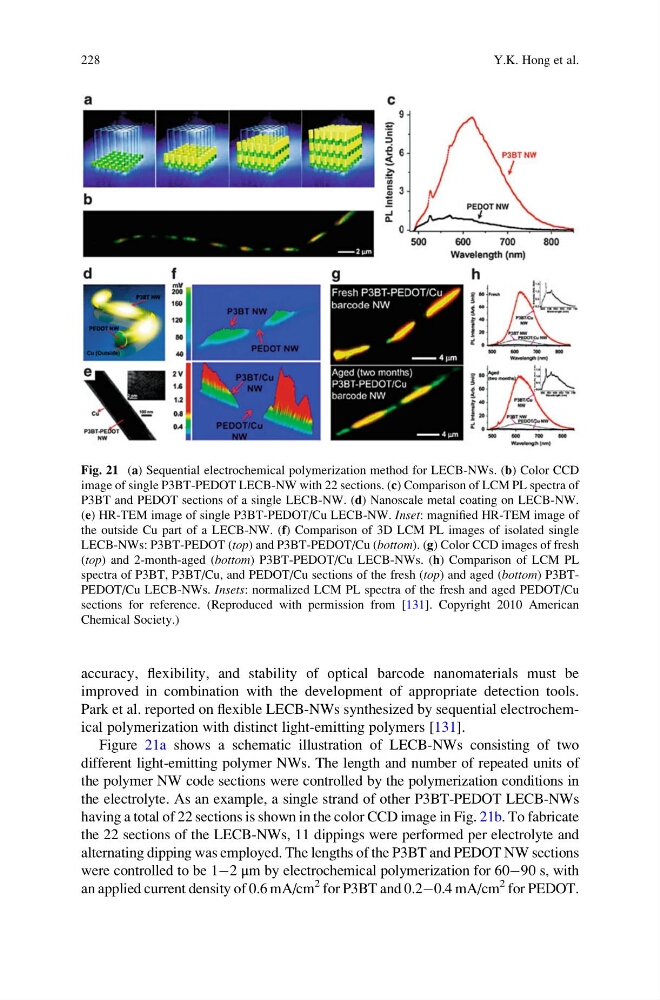
Park et al. reported on flexible LECB-NWs synthesized by sequential electrochemical polymerization with distinct light-emitting polymers [131].
Figure 21a shows a schematic illustration of LECB-NWs consisting of two
different light-emitting polymer NWs. The length and number of repeated units of
the polymer NW code sections were controlled by the polymerization conditions in
the electrolyte. As an example, a single strand of other P3BT-PEDOT LECB-NWs
having a total of 22 sections is shown in the color CCD image in Fig. 21b. To fabricate
the 22 sections of the LECB-NWs, 11 dippings were performed per electrolyte and
alternating dipping was employed. The lengths of the P3BT and PEDOT NW sections
were controlled to be 1À2 μm by electrochemical polymerization for 60À90 s, with
an applied current density of 0.6 mA/cm
2 for P3BT and 0.2À0.4 mA/cm
2 for PEDOT.
Fig. 21 (a) Sequential electrochemical polymerization method for LECB-NWs. (b) Color CCD
image of single P3BT-PEDOT LECB-NW with 22 sections. (c) Comparison of LCM PL spectra of
P3BT and PEDOT sections of a single LECB-NW. (d) Nanoscale metal coating on LECB-NW.
(e) HR-TEM image of single P3BT-PEDOT/Cu LECB-NW. Inset: magnified HR-TEM image of
the outside Cu part of a LECB-NW. (f) Comparison of 3D LCM PL images of isolated single
LECB-NWs: P3BT-PEDOT (top) and P3BT-PEDOT/Cu (bottom). (g) Color CCD images of fresh
(top) and 2-month-aged (bottom) P3BT-PEDOT/Cu LECB-NWs. (h) Comparison of LCM PL
spectra of P3BT, P3BT/Cu, and PEDOT/Cu sections of the fresh (top) and aged (bottom) P3BTPEDOT/Cu LECB-NWs. Insets: normalized LCM PL spectra of the fresh and aged PEDOT/Cu
sections for reference. (Reproduced with permission from [131]. Copyright 2010 American
Chemical Society.)
228
Y.K. Hong et al.
improved in combination with the development of appropriate detection tools.
Park et al. reported on flexible LECB-NWs synthesized by sequential electrochemical polymerization with distinct light-emitting polymers [131].
Figure 21a shows a schematic illustration of LECB-NWs consisting of two
different light-emitting polymer NWs. The length and number of repeated units of
the polymer NW code sections were controlled by the polymerization conditions in
the electrolyte. As an example, a single strand of other P3BT-PEDOT LECB-NWs
having a total of 22 sections is shown in the color CCD image in Fig. 21b. To fabricate
the 22 sections of the LECB-NWs, 11 dippings were performed per electrolyte and
alternating dipping was employed. The lengths of the P3BT and PEDOT NW sections
were controlled to be 1À2 μm by electrochemical polymerization for 60À90 s, with
an applied current density of 0.6 mA/cm
2 for P3BT and 0.2À0.4 mA/cm
2 for PEDOT.
Fig. 21 (a) Sequential electrochemical polymerization method for LECB-NWs. (b) Color CCD
image of single P3BT-PEDOT LECB-NW with 22 sections. (c) Comparison of LCM PL spectra of
P3BT and PEDOT sections of a single LECB-NW. (d) Nanoscale metal coating on LECB-NW.
(e) HR-TEM image of single P3BT-PEDOT/Cu LECB-NW. Inset: magnified HR-TEM image of
the outside Cu part of a LECB-NW. (f) Comparison of 3D LCM PL images of isolated single
LECB-NWs: P3BT-PEDOT (top) and P3BT-PEDOT/Cu (bottom). (g) Color CCD images of fresh
(top) and 2-month-aged (bottom) P3BT-PEDOT/Cu LECB-NWs. (h) Comparison of LCM PL
spectra of P3BT, P3BT/Cu, and PEDOT/Cu sections of the fresh (top) and aged (bottom) P3BTPEDOT/Cu LECB-NWs. Insets: normalized LCM PL spectra of the fresh and aged PEDOT/Cu
sections for reference. (Reproduced with permission from [131]. Copyright 2010 American
Chemical Society.)
228
Y.K. Hong et al.