

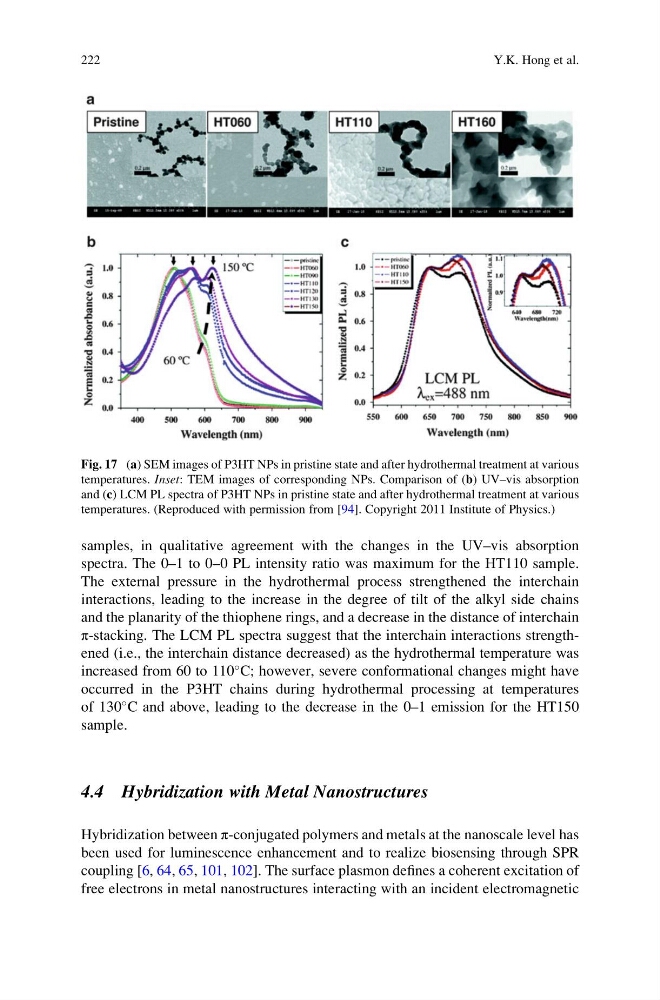
samples, in qualitative agreement with the changes in the UV–vis absorption
spectra. The 0–1 to 0–0 PL intensity ratio was maximum for the HT110 sample.
The external pressure in the hydrothermal process strengthened the interchain
interactions, leading to the increase in the degree of tilt of the alkyl side chains
and the planarity of the thiophene rings, and a decrease in the distance of interchain
π-stacking. The LCM PL spectra suggest that the interchain interactions strengthened (i.e., the interchain distance decreased) as the hydrothermal temperature was
increased from 60 to 110
C; however, severe conformational changes might have
occurred in the P3HT chains during hydrothermal processing at temperatures
of 130
C and above, leading to the decrease in the 0–1 emission for the HT150
sample.
4.4 Hybridization with Metal Nanostructures
Hybridization between π-conjugated polymers and metals at the nanoscale level has
been used for luminescence enhancement and to realize biosensing through SPR
coupling [6, 64, 65, 101, 102]. The surface plasmon defines a coherent excitation of
free electrons in metal nanostructures interacting with an incident electromagnetic
Fig. 17 (a) SEM images of P3HT NPs in pristine state and after hydrothermal treatment at various
temperatures. Inset: TEM images of corresponding NPs. Comparison of (b) UV–vis absorption
and (c) LCM PL spectra of P3HT NPs in pristine state and after hydrothermal treatment at various
temperatures. (Reproduced with permission from [94]. Copyright 2011 Institute of Physics.)
222
Y.K. Hong et al.
spectra. The 0–1 to 0–0 PL intensity ratio was maximum for the HT110 sample.
The external pressure in the hydrothermal process strengthened the interchain
interactions, leading to the increase in the degree of tilt of the alkyl side chains
and the planarity of the thiophene rings, and a decrease in the distance of interchain
π-stacking. The LCM PL spectra suggest that the interchain interactions strengthened (i.e., the interchain distance decreased) as the hydrothermal temperature was
increased from 60 to 110
C; however, severe conformational changes might have
occurred in the P3HT chains during hydrothermal processing at temperatures
of 130
C and above, leading to the decrease in the 0–1 emission for the HT150
sample.
4.4 Hybridization with Metal Nanostructures
Hybridization between π-conjugated polymers and metals at the nanoscale level has
been used for luminescence enhancement and to realize biosensing through SPR
coupling [6, 64, 65, 101, 102]. The surface plasmon defines a coherent excitation of
free electrons in metal nanostructures interacting with an incident electromagnetic
Fig. 17 (a) SEM images of P3HT NPs in pristine state and after hydrothermal treatment at various
temperatures. Inset: TEM images of corresponding NPs. Comparison of (b) UV–vis absorption
and (c) LCM PL spectra of P3HT NPs in pristine state and after hydrothermal treatment at various
temperatures. (Reproduced with permission from [94]. Copyright 2011 Institute of Physics.)
222
Y.K. Hong et al.