

applied to styrene derivatives having silyl, methoxy, alkynyl, and alkylthio groups
on the benzene ring. Wurm et al. also reported the anionic polymerization of styrene
at 20
C using a flow microreactor [147]. Polystyrenes in a broad range of molecular
weight with a narrow molecular weight distribution can be obtained within several
seconds (M n ¼ 1,700–70,000, M w /M n ¼ 1.09–1.41). It should be noted that strict
dryness of the apparatus and high vacuum techniques is needed in the classical
batch methods but that such experimental effort can be significant reduced by using
flow microreactors. Residual impurities and moisture can be removed by purging
the reactor with solutions of a monomer and an initiator before a solution of the
desired polymer product is collected at the outlet of flow microreactors.
Integration of chemical reactions enhances the power and speed of organic and
polymer synthesis, and recently it has been recognized that flow microreactors
enable space-integration of reactions [148–153]. On the basis of livingness of the
polymer end, structurally well-defined polymers such as end-functionalized
polymers and block copolymers can be synthesized using integrated flow
microreactor systems consisting of two micromixers and two microtube reactors.
For example, functionalization of a living polymer end using chlorosilanes such as
chlorotrimethylsilane and chlorodimethylvinylsilane is effectively achieved by
using integrated flow microreactor systems to obtain polystyrenes bearing the
silyl group at the terminal. Block copolymerization can also be achieved using
the integrated flow microreactor system at 0
C and 24
C to obtain structurally
defined block copolymers composed of two different styrenes in quantitative yields
(Fig. 10).
End-functionalization with epoxides is also popular because epoxides have high
reactivity toward nucleophiles by virtue of ring strain. Use of functionalized epoxides
enables a further transformation after deprotection. For example, polymerization of
styrene followed by end-functionalization with the various glycidyl ethers having
acetal structures such as ethoxy ethyl glycidyl ether (EEGE), 1,2-isopropylidene
glyceryl glycidyl ether (IGG), and trans-2-phenyl-1,3-dioxane glycidyl ether
(PDGE) can be accomplished using a flow microreactor system (Fig. 11) [154].
The acetal and ketal protecting groups in the glycidyl ethers are stable toward the
highly reactive carbanionic living polymer ends but they can be easily cleaved under
acidic conditions to afford multihydroxyl end-functionalized polymers (Fig. 12).
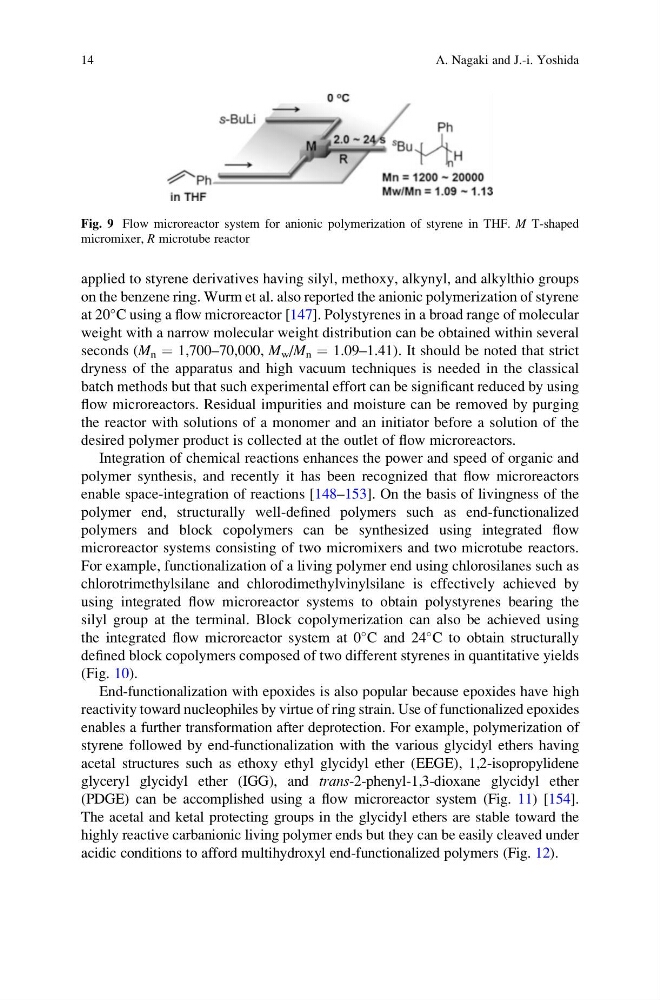
Fig. 9 Flow microreactor system for anionic polymerization of styrene in THF. M T-shaped
micromixer, R microtube reactor
14
A. Nagaki and J.-i. Yoshida
on the benzene ring. Wurm et al. also reported the anionic polymerization of styrene
at 20
C using a flow microreactor [147]. Polystyrenes in a broad range of molecular
weight with a narrow molecular weight distribution can be obtained within several
seconds (M n ¼ 1,700–70,000, M w /M n ¼ 1.09–1.41). It should be noted that strict
dryness of the apparatus and high vacuum techniques is needed in the classical
batch methods but that such experimental effort can be significant reduced by using
flow microreactors. Residual impurities and moisture can be removed by purging
the reactor with solutions of a monomer and an initiator before a solution of the
desired polymer product is collected at the outlet of flow microreactors.
Integration of chemical reactions enhances the power and speed of organic and
polymer synthesis, and recently it has been recognized that flow microreactors
enable space-integration of reactions [148–153]. On the basis of livingness of the
polymer end, structurally well-defined polymers such as end-functionalized
polymers and block copolymers can be synthesized using integrated flow
microreactor systems consisting of two micromixers and two microtube reactors.
For example, functionalization of a living polymer end using chlorosilanes such as
chlorotrimethylsilane and chlorodimethylvinylsilane is effectively achieved by
using integrated flow microreactor systems to obtain polystyrenes bearing the
silyl group at the terminal. Block copolymerization can also be achieved using
the integrated flow microreactor system at 0
C and 24
C to obtain structurally
defined block copolymers composed of two different styrenes in quantitative yields
(Fig. 10).
End-functionalization with epoxides is also popular because epoxides have high
reactivity toward nucleophiles by virtue of ring strain. Use of functionalized epoxides
enables a further transformation after deprotection. For example, polymerization of
styrene followed by end-functionalization with the various glycidyl ethers having
acetal structures such as ethoxy ethyl glycidyl ether (EEGE), 1,2-isopropylidene
glyceryl glycidyl ether (IGG), and trans-2-phenyl-1,3-dioxane glycidyl ether
(PDGE) can be accomplished using a flow microreactor system (Fig. 11) [154].
The acetal and ketal protecting groups in the glycidyl ethers are stable toward the
highly reactive carbanionic living polymer ends but they can be easily cleaved under
acidic conditions to afford multihydroxyl end-functionalized polymers (Fig. 12).
Fig. 9 Flow microreactor system for anionic polymerization of styrene in THF. M T-shaped
micromixer, R microtube reactor
14
A. Nagaki and J.-i. Yoshida