

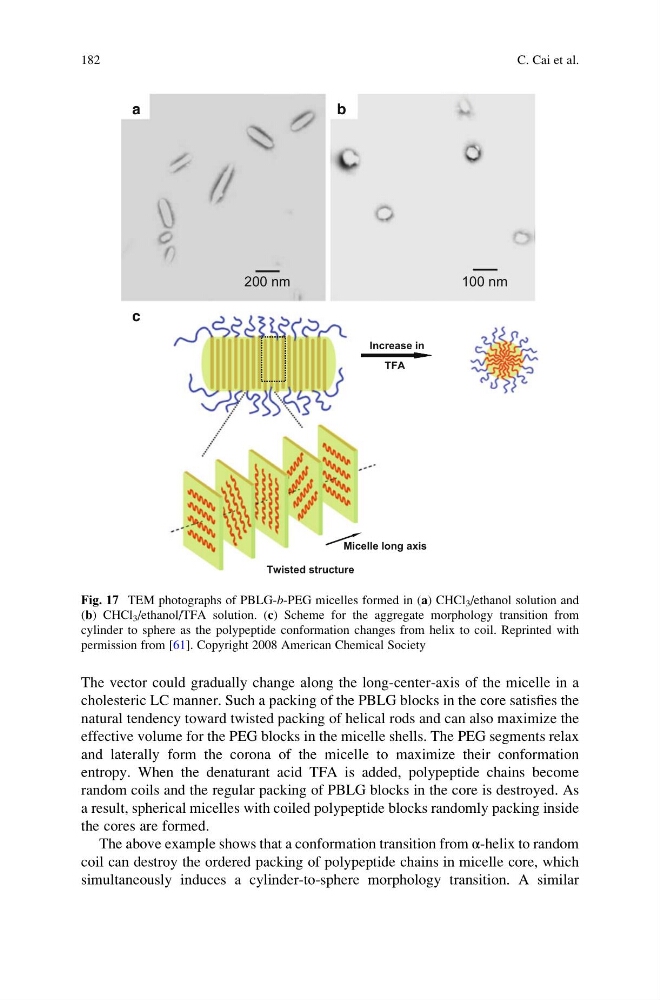
The vector could gradually change along the long-center-axis of the micelle in a
cholesteric LC manner. Such a packing of the PBLG blocks in the core satisfies the
natural tendency toward twisted packing of helical rods and can also maximize the
effective volume for the PEG blocks in the micelle shells. The PEG segments relax
and laterally form the corona of the micelle to maximize their conformation
entropy. When the denaturant acid TFA is added, polypeptide chains become
random coils and the regular packing of PBLG blocks in the core is destroyed. As
a result, spherical micelles with coiled polypeptide blocks randomly packing inside
the cores are formed.
The above example shows that a conformation transition from α-helix to random
coil can destroy the ordered packing of polypeptide chains in micelle core, which
simultaneously induces a cylinder-to-sphere morphology transition. A similar
Micelle long axis
Twisted structure
Increase in
a
c
b
TFA
100 nm
200 nm
Fig. 17 TEM photographs of PBLG-b-PEG micelles formed in (a) CHCl 3 /ethanol solution and
(b) CHCl 3 /ethanol/TFA solution. (c) Scheme for the aggregate morphology transition from
cylinder to sphere as the polypeptide conformation changes from helix to coil. Reprinted with
permission from [61]. Copyright 2008 American Chemical Society
182
C. Cai et al.
cholesteric LC manner. Such a packing of the PBLG blocks in the core satisfies the
natural tendency toward twisted packing of helical rods and can also maximize the
effective volume for the PEG blocks in the micelle shells. The PEG segments relax
and laterally form the corona of the micelle to maximize their conformation
entropy. When the denaturant acid TFA is added, polypeptide chains become
random coils and the regular packing of PBLG blocks in the core is destroyed. As
a result, spherical micelles with coiled polypeptide blocks randomly packing inside
the cores are formed.
The above example shows that a conformation transition from α-helix to random
coil can destroy the ordered packing of polypeptide chains in micelle core, which
simultaneously induces a cylinder-to-sphere morphology transition. A similar
Micelle long axis
Twisted structure
Increase in
a
c
b
TFA
100 nm
200 nm
Fig. 17 TEM photographs of PBLG-b-PEG micelles formed in (a) CHCl 3 /ethanol solution and
(b) CHCl 3 /ethanol/TFA solution. (c) Scheme for the aggregate morphology transition from
cylinder to sphere as the polypeptide conformation changes from helix to coil. Reprinted with
permission from [61]. Copyright 2008 American Chemical Society
182
C. Cai et al.