

pathway could be more rigorously verified using time-resolved SAXS or SANS
whereby the intermediate nanostructures can be observed directly. An example
using this technique is given in the next section.
5.1.3 Time-Resolved SAXS with Millisecond Resolution
Most of the works mentioned so far have used light scattering or fluorescence
spectroscopy to follow the kinetics, hence the experiments provide little or no
structural resolution. In a recent work by Lund et al. [183], synchrotron SAXS was
coupled with a stopped-flow apparatus in order to study micellization kinetics with a
millisecond time resolution and nanometer structural resolution. In this study, an
amphiphilic model system consisting of a well-defined PEP1-PEO20 block copolymer in DMF/water mixtures was used. As previously mentioned, both DMF and
water are bad solvents towards PEP but good solvents for PEO. The PEP1-PEO20
system is very useful for studying micellization because in pure DMF only single
chains (unimers) are present, but the block copolymers aggregate into wellsegregated micelles as soon as some water is added. Hence, micellization can be
induced by rapidly mixing a solution of PEP1-PEO20 in DMF with water in a
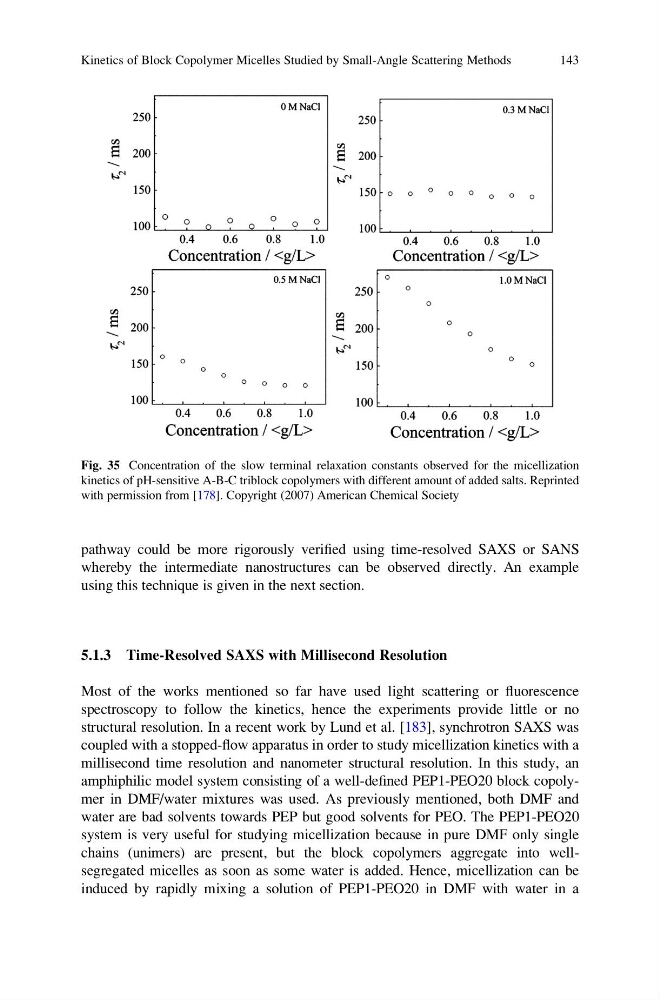
Fig. 35 Concentration of the slow terminal relaxation constants observed for the micellization
kinetics of pH-sensitive A-B-C triblock copolymers with different amount of added salts. Reprinted
with permission from [178]. Copyright (2007) American Chemical Society
Kinetics of Block Copolymer Micelles Studied by Small-Angle Scattering Methods
143
whereby the intermediate nanostructures can be observed directly. An example
using this technique is given in the next section.
5.1.3 Time-Resolved SAXS with Millisecond Resolution
Most of the works mentioned so far have used light scattering or fluorescence
spectroscopy to follow the kinetics, hence the experiments provide little or no
structural resolution. In a recent work by Lund et al. [183], synchrotron SAXS was
coupled with a stopped-flow apparatus in order to study micellization kinetics with a
millisecond time resolution and nanometer structural resolution. In this study, an
amphiphilic model system consisting of a well-defined PEP1-PEO20 block copolymer in DMF/water mixtures was used. As previously mentioned, both DMF and
water are bad solvents towards PEP but good solvents for PEO. The PEP1-PEO20
system is very useful for studying micellization because in pure DMF only single
chains (unimers) are present, but the block copolymers aggregate into wellsegregated micelles as soon as some water is added. Hence, micellization can be
induced by rapidly mixing a solution of PEP1-PEO20 in DMF with water in a
Fig. 35 Concentration of the slow terminal relaxation constants observed for the micellization
kinetics of pH-sensitive A-B-C triblock copolymers with different amount of added salts. Reprinted
with permission from [178]. Copyright (2007) American Chemical Society
Kinetics of Block Copolymer Micelles Studied by Small-Angle Scattering Methods
143