

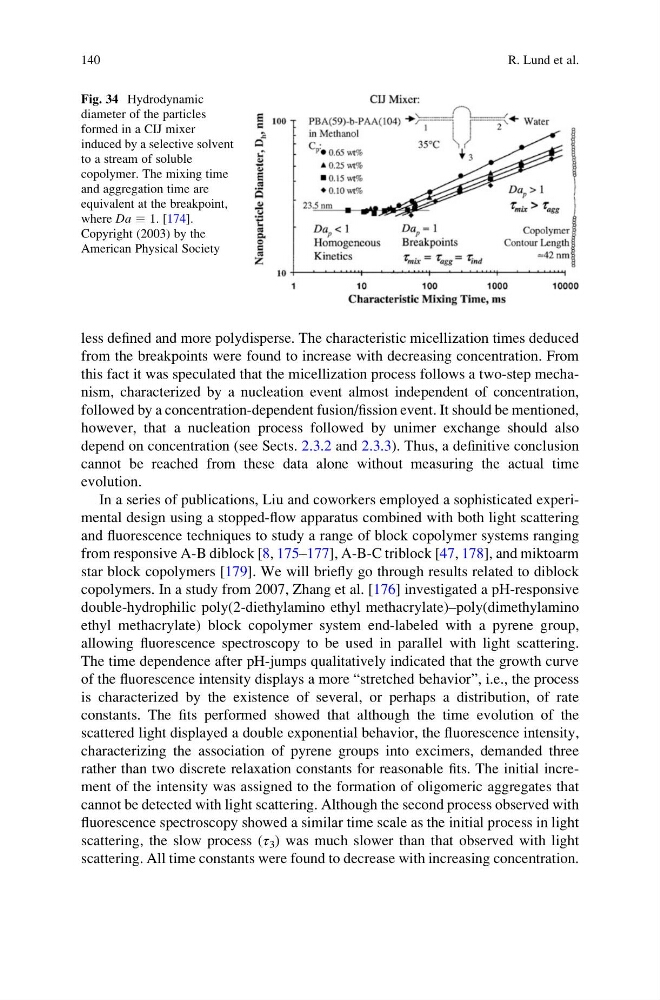
less defined and more polydisperse. The characteristic micellization times deduced
from the breakpoints were found to increase with decreasing concentration. From
this fact it was speculated that the micellization process follows a two-step mechanism, characterized by a nucleation event almost independent of concentration,
followed by a concentration-dependent fusion/fission event. It should be mentioned,
however, that a nucleation process followed by unimer exchange should also
depend on concentration (see Sects. 2.3.2 and 2.3.3). Thus, a definitive conclusion
cannot be reached from these data alone without measuring the actual time
evolution.
In a series of publications, Liu and coworkers employed a sophisticated experimental design using a stopped-flow apparatus combined with both light scattering
and fluorescence techniques to study a range of block copolymer systems ranging
from responsive A-B diblock [8, 175–177], A-B-C triblock [47, 178], and miktoarm
star block copolymers [179]. We will briefly go through results related to diblock
copolymers. In a study from 2007, Zhang et al. [176] investigated a pH-responsive
double-hydrophilic poly(2-diethylamino ethyl methacrylate)–poly(dimethylamino
ethyl methacrylate) block copolymer system end-labeled with a pyrene group,
allowing fluorescence spectroscopy to be used in parallel with light scattering.
The time dependence after pH-jumps qualitatively indicated that the growth curve
of the fluorescence intensity displays a more “stretched behavior”, i.e., the process
is characterized by the existence of several, or perhaps a distribution, of rate
constants. The fits performed showed that although the time evolution of the
scattered light displayed a double exponential behavior, the fluorescence intensity,
characterizing the association of pyrene groups into excimers, demanded three
rather than two discrete relaxation constants for reasonable fits. The initial increment of the intensity was assigned to the formation of oligomeric aggregates that
cannot be detected with light scattering. Although the second process observed with
fluorescence spectroscopy showed a similar time scale as the initial process in light
scattering, the slow process (τ 3 ) was much slower than that observed with light
scattering. All time constants were found to decrease with increasing concentration.
Fig. 34 Hydrodynamic
diameter of the particles
formed in a CIJ mixer
induced by a selective solvent
to a stream of soluble
copolymer. The mixing time
and aggregation time are
equivalent at the breakpoint,
where Da 1. [174].
Copyright (2003) by the
American Physical Society
140
R. Lund et al.
from the breakpoints were found to increase with decreasing concentration. From
this fact it was speculated that the micellization process follows a two-step mechanism, characterized by a nucleation event almost independent of concentration,
followed by a concentration-dependent fusion/fission event. It should be mentioned,
however, that a nucleation process followed by unimer exchange should also
depend on concentration (see Sects. 2.3.2 and 2.3.3). Thus, a definitive conclusion
cannot be reached from these data alone without measuring the actual time
evolution.
In a series of publications, Liu and coworkers employed a sophisticated experimental design using a stopped-flow apparatus combined with both light scattering
and fluorescence techniques to study a range of block copolymer systems ranging
from responsive A-B diblock [8, 175–177], A-B-C triblock [47, 178], and miktoarm
star block copolymers [179]. We will briefly go through results related to diblock
copolymers. In a study from 2007, Zhang et al. [176] investigated a pH-responsive
double-hydrophilic poly(2-diethylamino ethyl methacrylate)–poly(dimethylamino
ethyl methacrylate) block copolymer system end-labeled with a pyrene group,
allowing fluorescence spectroscopy to be used in parallel with light scattering.
The time dependence after pH-jumps qualitatively indicated that the growth curve
of the fluorescence intensity displays a more “stretched behavior”, i.e., the process
is characterized by the existence of several, or perhaps a distribution, of rate
constants. The fits performed showed that although the time evolution of the
scattered light displayed a double exponential behavior, the fluorescence intensity,
characterizing the association of pyrene groups into excimers, demanded three
rather than two discrete relaxation constants for reasonable fits. The initial increment of the intensity was assigned to the formation of oligomeric aggregates that
cannot be detected with light scattering. Although the second process observed with
fluorescence spectroscopy showed a similar time scale as the initial process in light
scattering, the slow process (τ 3 ) was much slower than that observed with light
scattering. All time constants were found to decrease with increasing concentration.
Fig. 34 Hydrodynamic
diameter of the particles
formed in a CIJ mixer
induced by a selective solvent
to a stream of soluble
copolymer. The mixing time
and aggregation time are
equivalent at the breakpoint,
where Da 1. [174].
Copyright (2003) by the
American Physical Society
140
R. Lund et al.