

5.1.2 Stopped-Flow Experiments
As seen from the results from the T-jump experiments described above, there is a
tendency in the literature to analyze the data in terms of two relaxation constants, even
for highly non-equilibrium processes such as micellization kinetics. This is not
obvious because micelle formation kinetics involves a distribution of many types of
intermediate aggregates and will not necessarily behave in the way Aniansson and
Wall predicted for small perturbations away from equilibrium (“linear regime”).
Perhaps a more convenient way of inducing micellization is by adding a component
that selectively precipitates one of the blocks. Fast kinetic measurements in the order
of microseconds can be achieved with modern instruments by using a stopped-flow
apparatus for rapid mixing, as described in Sect. 3.2.1. Because micellization is
induced very rapidly, this technique is in principle very suitable for comparing
experimental data with theory.
The earliest measurements using stopped-flow and light scattering to study kinetics of block copolymer micelles were done by Bednar et al. [173]. In their work, both
the micellization kinetics and dissociation kinetics of two commercial block
copolymers (“Kraton”) were studied: an A-B poly(styrene-b-ethylene/propylene)
(SEP) diblock and an A-B-A poly(styrene-b-ethylene/butylene-b-styrene) (SEBS)
triblock copolymer. The polymers were molecularly dissolved in mixtures of
1,4-dioxane and heptane that were poor solvents for either EP/EB or S blocks. Micelle
formation with EP or EB as core block was then studied by rapidly adding additional
pure 1,4 dioxane to the solution. Dissociation of the micelles could be observed by
adding heptane to the mixture. Although heptane is a good solvent for the EP or EB
blocks it is a marginally bad solvent for PS and thus dissolution of the system is only
possible in a solvent mixture and the micelles are likely to have partially swollen
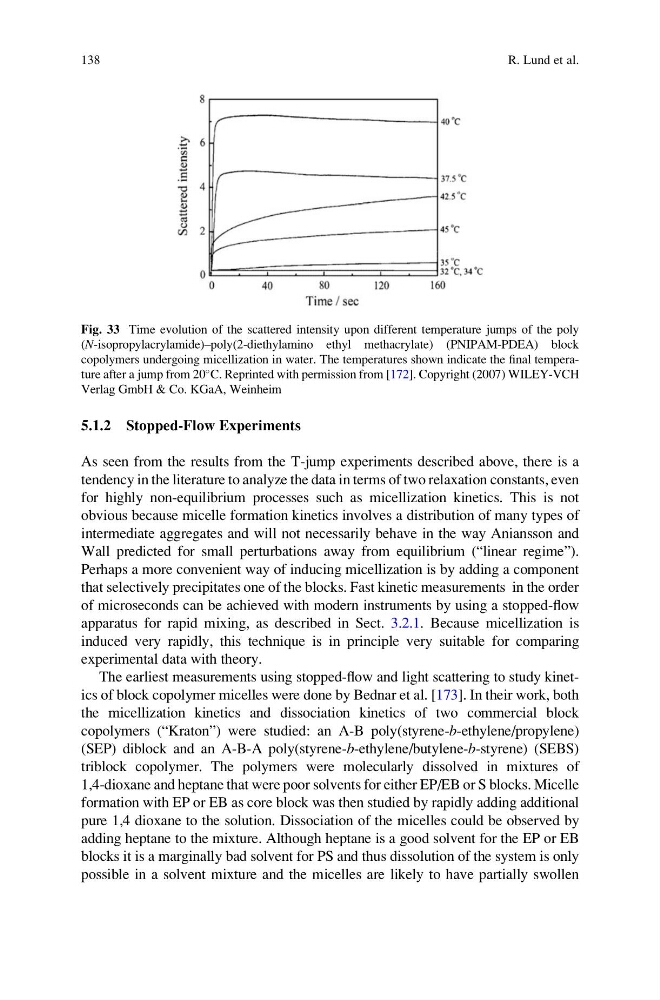
Fig. 33 Time evolution of the scattered intensity upon different temperature jumps of the poly
(N-isopropylacrylamide)–poly(2-diethylamino ethyl methacrylate) (PNIPAM-PDEA) block
copolymers undergoing micellization in water. The temperatures shown indicate the final temperature after a jump from 20
C. Reprinted with permission from [172]. Copyright (2007) WILEY-VCH
Verlag GmbH & Co. KGaA, Weinheim
138
R. Lund et al.
As seen from the results from the T-jump experiments described above, there is a
tendency in the literature to analyze the data in terms of two relaxation constants, even
for highly non-equilibrium processes such as micellization kinetics. This is not
obvious because micelle formation kinetics involves a distribution of many types of
intermediate aggregates and will not necessarily behave in the way Aniansson and
Wall predicted for small perturbations away from equilibrium (“linear regime”).
Perhaps a more convenient way of inducing micellization is by adding a component
that selectively precipitates one of the blocks. Fast kinetic measurements in the order
of microseconds can be achieved with modern instruments by using a stopped-flow
apparatus for rapid mixing, as described in Sect. 3.2.1. Because micellization is
induced very rapidly, this technique is in principle very suitable for comparing
experimental data with theory.
The earliest measurements using stopped-flow and light scattering to study kinetics of block copolymer micelles were done by Bednar et al. [173]. In their work, both
the micellization kinetics and dissociation kinetics of two commercial block
copolymers (“Kraton”) were studied: an A-B poly(styrene-b-ethylene/propylene)
(SEP) diblock and an A-B-A poly(styrene-b-ethylene/butylene-b-styrene) (SEBS)
triblock copolymer. The polymers were molecularly dissolved in mixtures of
1,4-dioxane and heptane that were poor solvents for either EP/EB or S blocks. Micelle
formation with EP or EB as core block was then studied by rapidly adding additional
pure 1,4 dioxane to the solution. Dissociation of the micelles could be observed by
adding heptane to the mixture. Although heptane is a good solvent for the EP or EB
blocks it is a marginally bad solvent for PS and thus dissolution of the system is only
possible in a solvent mixture and the micelles are likely to have partially swollen
Fig. 33 Time evolution of the scattered intensity upon different temperature jumps of the poly
(N-isopropylacrylamide)–poly(2-diethylamino ethyl methacrylate) (PNIPAM-PDEA) block
copolymers undergoing micellization in water. The temperatures shown indicate the final temperature after a jump from 20
C. Reprinted with permission from [172]. Copyright (2007) WILEY-VCH
Verlag GmbH & Co. KGaA, Weinheim
138
R. Lund et al.