

time evolution of the scattered signal was found to be close to exponential in all cases.
Typical time constants ranged from 1 s to a few milliseconds; however, no clear
physical interpretation of the results was presented.
Later studies of Pluronics have similarly been performed without a clear distinction between micellization kinetics and micelle–micelle relaxation kinetics
[115, 127–129]. Contrary to the study of Hecht and Hoffmann, these studies reveal
the presence of two [115, 127] or three time constants [128, 129]. The first two were
interpreted in terms of the Aniansson and Wall theory and attributed to unimer
absorption and unimer exchange-mediated reorganization kinetics. The third relaxation time constant was proposed by Kositza et al. [128, 129] on the basis of a
infrared laser-induced T-jump and attributed to “clustering of micelles into larger
aggregates” and was observed with increasing amplitude close to the cloud point of
the sample, i.e., a micellar fusion mechanism related to a macrophase separation. In
one of the works by Kositza et al. [128], the effect of impurities, inherently present
in industrial grade Pluronic samples, was investigated by fractionation and purification. The results showed that although the first (fast) process was not appreciatively affected by impurities, the second and third processes were slowed down,
suggesting that these processes are dependent on the structural composition. It was
also found that addition of hydrophobic compounds led to much larger clusters,
especially around the cmt.
In the experiments of Goldmints et al. [127] and Kositza et al.[128, 129] mentioned above, an iodine-based laser heating was used, which provides a faster heating
as compared to a traditional resistance-based heating apparatus (“Joule heating”).
Using Joule heating, a certain thermal inertia may be important and cause a time-lag
as opposed to the instantaneous perturbation often assumed in theories. Consequently,
if the heating time is slow, the process may be regarded as a gradual thermal
equilibration process rather than a deep non-equilibrium quench, which would lead
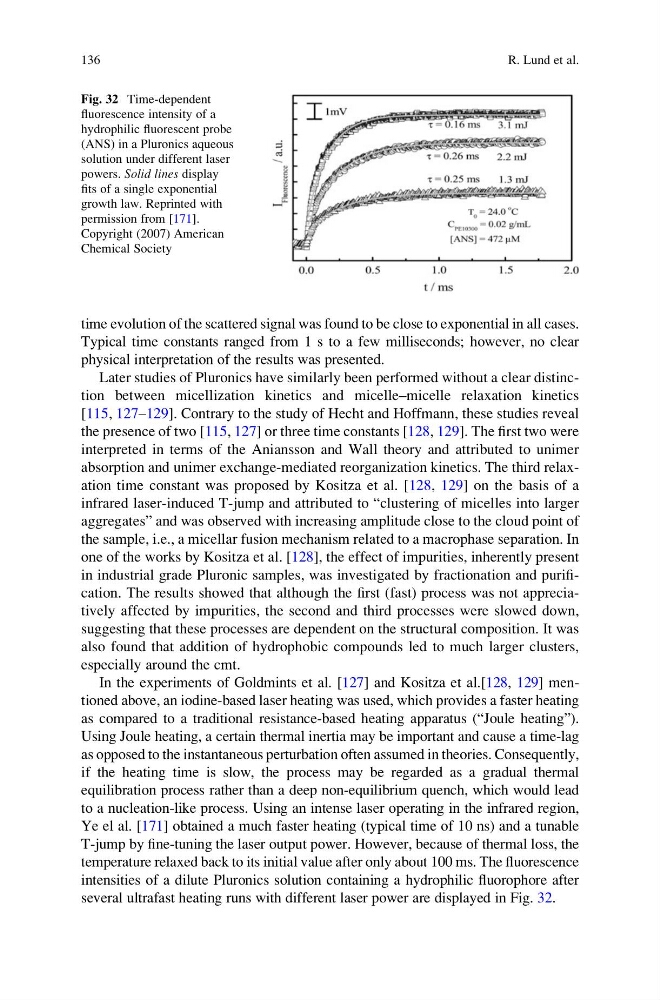
to a nucleation-like process. Using an intense laser operating in the infrared region,
Ye el al. [171] obtained a much faster heating (typical time of 10 ns) and a tunable
T-jump by fine-tuning the laser output power. However, because of thermal loss, the
temperature relaxed back to its initial value after only about 100 ms. The fluorescence
intensities of a dilute Pluronics solution containing a hydrophilic fluorophore after
several ultrafast heating runs with different laser power are displayed in Fig. 32.
Fig. 32 Time-dependent
fluorescence intensity of a
hydrophilic fluorescent probe
(ANS) in a Pluronics aqueous
solution under different laser
powers. Solid lines display
fits of a single exponential
growth law. Reprinted with
permission from [171].
Copyright (2007) American
Chemical Society
136
R. Lund et al.
Typical time constants ranged from 1 s to a few milliseconds; however, no clear
physical interpretation of the results was presented.
Later studies of Pluronics have similarly been performed without a clear distinction between micellization kinetics and micelle–micelle relaxation kinetics
[115, 127–129]. Contrary to the study of Hecht and Hoffmann, these studies reveal
the presence of two [115, 127] or three time constants [128, 129]. The first two were
interpreted in terms of the Aniansson and Wall theory and attributed to unimer
absorption and unimer exchange-mediated reorganization kinetics. The third relaxation time constant was proposed by Kositza et al. [128, 129] on the basis of a
infrared laser-induced T-jump and attributed to “clustering of micelles into larger
aggregates” and was observed with increasing amplitude close to the cloud point of
the sample, i.e., a micellar fusion mechanism related to a macrophase separation. In
one of the works by Kositza et al. [128], the effect of impurities, inherently present
in industrial grade Pluronic samples, was investigated by fractionation and purification. The results showed that although the first (fast) process was not appreciatively affected by impurities, the second and third processes were slowed down,
suggesting that these processes are dependent on the structural composition. It was
also found that addition of hydrophobic compounds led to much larger clusters,
especially around the cmt.
In the experiments of Goldmints et al. [127] and Kositza et al.[128, 129] mentioned above, an iodine-based laser heating was used, which provides a faster heating
as compared to a traditional resistance-based heating apparatus (“Joule heating”).
Using Joule heating, a certain thermal inertia may be important and cause a time-lag
as opposed to the instantaneous perturbation often assumed in theories. Consequently,
if the heating time is slow, the process may be regarded as a gradual thermal
equilibration process rather than a deep non-equilibrium quench, which would lead
to a nucleation-like process. Using an intense laser operating in the infrared region,
Ye el al. [171] obtained a much faster heating (typical time of 10 ns) and a tunable
T-jump by fine-tuning the laser output power. However, because of thermal loss, the
temperature relaxed back to its initial value after only about 100 ms. The fluorescence
intensities of a dilute Pluronics solution containing a hydrophilic fluorophore after
several ultrafast heating runs with different laser power are displayed in Fig. 32.
Fig. 32 Time-dependent
fluorescence intensity of a
hydrophilic fluorescent probe
(ANS) in a Pluronics aqueous
solution under different laser
powers. Solid lines display
fits of a single exponential
growth law. Reprinted with
permission from [171].
Copyright (2007) American
Chemical Society
136
R. Lund et al.