

the authors proposed that the deceleration in chain exchange might arise from
considerable corona overlap of neighboring micelles at higher concentration.
Crowding of corona polymer should generate an additional contribution to the
activation barrier because a single polymer would be more easily soluble in dilute
solution than in semidilute solution.
Based on this experimental observation, Halperin extended the original scaling
model to higher concentrations by introducing an additional penalty term that takes
into account an increase in the osmotic pressure due to coronal screening. This was
outlined in Sect. 2.2.7. Halperin further suggested that for a systematic investigation, coronal screening can also be obtained by the addition of soluble corona
homopolymer while keeping a dilute solution of micelles. This would facilitate
the interpretation because other possible mechanisms like fusion and fission, which
are expected from computer simulation and theory, occur at higher concentrations
and need not to be discussed.
4.6 Cylinders Versus Spheres: Effect of Morphology
The influence of micellar morphology on the exchange kinetics in diblock copolymer micelles has been investigated by Lund et al. [104]. The studied system was a
short chain PEP1-PEO1 copolymer with symmetric block composition in water/
DMF mixtures as selective solvents for PEO. The morphological behavior of this
system has already been described. The main features are illustrated in Fig. 20d.
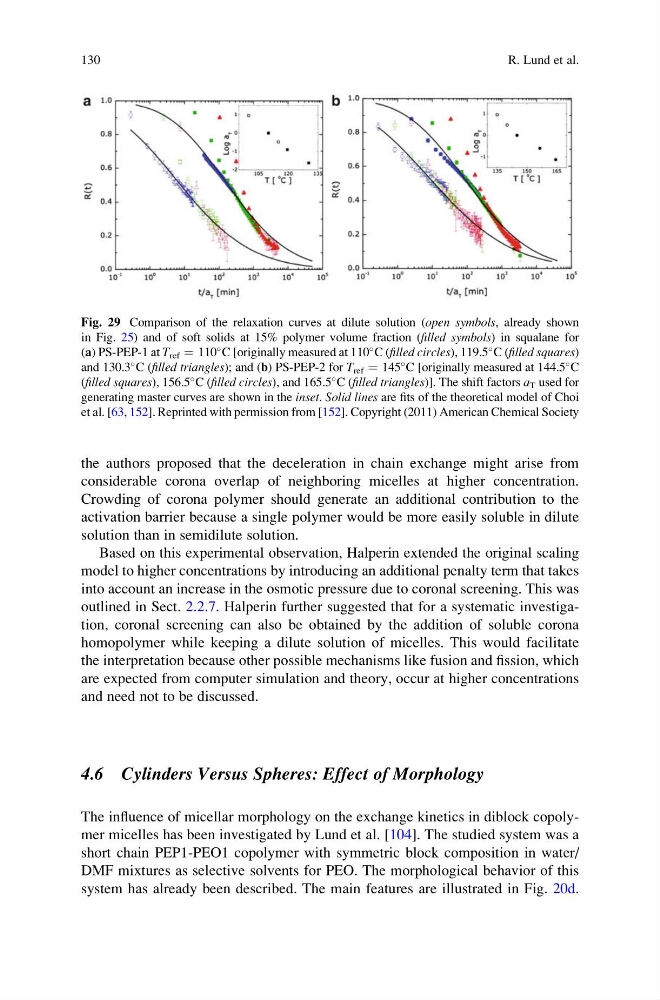
Fig. 29 Comparison of the relaxation curves at dilute solution (open symbols, already shown
in Fig. 25) and of soft solids at 15% polymer volume fraction (filled symbols) in squalane for
(a) PS-PEP-1 at T ref ¼ 110
C [originally measured at 110
C (filled circles), 119.5
C (filled squares)
and 130.3
C (filled triangles); and (b) PS-PEP-2 for T ref ¼ 145
C [originally measured at 144.5
C
(filled squares), 156.5
C (filled circles), and 165.5
C (filled triangles)]. The shift factors a T used for
generating master curves are shown in the inset. Solid lines are fits of the theoretical model of Choi
et al. [63, 152]. Reprinted with permission from [152]. Copyright (2011) American Chemical Society
130
R. Lund et al.
considerable corona overlap of neighboring micelles at higher concentration.
Crowding of corona polymer should generate an additional contribution to the
activation barrier because a single polymer would be more easily soluble in dilute
solution than in semidilute solution.
Based on this experimental observation, Halperin extended the original scaling
model to higher concentrations by introducing an additional penalty term that takes
into account an increase in the osmotic pressure due to coronal screening. This was
outlined in Sect. 2.2.7. Halperin further suggested that for a systematic investigation, coronal screening can also be obtained by the addition of soluble corona
homopolymer while keeping a dilute solution of micelles. This would facilitate
the interpretation because other possible mechanisms like fusion and fission, which
are expected from computer simulation and theory, occur at higher concentrations
and need not to be discussed.
4.6 Cylinders Versus Spheres: Effect of Morphology
The influence of micellar morphology on the exchange kinetics in diblock copolymer micelles has been investigated by Lund et al. [104]. The studied system was a
short chain PEP1-PEO1 copolymer with symmetric block composition in water/
DMF mixtures as selective solvents for PEO. The morphological behavior of this
system has already been described. The main features are illustrated in Fig. 20d.
Fig. 29 Comparison of the relaxation curves at dilute solution (open symbols, already shown
in Fig. 25) and of soft solids at 15% polymer volume fraction (filled symbols) in squalane for
(a) PS-PEP-1 at T ref ¼ 110
C [originally measured at 110
C (filled circles), 119.5
C (filled squares)
and 130.3
C (filled triangles); and (b) PS-PEP-2 for T ref ¼ 145
C [originally measured at 144.5
C
(filled squares), 156.5
C (filled circles), and 165.5
C (filled triangles)]. The shift factors a T used for
generating master curves are shown in the inset. Solid lines are fits of the theoretical model of Choi
et al. [63, 152]. Reprinted with permission from [152]. Copyright (2011) American Chemical Society
130
R. Lund et al.