

allows the adjustment of the rate of chain exchange from effectively frozen to
accessible time scales of minutes or hours. The kinetics of a PEP5-PEO15 block
copolymer was studied using pure DMF as selective solvent [100]. Although at room
temperature the kinetics was still too slow, chain exchange became progressively
faster at elevated temperatures between 65
C and 80
C. The influence of DMF on the
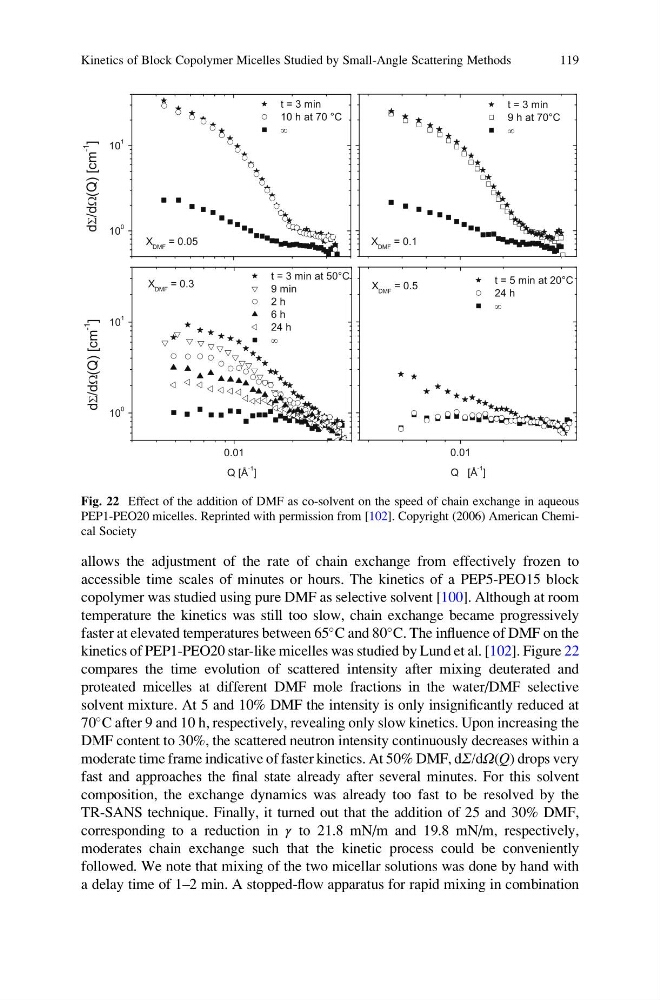
kinetics of PEP1-PEO20 star-like micelles was studied by Lund et al. [102]. Figure 22
compares the time evolution of scattered intensity after mixing deuterated and
proteated micelles at different DMF mole fractions in the water/DMF selective
solvent mixture. At 5 and 10% DMF the intensity is only insignificantly reduced at
70
C after 9 and 10 h, respectively, revealing only slow kinetics. Upon increasing the
DMF content to 30%, the scattered neutron intensity continuously decreases within a
moderate time frame indicative of faster kinetics. At 50% DMF, dΣ/dΩ(Q) drops very
fast and approaches the final state already after several minutes. For this solvent
composition, the exchange dynamics was already too fast to be resolved by the
TR-SANS technique. Finally, it turned out that the addition of 25 and 30% DMF,
corresponding to a reduction in γ to 21.8 mN/m and 19.8 mN/m, respectively,
moderates chain exchange such that the kinetic process could be conveniently
followed. We note that mixing of the two micellar solutions was done by hand with
a delay time of 1–2 min. A stopped-flow apparatus for rapid mixing in combination
Fig. 22 Effect of the addition of DMF as co-solvent on the speed of chain exchange in aqueous
PEP1-PEO20 micelles. Reprinted with permission from [102]. Copyright (2006) American Chemical Society
Kinetics of Block Copolymer Micelles Studied by Small-Angle Scattering Methods
119
accessible time scales of minutes or hours. The kinetics of a PEP5-PEO15 block
copolymer was studied using pure DMF as selective solvent [100]. Although at room
temperature the kinetics was still too slow, chain exchange became progressively
faster at elevated temperatures between 65
C and 80
C. The influence of DMF on the
kinetics of PEP1-PEO20 star-like micelles was studied by Lund et al. [102]. Figure 22
compares the time evolution of scattered intensity after mixing deuterated and
proteated micelles at different DMF mole fractions in the water/DMF selective
solvent mixture. At 5 and 10% DMF the intensity is only insignificantly reduced at
70
C after 9 and 10 h, respectively, revealing only slow kinetics. Upon increasing the
DMF content to 30%, the scattered neutron intensity continuously decreases within a
moderate time frame indicative of faster kinetics. At 50% DMF, dΣ/dΩ(Q) drops very
fast and approaches the final state already after several minutes. For this solvent
composition, the exchange dynamics was already too fast to be resolved by the
TR-SANS technique. Finally, it turned out that the addition of 25 and 30% DMF,
corresponding to a reduction in γ to 21.8 mN/m and 19.8 mN/m, respectively,
moderates chain exchange such that the kinetic process could be conveniently
followed. We note that mixing of the two micellar solutions was done by hand with
a delay time of 1–2 min. A stopped-flow apparatus for rapid mixing in combination
Fig. 22 Effect of the addition of DMF as co-solvent on the speed of chain exchange in aqueous
PEP1-PEO20 micelles. Reprinted with permission from [102]. Copyright (2006) American Chemical Society
Kinetics of Block Copolymer Micelles Studied by Small-Angle Scattering Methods
119