

1–2 kg/mol of the core polymer. Hence, from the kinetic studies of both PEP-PEO
and PB-PEO systems, it can be generally concluded that chain exchange dynamics in
aggregates built from strong amphiphilic block copolymers, i.e., characterized with
large interfacial tensions, is very likely to be frozen even at low molecular weights
and elevated temperatures.
4.2.3 Tuning of Chain Exchange
As discussed above, chain exchange in micelles built from block copolymers with
strong amphiphilicity, e.g., PEP-PEO or PB-PEO, is practically nonexistent. Consequently, such systems can be considered as effectively kinetically frozen. Therefore, in order to study such processes it is of great importance to adjust the rate of
chain exchange such that it can be resolved within the time window of a typical
scattering experiment. For instance, in a TR-SANS experiment using a stoppedflow apparatus for rapid mixing, the smallest achievable time resolution is about
50 ms. The longest accessible time is generally limited by the allocated beam time
at neutron research facilities, which is typically 2–3 days. In order to identify
effective tuning parameters we will briefly recall the Halperin and Alexander
scaling approach outlined in Sect. 2.2.5. Within this theory, the exchange rate
follows a single exponential behavior: R(t) ¼ exp(Àk_t) with k_ ¼ (1/τ 0 ) f(N A ,
N B ) exp(ÀE a /k B T) the expulsion rate constant. τ 0 denotes a characteristic diffusion
time, k B the Boltzmann constant, and T the absolute temperature. The activation
energy, E a $ γ Á l
2
Á N
2=3
B depends primarily on the degree of polymerization of coreforming B-block and the interfacial tension, γ, between selective solvent and block B.
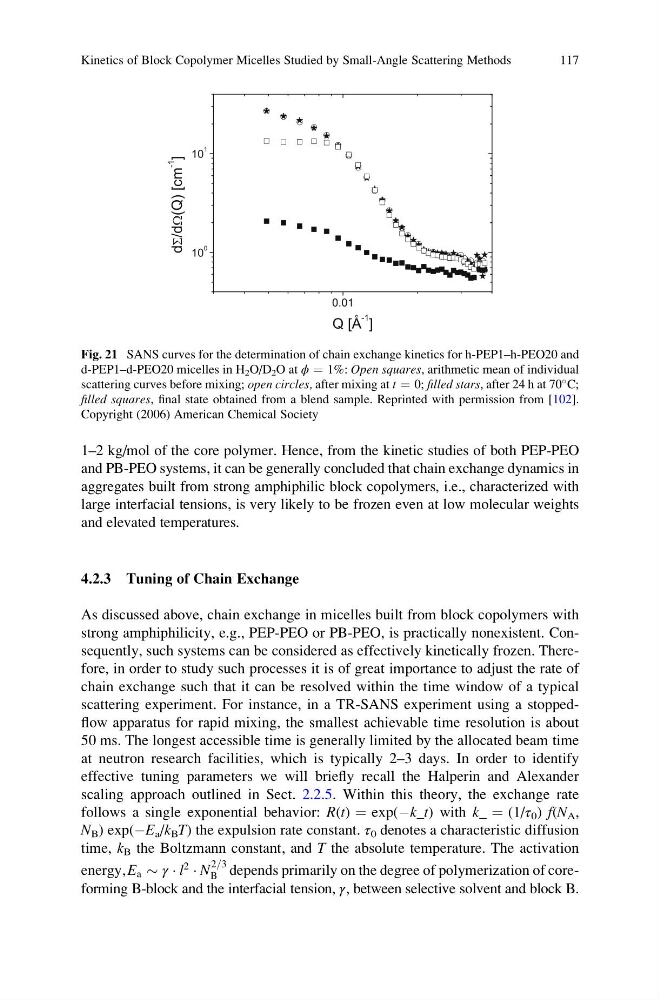
Fig. 21 SANS curves for the determination of chain exchange kinetics for h-PEP1–h-PEO20 and
d-PEP1–d-PEO20 micelles in H 2 O/D 2 O at ϕ ¼ 1%: Open squares, arithmetic mean of individual
scattering curves before mixing; open circles, after mixing at t ¼ 0; filled stars, after 24 h at 70
C;
filled squares, final state obtained from a blend sample. Reprinted with permission from [102].
Copyright (2006) American Chemical Society
Kinetics of Block Copolymer Micelles Studied by Small-Angle Scattering Methods
117
and PB-PEO systems, it can be generally concluded that chain exchange dynamics in
aggregates built from strong amphiphilic block copolymers, i.e., characterized with
large interfacial tensions, is very likely to be frozen even at low molecular weights
and elevated temperatures.
4.2.3 Tuning of Chain Exchange
As discussed above, chain exchange in micelles built from block copolymers with
strong amphiphilicity, e.g., PEP-PEO or PB-PEO, is practically nonexistent. Consequently, such systems can be considered as effectively kinetically frozen. Therefore, in order to study such processes it is of great importance to adjust the rate of
chain exchange such that it can be resolved within the time window of a typical
scattering experiment. For instance, in a TR-SANS experiment using a stoppedflow apparatus for rapid mixing, the smallest achievable time resolution is about
50 ms. The longest accessible time is generally limited by the allocated beam time
at neutron research facilities, which is typically 2–3 days. In order to identify
effective tuning parameters we will briefly recall the Halperin and Alexander
scaling approach outlined in Sect. 2.2.5. Within this theory, the exchange rate
follows a single exponential behavior: R(t) ¼ exp(Àk_t) with k_ ¼ (1/τ 0 ) f(N A ,
N B ) exp(ÀE a /k B T) the expulsion rate constant. τ 0 denotes a characteristic diffusion
time, k B the Boltzmann constant, and T the absolute temperature. The activation
energy, E a $ γ Á l
2
Á N
2=3
B depends primarily on the degree of polymerization of coreforming B-block and the interfacial tension, γ, between selective solvent and block B.
Fig. 21 SANS curves for the determination of chain exchange kinetics for h-PEP1–h-PEO20 and
d-PEP1–d-PEO20 micelles in H 2 O/D 2 O at ϕ ¼ 1%: Open squares, arithmetic mean of individual
scattering curves before mixing; open circles, after mixing at t ¼ 0; filled stars, after 24 h at 70
C;
filled squares, final state obtained from a blend sample. Reprinted with permission from [102].
Copyright (2006) American Chemical Society
Kinetics of Block Copolymer Micelles Studied by Small-Angle Scattering Methods
117