

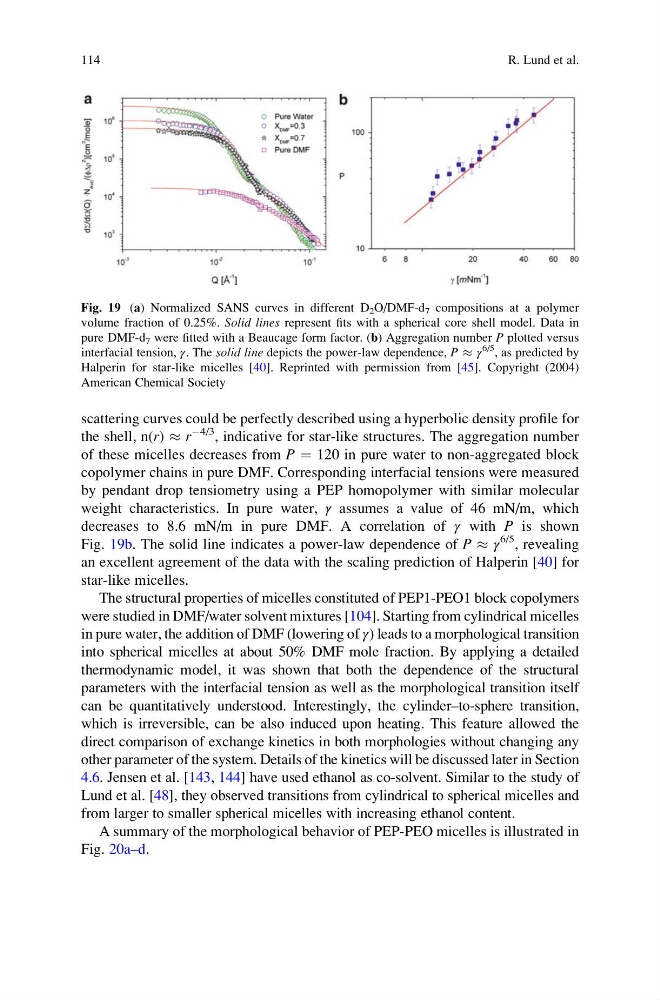
scattering curves could be perfectly described using a hyperbolic density profile for
the shell, n(r) % r
À4/3 , indicative for star-like structures. The aggregation number
of these micelles decreases from P ¼ 120 in pure water to non-aggregated block
copolymer chains in pure DMF. Corresponding interfacial tensions were measured
by pendant drop tensiometry using a PEP homopolymer with similar molecular
weight characteristics. In pure water, γ assumes a value of 46 mN/m, which
decreases to 8.6 mN/m in pure DMF. A correlation of γ with P is shown
Fig. 19b. The solid line indicates a power-law dependence of P % γ
6/5 , revealing
an excellent agreement of the data with the scaling prediction of Halperin [40] for
star-like micelles.
The structural properties of micelles constituted of PEP1-PEO1 block copolymers
were studied in DMF/water solvent mixtures [104]. Starting from cylindrical micelles
in pure water, the addition of DMF (lowering of γ) leads to a morphological transition
into spherical micelles at about 50% DMF mole fraction. By applying a detailed
thermodynamic model, it was shown that both the dependence of the structural
parameters with the interfacial tension as well as the morphological transition itself
can be quantitatively understood. Interestingly, the cylinder–to-sphere transition,
which is irreversible, can be also induced upon heating. This feature allowed the
direct comparison of exchange kinetics in both morphologies without changing any
other parameter of the system. Details of the kinetics will be discussed later in Section
4.6. Jensen et al. [143, 144] have used ethanol as co-solvent. Similar to the study of
Lund et al. [48], they observed transitions from cylindrical to spherical micelles and
from larger to smaller spherical micelles with increasing ethanol content.
A summary of the morphological behavior of PEP-PEO micelles is illustrated in
Fig. 20a–d.
Fig. 19 (a) Normalized SANS curves in different D 2 O/DMF-d 7 compositions at a polymer
volume fraction of 0.25%. Solid lines represent fits with a spherical core shell model. Data in
pure DMF-d 7 were fitted with a Beaucage form factor. (b) Aggregation number P plotted versus
interfacial tension, γ. The solid line depicts the power-law dependence, P % γ
6/5 , as predicted by
Halperin for star-like micelles [40]. Reprinted with permission from [45]. Copyright (2004)
American Chemical Society
114
R. Lund et al.
the shell, n(r) % r
À4/3 , indicative for star-like structures. The aggregation number
of these micelles decreases from P ¼ 120 in pure water to non-aggregated block
copolymer chains in pure DMF. Corresponding interfacial tensions were measured
by pendant drop tensiometry using a PEP homopolymer with similar molecular
weight characteristics. In pure water, γ assumes a value of 46 mN/m, which
decreases to 8.6 mN/m in pure DMF. A correlation of γ with P is shown
Fig. 19b. The solid line indicates a power-law dependence of P % γ
6/5 , revealing
an excellent agreement of the data with the scaling prediction of Halperin [40] for
star-like micelles.
The structural properties of micelles constituted of PEP1-PEO1 block copolymers
were studied in DMF/water solvent mixtures [104]. Starting from cylindrical micelles
in pure water, the addition of DMF (lowering of γ) leads to a morphological transition
into spherical micelles at about 50% DMF mole fraction. By applying a detailed
thermodynamic model, it was shown that both the dependence of the structural
parameters with the interfacial tension as well as the morphological transition itself
can be quantitatively understood. Interestingly, the cylinder–to-sphere transition,
which is irreversible, can be also induced upon heating. This feature allowed the
direct comparison of exchange kinetics in both morphologies without changing any
other parameter of the system. Details of the kinetics will be discussed later in Section
4.6. Jensen et al. [143, 144] have used ethanol as co-solvent. Similar to the study of
Lund et al. [48], they observed transitions from cylindrical to spherical micelles and
from larger to smaller spherical micelles with increasing ethanol content.
A summary of the morphological behavior of PEP-PEO micelles is illustrated in
Fig. 20a–d.
Fig. 19 (a) Normalized SANS curves in different D 2 O/DMF-d 7 compositions at a polymer
volume fraction of 0.25%. Solid lines represent fits with a spherical core shell model. Data in
pure DMF-d 7 were fitted with a Beaucage form factor. (b) Aggregation number P plotted versus
interfacial tension, γ. The solid line depicts the power-law dependence, P % γ
6/5 , as predicted by
Halperin for star-like micelles [40]. Reprinted with permission from [45]. Copyright (2004)
American Chemical Society
114
R. Lund et al.