

df II
dt
¼
1
N II
H þ N II
D
Á ð1 À f II Þ
dN
II
H
dt
À f 1
dN
II
D
dt
!
(111)
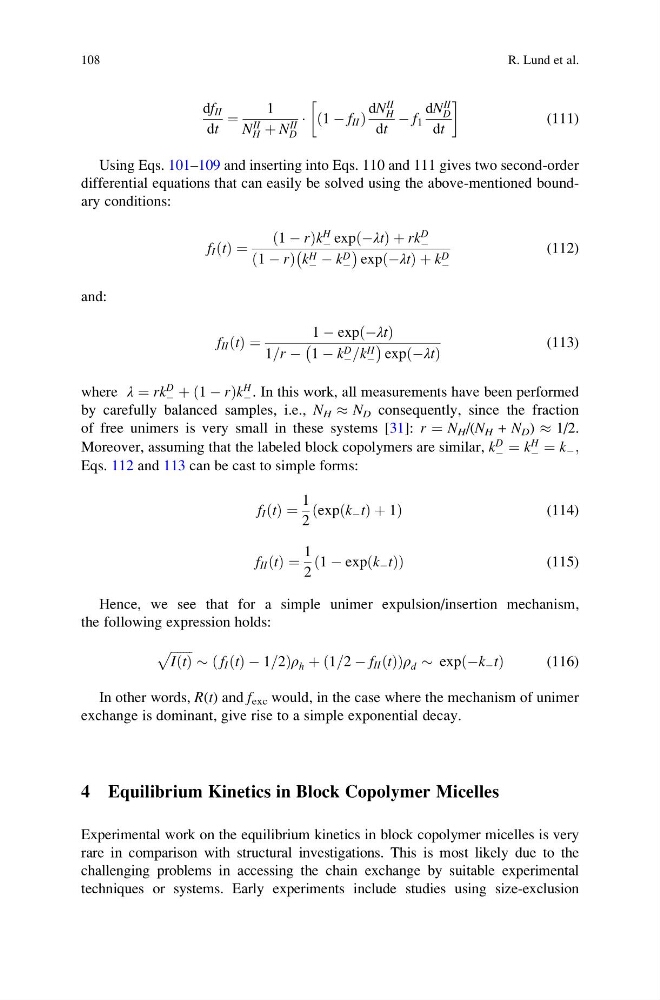
Using Eqs. 101–109 and inserting into Eqs. 110 and 111 gives two second-order
differential equations that can easily be solved using the above-mentioned boundary conditions:
f I ðtÞ ¼
ð1 À rÞk
H
À expðÀλtÞ þ rk
D
À
ð1 À rÞ k H
À À k D
À
À
Á
expðÀλtÞ þ k D
À
(112)
and:
f II ðtÞ ¼
1 À expðÀλtÞ
1=r À 1 À k D
À =k H
À
À
Á
expðÀλtÞ
(113)
where λ ¼ rk
D
À þ ð1 À rÞk
H
À . In this work, all measurements have been performed
by carefully balanced samples, i.e., N H % N D consequently, since the fraction
of free unimers is very small in these systems [31]: r ¼ N H /(N H + N D ) % 1/2.
Moreover, assuming that the labeled block copolymers are similar, k
D
À ¼ k
H
À ¼ k À ;
Eqs. 112 and 113 can be cast to simple forms:
f I ðtÞ ¼
1
2
expðk À tÞ þ 1
ð
Þ
(114)
f II ðtÞ ¼
1
2
1 À expðk À tÞ
ð
Þ
(115)
Hence, we see that for a simple unimer expulsion/insertion mechanism,
the following expression holds:
ffiffiffiffiffiffiffi
IðtÞ
p
$ f I ðtÞ À 1=2
ð
Þ ρ h þ 1=2 À f II ðtÞ
ð
Þ ρ d $ expðÀk À tÞ
(116)
In other words, R(t) and f exc would, in the case where the mechanism of unimer
exchange is dominant, give rise to a simple exponential decay.
4 Equilibrium Kinetics in Block Copolymer Micelles
Experimental work on the equilibrium kinetics in block copolymer micelles is very
rare in comparison with structural investigations. This is most likely due to the
challenging problems in accessing the chain exchange by suitable experimental
techniques or systems. Early experiments include studies using size-exclusion
108
R. Lund et al.
dt
¼
1
N II
H þ N II
D
Á ð1 À f II Þ
dN
II
H
dt
À f 1
dN
II
D
dt
!
(111)
Using Eqs. 101–109 and inserting into Eqs. 110 and 111 gives two second-order
differential equations that can easily be solved using the above-mentioned boundary conditions:
f I ðtÞ ¼
ð1 À rÞk
H
À expðÀλtÞ þ rk
D
À
ð1 À rÞ k H
À À k D
À
À
Á
expðÀλtÞ þ k D
À
(112)
and:
f II ðtÞ ¼
1 À expðÀλtÞ
1=r À 1 À k D
À =k H
À
À
Á
expðÀλtÞ
(113)
where λ ¼ rk
D
À þ ð1 À rÞk
H
À . In this work, all measurements have been performed
by carefully balanced samples, i.e., N H % N D consequently, since the fraction
of free unimers is very small in these systems [31]: r ¼ N H /(N H + N D ) % 1/2.
Moreover, assuming that the labeled block copolymers are similar, k
D
À ¼ k
H
À ¼ k À ;
Eqs. 112 and 113 can be cast to simple forms:
f I ðtÞ ¼
1
2
expðk À tÞ þ 1
ð
Þ
(114)
f II ðtÞ ¼
1
2
1 À expðk À tÞ
ð
Þ
(115)
Hence, we see that for a simple unimer expulsion/insertion mechanism,
the following expression holds:
ffiffiffiffiffiffiffi
IðtÞ
p
$ f I ðtÞ À 1=2
ð
Þ ρ h þ 1=2 À f II ðtÞ
ð
Þ ρ d $ expðÀk À tÞ
(116)
In other words, R(t) and f exc would, in the case where the mechanism of unimer
exchange is dominant, give rise to a simple exponential decay.
4 Equilibrium Kinetics in Block Copolymer Micelles
Experimental work on the equilibrium kinetics in block copolymer micelles is very
rare in comparison with structural investigations. This is most likely due to the
challenging problems in accessing the chain exchange by suitable experimental
techniques or systems. Early experiments include studies using size-exclusion
108
R. Lund et al.