

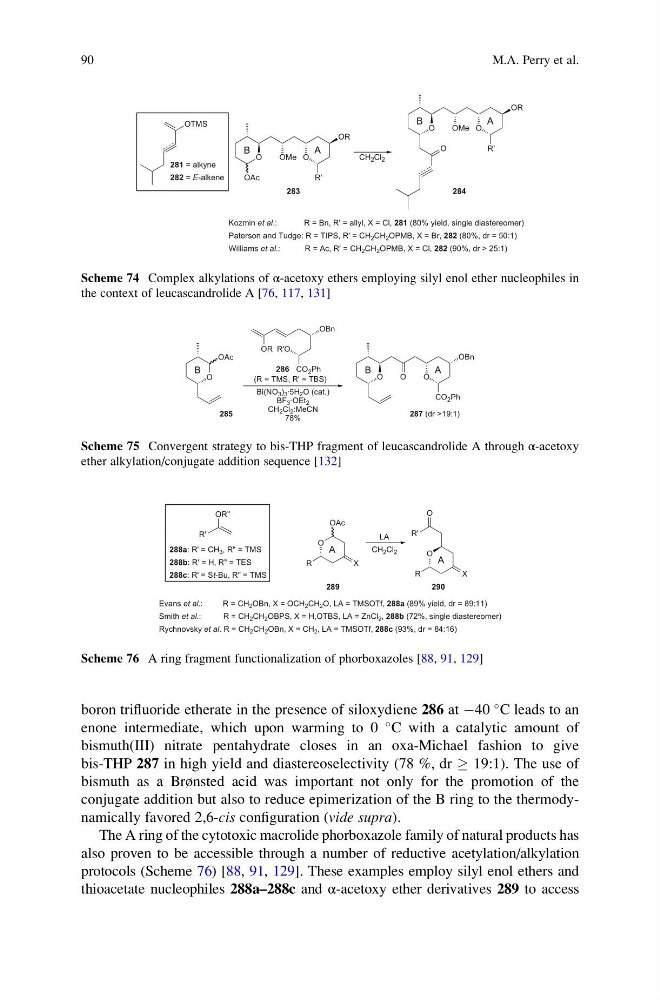
boron trifluoride etherate in the presence of siloxydiene 286 at À40
C leads to an
enone intermediate, which upon warming to 0
C with a catalytic amount of
bismuth(III) nitrate pentahydrate closes in an oxa-Michael fashion to give
bis-THP 287 in high yield and diastereoselectivity (78 %, dr ! 19:1). The use of
bismuth as a Brønsted acid was important not only for the promotion of the
conjugate addition but also to reduce epimerization of the B ring to the thermodynamically favored 2,6-cis configuration (vide supra).
The A ring of the cytotoxic macrolide phorboxazole family of natural products has
also proven to be accessible through a number of reductive acetylation/alkylation
protocols (Scheme 76) [88, 91, 129]. These examples employ silyl enol ethers and
thioacetate nucleophiles 288a–288c and α-acetoxy ether derivatives 289 to access
O
OMe O
OR
A
R'
OAc
B
O
OMe O
OR
A
R'
B
O
OTMS
CH 2 Cl 2
Kozmin et al.:
R = Bn, R' = allyl, X = Cl, 281 (80% yield, single diastereomer)
Paterson and Tudge: R = TIPS, R' = CH 2 CH 2 OPMB, X = Br, 282 (80%, dr = 50:1)
Williams et al.:
R = Ac, R' = CH 2 CH 2 OPMB, X = Cl, 282 (90%, dr > 25:1)
281 = alkyne
282 = E-alkene
283
284
Scheme 74 Complex alkylations of α-acetoxy ethers employing silyl enol ether nucleophiles in
the context of leucascandrolide A [76, 117, 131]
R'O
CO 2 Ph
OR
OBn
O
OAc
B
O
O
OBn
A
CO 2 Ph
B
O
Bi(NO 3 ) 3 ·5H 2 O (cat.)
BF 3 ·OEt 2
CH 2 Cl 2 :MeCN
78%
285
287 (dr > 19:1)
286
(R = TMS, R' = TBS)
Scheme 75 Convergent strategy to bis-THP fragment of leucascandrolide A through α-acetoxy
ether alkylation/conjugate addition sequence [132]
R
O
X
A
OAc
R
O
X
A
O
R'
Evans et al.:
R = CH 2 OBn, X = OCH 2 CH 2 O, LA = TMSOTf, 288a (89% yield, dr = 89:11)
Smith et al.:
R = CH 2 CH 2 OBPS, X = H,OTBS, LA = ZnCl 2 , 288b (72%, single diastereomer)
Rychnovsky et al. R = CH 2 CH 2 OBn, X = CH 2 , LA = TMSOTf, 288c (93%, dr = 84:16)
R'
OR"
288a: R' = CH 3 , R" = TMS
288b: R' = H, R" = TES
288c: R' = St-Bu, R" = TMS
LA
CH 2 Cl 2
289
290
Scheme 76 A ring fragment functionalization of phorboxazoles [88, 91, 129]
90
M.A. Perry et al.
C leads to an
enone intermediate, which upon warming to 0
C with a catalytic amount of
bismuth(III) nitrate pentahydrate closes in an oxa-Michael fashion to give
bis-THP 287 in high yield and diastereoselectivity (78 %, dr ! 19:1). The use of
bismuth as a Brønsted acid was important not only for the promotion of the
conjugate addition but also to reduce epimerization of the B ring to the thermodynamically favored 2,6-cis configuration (vide supra).
The A ring of the cytotoxic macrolide phorboxazole family of natural products has
also proven to be accessible through a number of reductive acetylation/alkylation
protocols (Scheme 76) [88, 91, 129]. These examples employ silyl enol ethers and
thioacetate nucleophiles 288a–288c and α-acetoxy ether derivatives 289 to access
O
OMe O
OR
A
R'
OAc
B
O
OMe O
OR
A
R'
B
O
OTMS
CH 2 Cl 2
Kozmin et al.:
R = Bn, R' = allyl, X = Cl, 281 (80% yield, single diastereomer)
Paterson and Tudge: R = TIPS, R' = CH 2 CH 2 OPMB, X = Br, 282 (80%, dr = 50:1)
Williams et al.:
R = Ac, R' = CH 2 CH 2 OPMB, X = Cl, 282 (90%, dr > 25:1)
281 = alkyne
282 = E-alkene
283
284
Scheme 74 Complex alkylations of α-acetoxy ethers employing silyl enol ether nucleophiles in
the context of leucascandrolide A [76, 117, 131]
R'O
CO 2 Ph
OR
OBn
O
OAc
B
O
O
OBn
A
CO 2 Ph
B
O
Bi(NO 3 ) 3 ·5H 2 O (cat.)
BF 3 ·OEt 2
CH 2 Cl 2 :MeCN
78%
285
287 (dr > 19:1)
286
(R = TMS, R' = TBS)
Scheme 75 Convergent strategy to bis-THP fragment of leucascandrolide A through α-acetoxy
ether alkylation/conjugate addition sequence [132]
R
O
X
A
OAc
R
O
X
A
O
R'
Evans et al.:
R = CH 2 OBn, X = OCH 2 CH 2 O, LA = TMSOTf, 288a (89% yield, dr = 89:11)
Smith et al.:
R = CH 2 CH 2 OBPS, X = H,OTBS, LA = ZnCl 2 , 288b (72%, single diastereomer)
Rychnovsky et al. R = CH 2 CH 2 OBn, X = CH 2 , LA = TMSOTf, 288c (93%, dr = 84:16)
R'
OR"
288a: R' = CH 3 , R" = TMS
288b: R' = H, R" = TES
288c: R' = St-Bu, R" = TMS
LA
CH 2 Cl 2
289
290
Scheme 76 A ring fragment functionalization of phorboxazoles [88, 91, 129]
90
M.A. Perry et al.