

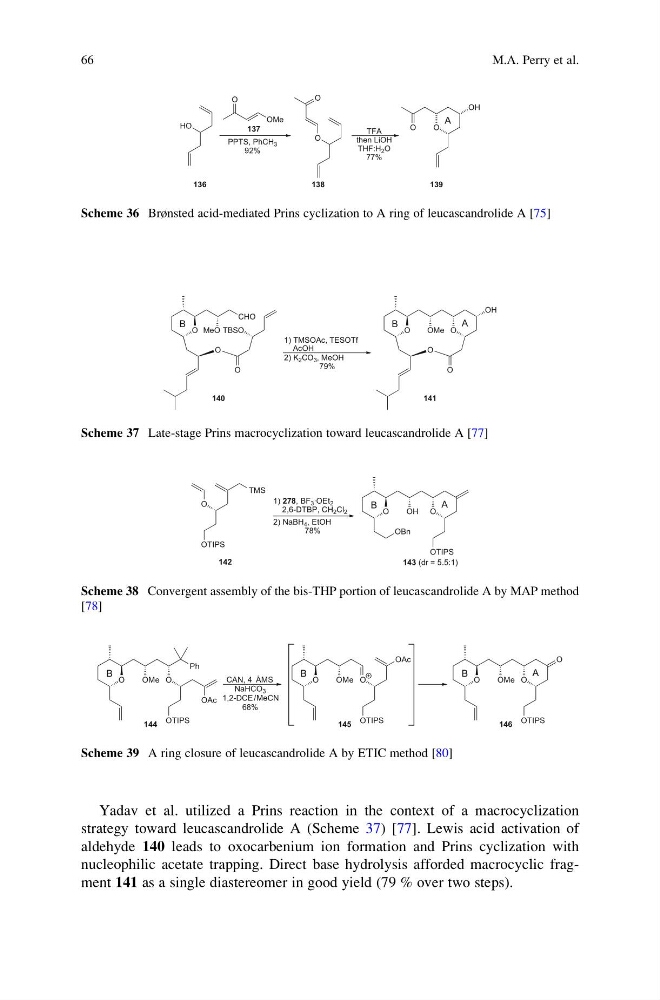
Yadav et al. utilized a Prins reaction in the context of a macrocyclization
strategy toward leucascandrolide A (Scheme 37) [77]. Lewis acid activation of
aldehyde 140 leads to oxocarbenium ion formation and Prins cyclization with
nucleophilic acetate trapping. Direct base hydrolysis afforded macrocyclic fragment 141 as a single diastereomer in good yield (79 % over two steps).
O
O
OH
A
O
O
HO
OMe
O
PPTS, PhCH 3
92%
TFA
then LiOH
THF:H 2 O
77%
136
137
138
139
Scheme 36 Brønsted acid-mediated Prins cyclization to A ring of leucascandrolide A [75]
O
OMe O
O
O
OH
A
B
O MeO TBSO
CHO
O
O
B
1) TMSOAc, TESOTf
AcOH
2) K 2 CO 3 , MeOH
79%
140
141
Scheme 37 Late-stage Prins macrocyclization toward leucascandrolide A [77]
142
143 (dr = 5.5:1)
O
OH O
A
B
OTIPS
OBn
O
OTIPS
TMS
1) 278, BF 3 ·OEt 2
2,6-DTBP, CH 2 Cl 2
2) NaBH 4 , EtOH
78%
Scheme 38 Convergent assembly of the bis-THP portion of leucascandrolide A by MAP method
[78]
O
OMe O
O
A
B
OTIPS
O
OMe O
B
OTIPS
OAc
CAN, 4 ÅMS
NaHCO 3
1,2-DCE / MeCN
68%
O
OMe O
Ph
B
OTIPS
OAc
144
145
146
Scheme 39 A ring closure of leucascandrolide A by ETIC method [80]
66
M.A. Perry et al.
strategy toward leucascandrolide A (Scheme 37) [77]. Lewis acid activation of
aldehyde 140 leads to oxocarbenium ion formation and Prins cyclization with
nucleophilic acetate trapping. Direct base hydrolysis afforded macrocyclic fragment 141 as a single diastereomer in good yield (79 % over two steps).
O
O
OH
A
O
O
HO
OMe
O
PPTS, PhCH 3
92%
TFA
then LiOH
THF:H 2 O
77%
136
137
138
139
Scheme 36 Brønsted acid-mediated Prins cyclization to A ring of leucascandrolide A [75]
O
OMe O
O
O
OH
A
B
O MeO TBSO
CHO
O
O
B
1) TMSOAc, TESOTf
AcOH
2) K 2 CO 3 , MeOH
79%
140
141
Scheme 37 Late-stage Prins macrocyclization toward leucascandrolide A [77]
142
143 (dr = 5.5:1)
O
OH O
A
B
OTIPS
OBn
O
OTIPS
TMS
1) 278, BF 3 ·OEt 2
2,6-DTBP, CH 2 Cl 2
2) NaBH 4 , EtOH
78%
Scheme 38 Convergent assembly of the bis-THP portion of leucascandrolide A by MAP method
[78]
O
OMe O
O
A
B
OTIPS
O
OMe O
B
OTIPS
OAc
CAN, 4 ÅMS
NaHCO 3
1,2-DCE / MeCN
68%
O
OMe O
Ph
B
OTIPS
OAc
144
145
146
Scheme 39 A ring closure of leucascandrolide A by ETIC method [80]
66
M.A. Perry et al.