

corresponding syn-diol) was used to give 2,3,5-cis-tetrahydrofuran 210 in 90 %
yield as a single diastereomer [64]. The reaction of 209 has been proposed to
proceed via chair TS 211 to initially give 212 where the methyl group that is
attached to the oxonium ion lies in the equatorial position in the transition state.
A subsequent pinacol rearrangement gives 210.
A particularly impressive example of the Prins-pinacol chemistry is illustrated in
Scheme 57 where tetrahydrofuran 214 having five contiguous stereocenters was
generated in 89 % yield from the treatment of acetal 213 with SnCl 4 . As illustrated,
214 served as a precursor to the natural product (–)-citreoviral [65].
Not surprisingly, other groups have also examined Prins-pinacol reactions.
Cho et al. have used Prins-pinacol cascades to build spiro-fused tetrahydrofurans
(Scheme 58) [66].
O
Br
Br
Br
Br
O
Cu/Zn, CH 3 CN, 10 °C
Cu/Zn, NH 4 Cl, EtOH, CH 3 CN
-78 °C to rt
O
O
E. coli expressing
cyclopentanone monooxygenase
O
O
O
(+)-219 (ee = 95%)
OsO 4 , NMO
acetone, AlCl 3
isopropyl-β-D-thiogalactopyroside
O
O
O
(+)-220
O
O
O
HO
OH
NH
O
O
HO
(+)-Showdomycin
1) m-CPBA (98%)
2) MeOH, H 2 O, K 2 CO 3 (98%)
3) SnCl 4 , CH 2 Cl 2 , -78 °C (98%)
O
O
O
H
H
HO
HO
O
O
O
H
H
HO
HO
Ph
Goniofufurone
analogs
1) CH 3 CN, H 2 O
KOH, rt
2) I 2 , KI, 40°C
75%
O
O
O
H
H
I
HO
O
OAc
Br
(+)-trans-Kumausyne
217
70%
218
221
222
72%
+
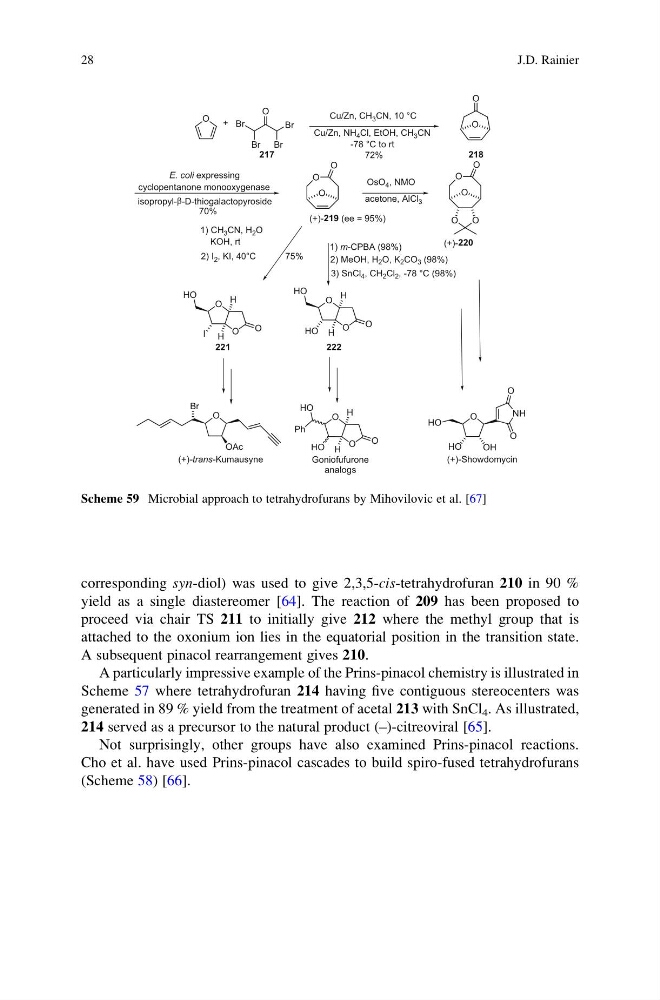
Scheme 59 Microbial approach to tetrahydrofurans by Mihovilovic et al. [67]
28
J.D. Rainier
yield as a single diastereomer [64]. The reaction of 209 has been proposed to
proceed via chair TS 211 to initially give 212 where the methyl group that is
attached to the oxonium ion lies in the equatorial position in the transition state.
A subsequent pinacol rearrangement gives 210.
A particularly impressive example of the Prins-pinacol chemistry is illustrated in
Scheme 57 where tetrahydrofuran 214 having five contiguous stereocenters was
generated in 89 % yield from the treatment of acetal 213 with SnCl 4 . As illustrated,
214 served as a precursor to the natural product (–)-citreoviral [65].
Not surprisingly, other groups have also examined Prins-pinacol reactions.
Cho et al. have used Prins-pinacol cascades to build spiro-fused tetrahydrofurans
(Scheme 58) [66].
O
Br
Br
Br
Br
O
Cu/Zn, CH 3 CN, 10 °C
Cu/Zn, NH 4 Cl, EtOH, CH 3 CN
-78 °C to rt
O
O
E. coli expressing
cyclopentanone monooxygenase
O
O
O
(+)-219 (ee = 95%)
OsO 4 , NMO
acetone, AlCl 3
isopropyl-β-D-thiogalactopyroside
O
O
O
(+)-220
O
O
O
HO
OH
NH
O
O
HO
(+)-Showdomycin
1) m-CPBA (98%)
2) MeOH, H 2 O, K 2 CO 3 (98%)
3) SnCl 4 , CH 2 Cl 2 , -78 °C (98%)
O
O
O
H
H
HO
HO
O
O
O
H
H
HO
HO
Ph
Goniofufurone
analogs
1) CH 3 CN, H 2 O
KOH, rt
2) I 2 , KI, 40°C
75%
O
O
O
H
H
I
HO
O
OAc
Br
(+)-trans-Kumausyne
217
70%
218
221
222
72%
+
Scheme 59 Microbial approach to tetrahydrofurans by Mihovilovic et al. [67]
28
J.D. Rainier