

Illustrated in Scheme 44 is Stark and coworkers’ use of RuO 4 to synthesize
the tetrahydrofuran ring of the annonaceous acetogenin cis-solamin [46]. From
diene 164 (available in four steps from cyclododecatriene), oxidative cyclization
using RuO 4 formed in situ led to an 83 % yield of meso-tetrahydrofuran 165
as the major diastereomer. Lipase desymmetrization of 165 gave 166 in 81 %
yield as a single enantiomer and diastereomer. Subsequent to the generation of
166, differentiation of the two primary hydroxyl groups and functionalization
gave cis-solamin.
4.4 Manganese-Mediated Cyclizations
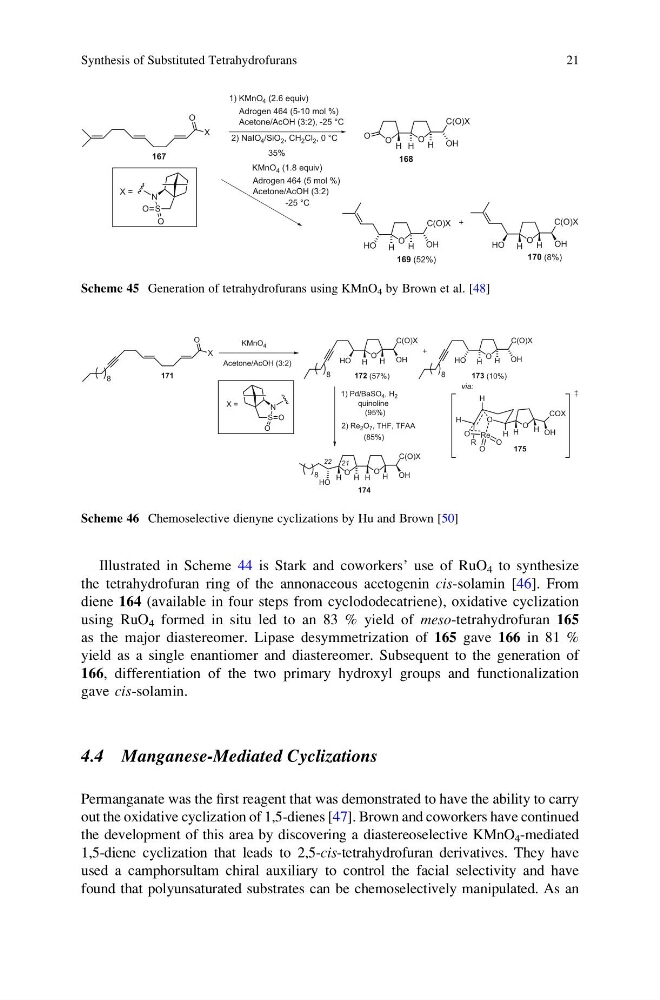
Permanganate was the first reagent that was demonstrated to have the ability to carry
out the oxidative cyclization of 1,5-dienes [47]. Brown and coworkers have continued
the development of this area by discovering a diastereoselective KMnO 4 -mediated
1,5-diene cyclization that leads to 2,5-cis-tetrahydrofuran derivatives. They have
used a camphorsultam chiral auxiliary to control the facial selectivity and have
found that polyunsaturated substrates can be chemoselectively manipulated. As an
O
X
1) KMnO 4 (2.6 equiv)
Adrogen 464 (5-10 mol %)
Acetone/AcOH (3:2), -25 °C
2) NaIO 4 /SiO 2 , CH 2 Cl 2 , 0 °C
35%
N
S
O
O
X =
O
O
O
H H
H
C(O)X
OH
KMnO 4 (1.8 equiv)
Adrogen 464 (5 mol %)
Acetone/AcOH (3:2)
-25 °C
O
H
H
C(O)X
OH
HO
+
O
H
H
C(O)X
OH
HO
169 (52%)
170 (8%)
167
168
Scheme 45 Generation of tetrahydrofurans using KMnO 4 by Brown et al. [48]
O
X
8
Acetone/AcOH (3:2)
KMnO 4
O
H
H
C(O)X
OH
HO
172 (57%)
8
N
S
O
O
X =
O
H
H
C(O)X
OH
HO
173 (10%)
8
+
1) Pd/BaSO 4 , H 2
quinoline
2) Re 2 O 7 , THF, TFAA
O
H
H
C(O)X
OH
O
(95%)
(85%)
H
H
HO
8
via:
O
O
O
H
R
Re
O
H
H
O
COX
OH
H
H
21
22
171
174
175
Scheme 46 Chemoselective dienyne cyclizations by Hu and Brown [50]
Synthesis of Substituted Tetrahydrofurans
21
the tetrahydrofuran ring of the annonaceous acetogenin cis-solamin [46]. From
diene 164 (available in four steps from cyclododecatriene), oxidative cyclization
using RuO 4 formed in situ led to an 83 % yield of meso-tetrahydrofuran 165
as the major diastereomer. Lipase desymmetrization of 165 gave 166 in 81 %
yield as a single enantiomer and diastereomer. Subsequent to the generation of
166, differentiation of the two primary hydroxyl groups and functionalization
gave cis-solamin.
4.4 Manganese-Mediated Cyclizations
Permanganate was the first reagent that was demonstrated to have the ability to carry
out the oxidative cyclization of 1,5-dienes [47]. Brown and coworkers have continued
the development of this area by discovering a diastereoselective KMnO 4 -mediated
1,5-diene cyclization that leads to 2,5-cis-tetrahydrofuran derivatives. They have
used a camphorsultam chiral auxiliary to control the facial selectivity and have
found that polyunsaturated substrates can be chemoselectively manipulated. As an
O
X
1) KMnO 4 (2.6 equiv)
Adrogen 464 (5-10 mol %)
Acetone/AcOH (3:2), -25 °C
2) NaIO 4 /SiO 2 , CH 2 Cl 2 , 0 °C
35%
N
S
O
O
X =
O
O
O
H H
H
C(O)X
OH
KMnO 4 (1.8 equiv)
Adrogen 464 (5 mol %)
Acetone/AcOH (3:2)
-25 °C
O
H
H
C(O)X
OH
HO
+
O
H
H
C(O)X
OH
HO
169 (52%)
170 (8%)
167
168
Scheme 45 Generation of tetrahydrofurans using KMnO 4 by Brown et al. [48]
O
X
8
Acetone/AcOH (3:2)
KMnO 4
O
H
H
C(O)X
OH
HO
172 (57%)
8
N
S
O
O
X =
O
H
H
C(O)X
OH
HO
173 (10%)
8
+
1) Pd/BaSO 4 , H 2
quinoline
2) Re 2 O 7 , THF, TFAA
O
H
H
C(O)X
OH
O
(95%)
(85%)
H
H
HO
8
via:
O
O
O
H
R
Re
O
H
H
O
COX
OH
H
H
21
22
171
174
175
Scheme 46 Chemoselective dienyne cyclizations by Hu and Brown [50]
Synthesis of Substituted Tetrahydrofurans
21