

PTSA in the reaction sequence, the yield of the unsaturated spiroacetal 443 could be
improved from 24 % to 62 %.
2.18.3 Rhenium-Catalyzed Allylic Alcohol Rearrangement
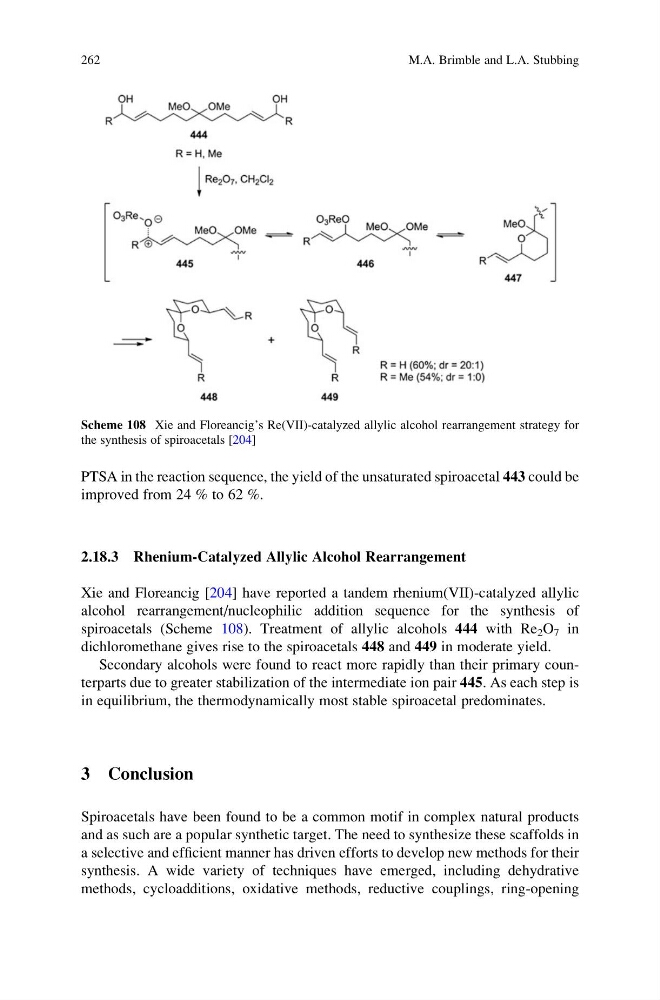
Xie and Floreancig [204] have reported a tandem rhenium(VII)-catalyzed allylic
alcohol rearrangement/nucleophilic addition sequence for the synthesis of
spiroacetals (Scheme 108). Treatment of allylic alcohols 444 with Re 2 O 7 in
dichloromethane gives rise to the spiroacetals 448 and 449 in moderate yield.
Secondary alcohols were found to react more rapidly than their primary counterparts due to greater stabilization of the intermediate ion pair 445. As each step is
in equilibrium, the thermodynamically most stable spiroacetal predominates.
3 Conclusion
Spiroacetals have been found to be a common motif in complex natural products
and as such are a popular synthetic target. The need to synthesize these scaffolds in
a selective and efficient manner has driven efforts to develop new methods for their
synthesis. A wide variety of techniques have emerged, including dehydrative
methods, cycloadditions, oxidative methods, reductive couplings, ring-opening
Scheme 108 Xie and Floreancig’s Re(VII)-catalyzed allylic alcohol rearrangement strategy for
the synthesis of spiroacetals [204]
262
M.A. Brimble and L.A. Stubbing
improved from 24 % to 62 %.
2.18.3 Rhenium-Catalyzed Allylic Alcohol Rearrangement
Xie and Floreancig [204] have reported a tandem rhenium(VII)-catalyzed allylic
alcohol rearrangement/nucleophilic addition sequence for the synthesis of
spiroacetals (Scheme 108). Treatment of allylic alcohols 444 with Re 2 O 7 in
dichloromethane gives rise to the spiroacetals 448 and 449 in moderate yield.
Secondary alcohols were found to react more rapidly than their primary counterparts due to greater stabilization of the intermediate ion pair 445. As each step is
in equilibrium, the thermodynamically most stable spiroacetal predominates.
3 Conclusion
Spiroacetals have been found to be a common motif in complex natural products
and as such are a popular synthetic target. The need to synthesize these scaffolds in
a selective and efficient manner has driven efforts to develop new methods for their
synthesis. A wide variety of techniques have emerged, including dehydrative
methods, cycloadditions, oxidative methods, reductive couplings, ring-opening
Scheme 108 Xie and Floreancig’s Re(VII)-catalyzed allylic alcohol rearrangement strategy for
the synthesis of spiroacetals [204]
262
M.A. Brimble and L.A. Stubbing