

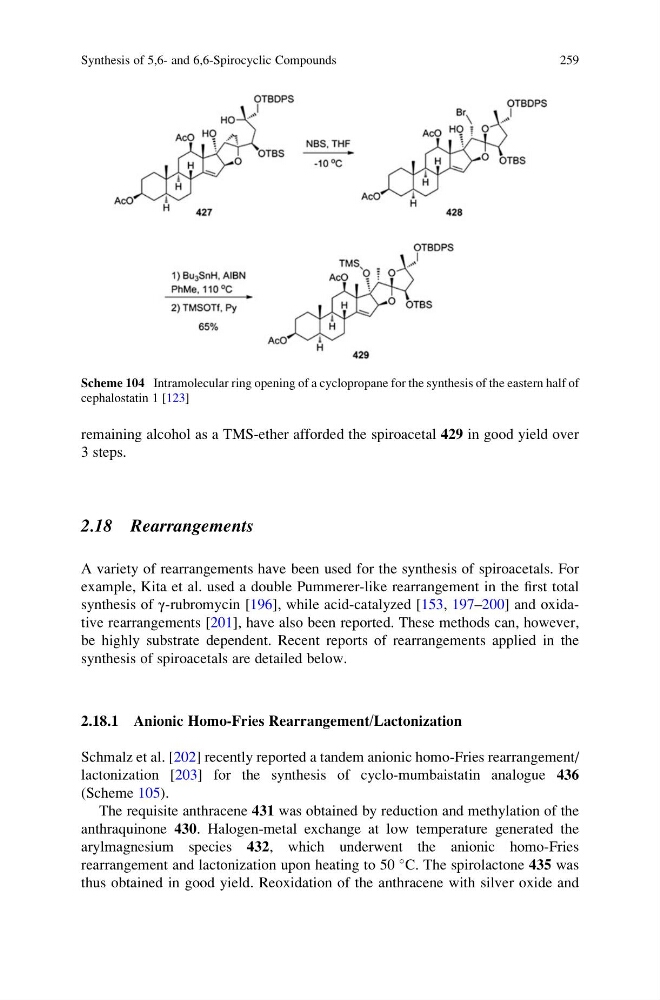
remaining alcohol as a TMS-ether afforded the spiroacetal 429 in good yield over
3 steps.
2.18 Rearrangements
A variety of rearrangements have been used for the synthesis of spiroacetals. For
example, Kita et al. used a double Pummerer-like rearrangement in the first total
synthesis of γ-rubromycin [196], while acid-catalyzed [153, 197–200] and oxidative rearrangements [201], have also been reported. These methods can, however,
be highly substrate dependent. Recent reports of rearrangements applied in the
synthesis of spiroacetals are detailed below.
2.18.1 Anionic Homo-Fries Rearrangement/Lactonization
Schmalz et al. [202] recently reported a tandem anionic homo-Fries rearrangement/
lactonization [203] for the synthesis of cyclo-mumbaistatin analogue 436
(Scheme 105).
The requisite anthracene 431 was obtained by reduction and methylation of the
anthraquinone 430. Halogen-metal exchange at low temperature generated the
arylmagnesium species 432, which underwent the anionic homo-Fries
rearrangement and lactonization upon heating to 50
C. The spirolactone 435 was
thus obtained in good yield. Reoxidation of the anthracene with silver oxide and
Scheme 104 Intramolecular ring opening of a cyclopropane for the synthesis of the eastern half of
cephalostatin 1 [123]
Synthesis of 5,6- and 6,6-Spirocyclic Compounds
259
3 steps.
2.18 Rearrangements
A variety of rearrangements have been used for the synthesis of spiroacetals. For
example, Kita et al. used a double Pummerer-like rearrangement in the first total
synthesis of γ-rubromycin [196], while acid-catalyzed [153, 197–200] and oxidative rearrangements [201], have also been reported. These methods can, however,
be highly substrate dependent. Recent reports of rearrangements applied in the
synthesis of spiroacetals are detailed below.
2.18.1 Anionic Homo-Fries Rearrangement/Lactonization
Schmalz et al. [202] recently reported a tandem anionic homo-Fries rearrangement/
lactonization [203] for the synthesis of cyclo-mumbaistatin analogue 436
(Scheme 105).
The requisite anthracene 431 was obtained by reduction and methylation of the
anthraquinone 430. Halogen-metal exchange at low temperature generated the
arylmagnesium species 432, which underwent the anionic homo-Fries
rearrangement and lactonization upon heating to 50
C. The spirolactone 435 was
thus obtained in good yield. Reoxidation of the anthracene with silver oxide and
Scheme 104 Intramolecular ring opening of a cyclopropane for the synthesis of the eastern half of
cephalostatin 1 [123]
Synthesis of 5,6- and 6,6-Spirocyclic Compounds
259