

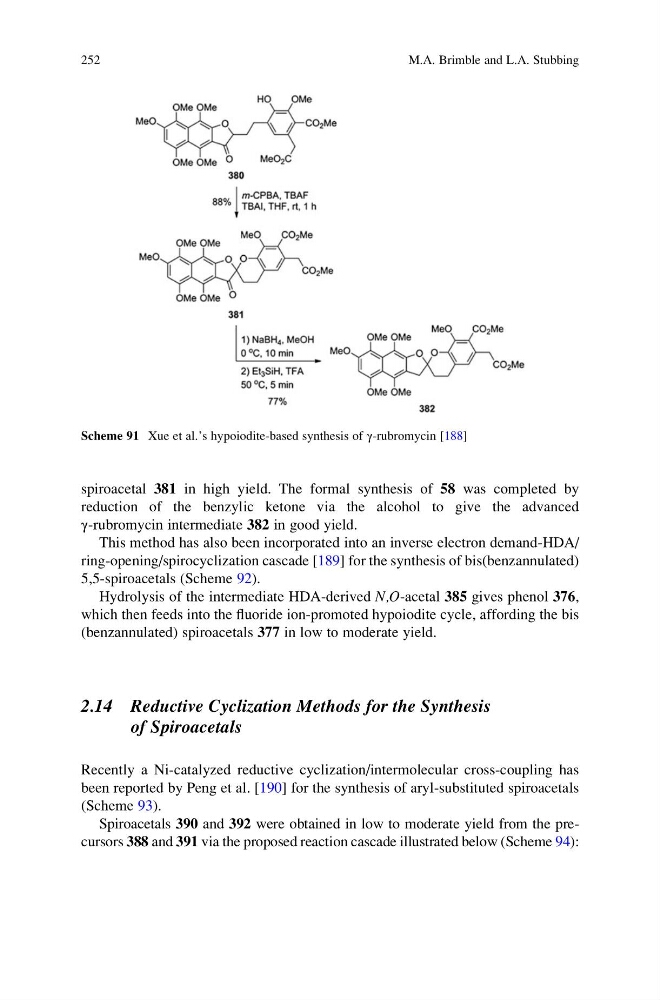
spiroacetal 381 in high yield. The formal synthesis of 58 was completed by
reduction of the benzylic ketone via the alcohol to give the advanced
γ-rubromycin intermediate 382 in good yield.
This method has also been incorporated into an inverse electron demand-HDA/
ring-opening/spirocyclization cascade [189] for the synthesis of bis(benzannulated)
5,5-spiroacetals (Scheme 92).
Hydrolysis of the intermediate HDA-derived N,O-acetal 385 gives phenol 376,
which then feeds into the fluoride ion-promoted hypoiodite cycle, affording the bis
(benzannulated) spiroacetals 377 in low to moderate yield.
2.14 Reductive Cyclization Methods for the Synthesis
of Spiroacetals
Recently a Ni-catalyzed reductive cyclization/intermolecular cross-coupling has
been reported by Peng et al. [190] for the synthesis of aryl-substituted spiroacetals
(Scheme 93).
Spiroacetals 390 and 392 were obtained in low to moderate yield from the precursors 388 and 391 via the proposed reaction cascade illustrated below (Scheme 94):
Scheme 91 Xue et al.’s hypoiodite-based synthesis of γ-rubromycin [188]
252
M.A. Brimble and L.A. Stubbing
reduction of the benzylic ketone via the alcohol to give the advanced
γ-rubromycin intermediate 382 in good yield.
This method has also been incorporated into an inverse electron demand-HDA/
ring-opening/spirocyclization cascade [189] for the synthesis of bis(benzannulated)
5,5-spiroacetals (Scheme 92).
Hydrolysis of the intermediate HDA-derived N,O-acetal 385 gives phenol 376,
which then feeds into the fluoride ion-promoted hypoiodite cycle, affording the bis
(benzannulated) spiroacetals 377 in low to moderate yield.
2.14 Reductive Cyclization Methods for the Synthesis
of Spiroacetals
Recently a Ni-catalyzed reductive cyclization/intermolecular cross-coupling has
been reported by Peng et al. [190] for the synthesis of aryl-substituted spiroacetals
(Scheme 93).
Spiroacetals 390 and 392 were obtained in low to moderate yield from the precursors 388 and 391 via the proposed reaction cascade illustrated below (Scheme 94):
Scheme 91 Xue et al.’s hypoiodite-based synthesis of γ-rubromycin [188]
252
M.A. Brimble and L.A. Stubbing