

Following the HDA, elimination of the sulfoxide occurs under the reaction
conditions to afford the 5,6-spiroacetals 326 in good yield.
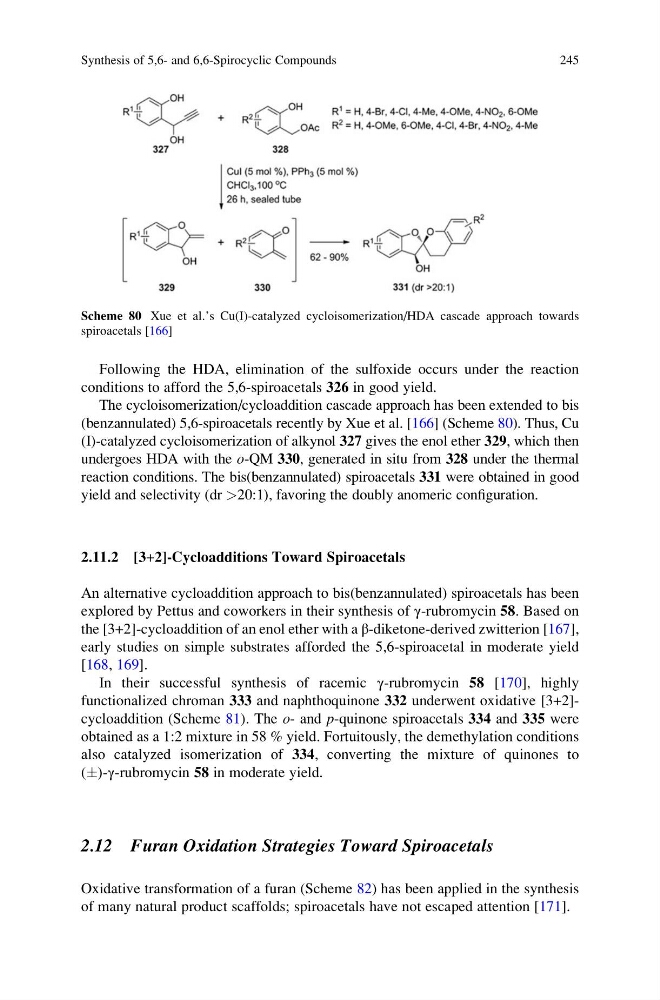
The cycloisomerization/cycloaddition cascade approach has been extended to bis
(benzannulated) 5,6-spiroacetals recently by Xue et al. [166] (Scheme 80). Thus, Cu
(I)-catalyzed cycloisomerization of alkynol 327 gives the enol ether 329, which then
undergoes HDA with the o-QM 330, generated in situ from 328 under the thermal
reaction conditions. The bis(benzannulated) spiroacetals 331 were obtained in good
yield and selectivity (dr >20:1), favoring the doubly anomeric configuration.
2.11.2 [3+2]-Cycloadditions Toward Spiroacetals
An alternative cycloaddition approach to bis(benzannulated) spiroacetals has been
explored by Pettus and coworkers in their synthesis of γ-rubromycin 58. Based on
the [3+2]-cycloaddition of an enol ether with a β-diketone-derived zwitterion [167],
early studies on simple substrates afforded the 5,6-spiroacetal in moderate yield
[168, 169].
In their successful synthesis of racemic γ-rubromycin 58 [170], highly
functionalized chroman 333 and naphthoquinone 332 underwent oxidative [3+2]cycloaddition (Scheme 81). The o- and p-quinone spiroacetals 334 and 335 were
obtained as a 1:2 mixture in 58 % yield. Fortuitously, the demethylation conditions
also catalyzed isomerization of 334, converting the mixture of quinones to
(Æ)-γ-rubromycin 58 in moderate yield.
2.12 Furan Oxidation Strategies Toward Spiroacetals
Oxidative transformation of a furan (Scheme 82) has been applied in the synthesis
of many natural product scaffolds; spiroacetals have not escaped attention [171].
Scheme 80 Xue et al.’s Cu(I)-catalyzed cycloisomerization/HDA cascade approach towards
spiroacetals [166]
Synthesis of 5,6- and 6,6-Spirocyclic Compounds
245
conditions to afford the 5,6-spiroacetals 326 in good yield.
The cycloisomerization/cycloaddition cascade approach has been extended to bis
(benzannulated) 5,6-spiroacetals recently by Xue et al. [166] (Scheme 80). Thus, Cu
(I)-catalyzed cycloisomerization of alkynol 327 gives the enol ether 329, which then
undergoes HDA with the o-QM 330, generated in situ from 328 under the thermal
reaction conditions. The bis(benzannulated) spiroacetals 331 were obtained in good
yield and selectivity (dr >20:1), favoring the doubly anomeric configuration.
2.11.2 [3+2]-Cycloadditions Toward Spiroacetals
An alternative cycloaddition approach to bis(benzannulated) spiroacetals has been
explored by Pettus and coworkers in their synthesis of γ-rubromycin 58. Based on
the [3+2]-cycloaddition of an enol ether with a β-diketone-derived zwitterion [167],
early studies on simple substrates afforded the 5,6-spiroacetal in moderate yield
[168, 169].
In their successful synthesis of racemic γ-rubromycin 58 [170], highly
functionalized chroman 333 and naphthoquinone 332 underwent oxidative [3+2]cycloaddition (Scheme 81). The o- and p-quinone spiroacetals 334 and 335 were
obtained as a 1:2 mixture in 58 % yield. Fortuitously, the demethylation conditions
also catalyzed isomerization of 334, converting the mixture of quinones to
(Æ)-γ-rubromycin 58 in moderate yield.
2.12 Furan Oxidation Strategies Toward Spiroacetals
Oxidative transformation of a furan (Scheme 82) has been applied in the synthesis
of many natural product scaffolds; spiroacetals have not escaped attention [171].
Scheme 80 Xue et al.’s Cu(I)-catalyzed cycloisomerization/HDA cascade approach towards
spiroacetals [166]
Synthesis of 5,6- and 6,6-Spirocyclic Compounds
245