

Treatment of spicifernin-inspired alkynol 307 and pulvilloric acid-inspired fragment 306 with AgSbF 6 resulted in cycloisomerization of 307 to enol ether 309;
formation of o-QM 308 from 306; and subsequent HDA of 308 and 309 to give an
inseparable mixture of spiroacetal 311 as the major component, along with a
mixture of four other diastereomers in an approximate ratio of 6:4. Careful
regioselective demethylation to the free acid allowed separation of the diastereomers, and berkelic acid 96 was therefore obtained in 46 % after one recycle.
Alternatively, the HDA approach toward mono(benzannulated) spiroacetals can
make use of aliphatic dienes, rather than o-QM, as the 4π reaction partner. This
strategy has been demonstrated most recently by Belmont et al. [163], where HDA
between a variety of furoquinolines 313 and acrolein affords the spiroacetals 314 in
good yield and selectivity (Scheme 77).
The application of a HDA strategy for the synthesis of bis(benzannulated)
spiroacetals as exemplified by the rubromycin family of natural products has also
attracted attention. An initial report [164] of the HDA between an o-QM and
chroman-derived enol ethers 315 required high temperature and pressure to afford
6,6-bis(benzannulated) spiroacetals (Scheme 78). Unfortunately, the corresponding
5,6-spiroacetals could not be accessed using this method due to the difficulty in
obtaining the requisite enol ether 318, which under methylenation conditions
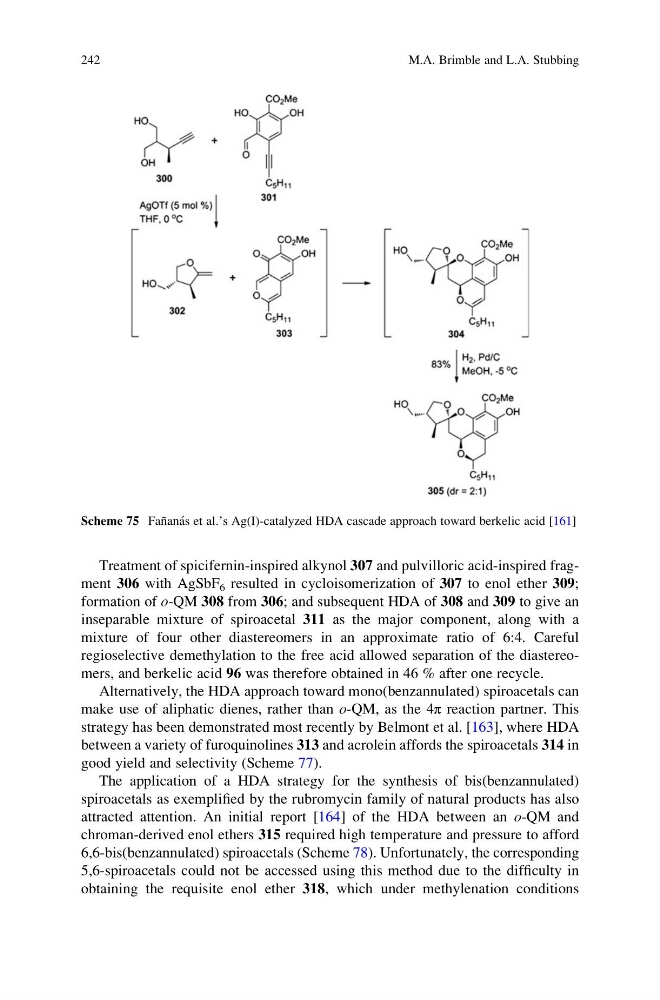
Scheme 75 Fan ˜ana ´s et al.’s Ag(I)-catalyzed HDA cascade approach toward berkelic acid [161]
242
M.A. Brimble and L.A. Stubbing
formation of o-QM 308 from 306; and subsequent HDA of 308 and 309 to give an
inseparable mixture of spiroacetal 311 as the major component, along with a
mixture of four other diastereomers in an approximate ratio of 6:4. Careful
regioselective demethylation to the free acid allowed separation of the diastereomers, and berkelic acid 96 was therefore obtained in 46 % after one recycle.
Alternatively, the HDA approach toward mono(benzannulated) spiroacetals can
make use of aliphatic dienes, rather than o-QM, as the 4π reaction partner. This
strategy has been demonstrated most recently by Belmont et al. [163], where HDA
between a variety of furoquinolines 313 and acrolein affords the spiroacetals 314 in
good yield and selectivity (Scheme 77).
The application of a HDA strategy for the synthesis of bis(benzannulated)
spiroacetals as exemplified by the rubromycin family of natural products has also
attracted attention. An initial report [164] of the HDA between an o-QM and
chroman-derived enol ethers 315 required high temperature and pressure to afford
6,6-bis(benzannulated) spiroacetals (Scheme 78). Unfortunately, the corresponding
5,6-spiroacetals could not be accessed using this method due to the difficulty in
obtaining the requisite enol ether 318, which under methylenation conditions
Scheme 75 Fan ˜ana ´s et al.’s Ag(I)-catalyzed HDA cascade approach toward berkelic acid [161]
242
M.A. Brimble and L.A. Stubbing