

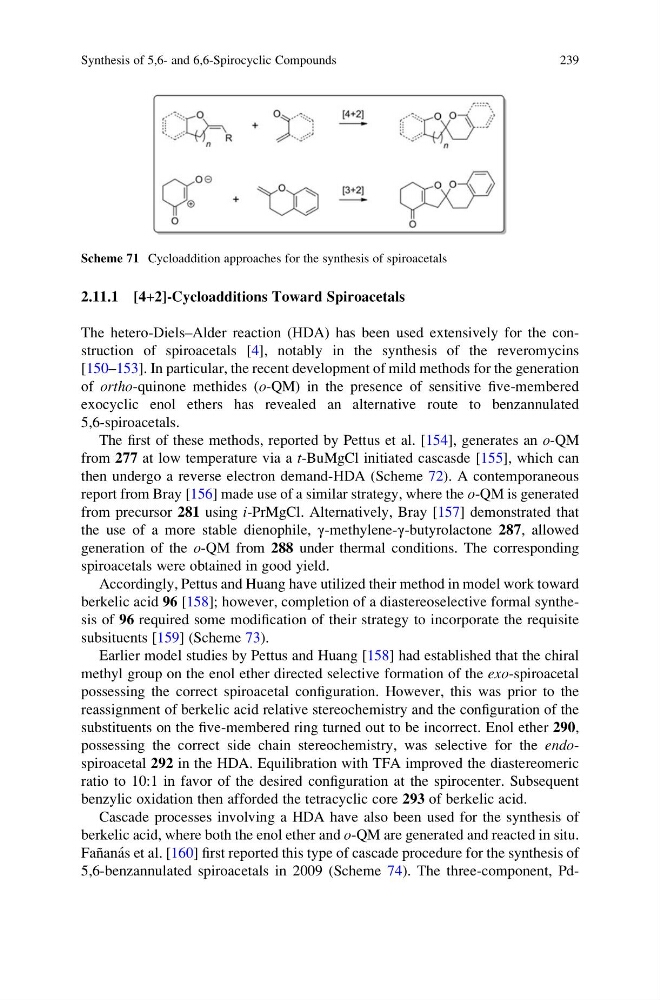
2.11.1 [4+2]-Cycloadditions Toward Spiroacetals
The hetero-Diels–Alder reaction (HDA) has been used extensively for the construction of spiroacetals [4], notably in the synthesis of the reveromycins
[150–153]. In particular, the recent development of mild methods for the generation
of ortho-quinone methides (o-QM) in the presence of sensitive five-membered
exocyclic enol ethers has revealed an alternative route to benzannulated
5,6-spiroacetals.
The first of these methods, reported by Pettus et al. [154], generates an o-QM
from 277 at low temperature via a t-BuMgCl initiated cascasde [155], which can
then undergo a reverse electron demand-HDA (Scheme 72). A contemporaneous
report from Bray [156] made use of a similar strategy, where the o-QM is generated
from precursor 281 using i-PrMgCl. Alternatively, Bray [157] demonstrated that
the use of a more stable dienophile, γ-methylene-γ-butyrolactone 287, allowed
generation of the o-QM from 288 under thermal conditions. The corresponding
spiroacetals were obtained in good yield.
Accordingly, Pettus and Huang have utilized their method in model work toward
berkelic acid 96 [158]; however, completion of a diastereoselective formal synthesis of 96 required some modification of their strategy to incorporate the requisite
subsituents [159] (Scheme 73).
Earlier model studies by Pettus and Huang [158] had established that the chiral
methyl group on the enol ether directed selective formation of the exo-spiroacetal
possessing the correct spiroacetal configuration. However, this was prior to the
reassignment of berkelic acid relative stereochemistry and the configuration of the
substituents on the five-membered ring turned out to be incorrect. Enol ether 290,
possessing the correct side chain stereochemistry, was selective for the endospiroacetal 292 in the HDA. Equilibration with TFA improved the diastereomeric
ratio to 10:1 in favor of the desired configuration at the spirocenter. Subsequent
benzylic oxidation then afforded the tetracyclic core 293 of berkelic acid.
Cascade processes involving a HDA have also been used for the synthesis of
berkelic acid, where both the enol ether and o-QM are generated and reacted in situ.
Fan ˜ana ´s et al. [160] first reported this type of cascade procedure for the synthesis of
5,6-benzannulated spiroacetals in 2009 (Scheme 74). The three-component, PdScheme 71 Cycloaddition approaches for the synthesis of spiroacetals
Synthesis of 5,6- and 6,6-Spirocyclic Compounds
239
The hetero-Diels–Alder reaction (HDA) has been used extensively for the construction of spiroacetals [4], notably in the synthesis of the reveromycins
[150–153]. In particular, the recent development of mild methods for the generation
of ortho-quinone methides (o-QM) in the presence of sensitive five-membered
exocyclic enol ethers has revealed an alternative route to benzannulated
5,6-spiroacetals.
The first of these methods, reported by Pettus et al. [154], generates an o-QM
from 277 at low temperature via a t-BuMgCl initiated cascasde [155], which can
then undergo a reverse electron demand-HDA (Scheme 72). A contemporaneous
report from Bray [156] made use of a similar strategy, where the o-QM is generated
from precursor 281 using i-PrMgCl. Alternatively, Bray [157] demonstrated that
the use of a more stable dienophile, γ-methylene-γ-butyrolactone 287, allowed
generation of the o-QM from 288 under thermal conditions. The corresponding
spiroacetals were obtained in good yield.
Accordingly, Pettus and Huang have utilized their method in model work toward
berkelic acid 96 [158]; however, completion of a diastereoselective formal synthesis of 96 required some modification of their strategy to incorporate the requisite
subsituents [159] (Scheme 73).
Earlier model studies by Pettus and Huang [158] had established that the chiral
methyl group on the enol ether directed selective formation of the exo-spiroacetal
possessing the correct spiroacetal configuration. However, this was prior to the
reassignment of berkelic acid relative stereochemistry and the configuration of the
substituents on the five-membered ring turned out to be incorrect. Enol ether 290,
possessing the correct side chain stereochemistry, was selective for the endospiroacetal 292 in the HDA. Equilibration with TFA improved the diastereomeric
ratio to 10:1 in favor of the desired configuration at the spirocenter. Subsequent
benzylic oxidation then afforded the tetracyclic core 293 of berkelic acid.
Cascade processes involving a HDA have also been used for the synthesis of
berkelic acid, where both the enol ether and o-QM are generated and reacted in situ.
Fan ˜ana ´s et al. [160] first reported this type of cascade procedure for the synthesis of
5,6-benzannulated spiroacetals in 2009 (Scheme 74). The three-component, PdScheme 71 Cycloaddition approaches for the synthesis of spiroacetals
Synthesis of 5,6- and 6,6-Spirocyclic Compounds
239