

2.7 Electrophilic Cyclization
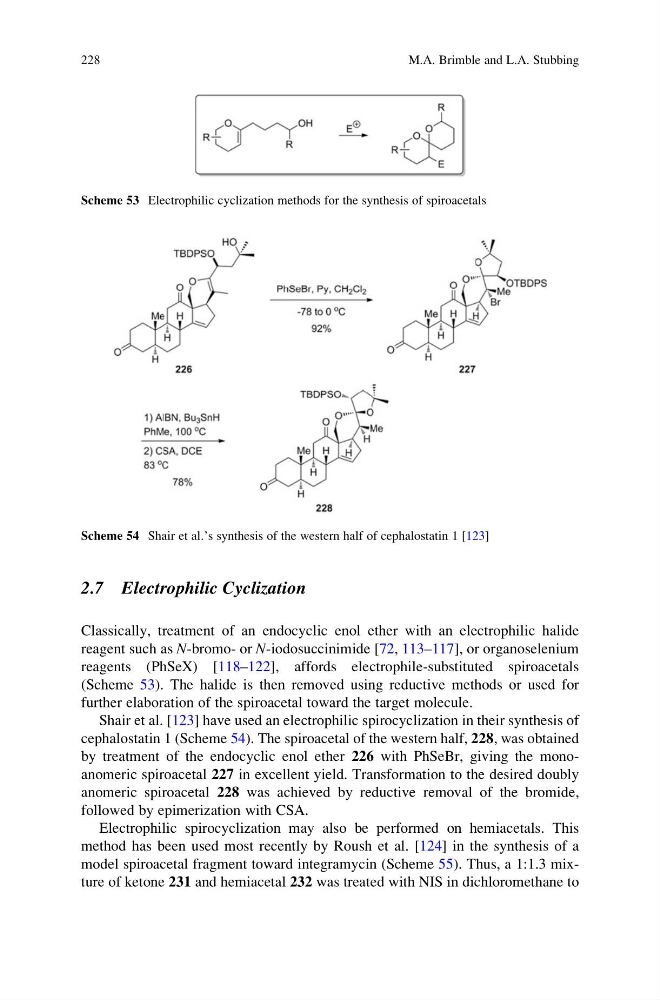
Classically, treatment of an endocyclic enol ether with an electrophilic halide
reagent such as N-bromo- or N-iodosuccinimide [72, 113–117], or organoselenium
reagents (PhSeX) [118–122], affords electrophile-substituted spiroacetals
(Scheme 53). The halide is then removed using reductive methods or used for
further elaboration of the spiroacetal toward the target molecule.
Shair et al. [123] have used an electrophilic spirocyclization in their synthesis of
cephalostatin 1 (Scheme 54). The spiroacetal of the western half, 228, was obtained
by treatment of the endocyclic enol ether 226 with PhSeBr, giving the monoanomeric spiroacetal 227 in excellent yield. Transformation to the desired doubly
anomeric spiroacetal 228 was achieved by reductive removal of the bromide,
followed by epimerization with CSA.
Electrophilic spirocyclization may also be performed on hemiacetals. This
method has been used most recently by Roush et al. [124] in the synthesis of a
model spiroacetal fragment toward integramycin (Scheme 55). Thus, a 1:1.3 mixture of ketone 231 and hemiacetal 232 was treated with NIS in dichloromethane to
Scheme 53 Electrophilic cyclization methods for the synthesis of spiroacetals
Scheme 54 Shair et al.’s synthesis of the western half of cephalostatin 1 [123]
228
M.A. Brimble and L.A. Stubbing
Classically, treatment of an endocyclic enol ether with an electrophilic halide
reagent such as N-bromo- or N-iodosuccinimide [72, 113–117], or organoselenium
reagents (PhSeX) [118–122], affords electrophile-substituted spiroacetals
(Scheme 53). The halide is then removed using reductive methods or used for
further elaboration of the spiroacetal toward the target molecule.
Shair et al. [123] have used an electrophilic spirocyclization in their synthesis of
cephalostatin 1 (Scheme 54). The spiroacetal of the western half, 228, was obtained
by treatment of the endocyclic enol ether 226 with PhSeBr, giving the monoanomeric spiroacetal 227 in excellent yield. Transformation to the desired doubly
anomeric spiroacetal 228 was achieved by reductive removal of the bromide,
followed by epimerization with CSA.
Electrophilic spirocyclization may also be performed on hemiacetals. This
method has been used most recently by Roush et al. [124] in the synthesis of a
model spiroacetal fragment toward integramycin (Scheme 55). Thus, a 1:1.3 mixture of ketone 231 and hemiacetal 232 was treated with NIS in dichloromethane to
Scheme 53 Electrophilic cyclization methods for the synthesis of spiroacetals
Scheme 54 Shair et al.’s synthesis of the western half of cephalostatin 1 [123]
228
M.A. Brimble and L.A. Stubbing