

2.6.3 Mono(benzannulated) Spiroacetals: Gold, Rhodium, Iridium,
and Mercury Catalysts
The synthesis of mono(benzannulated) spiroacetals has been studied by several
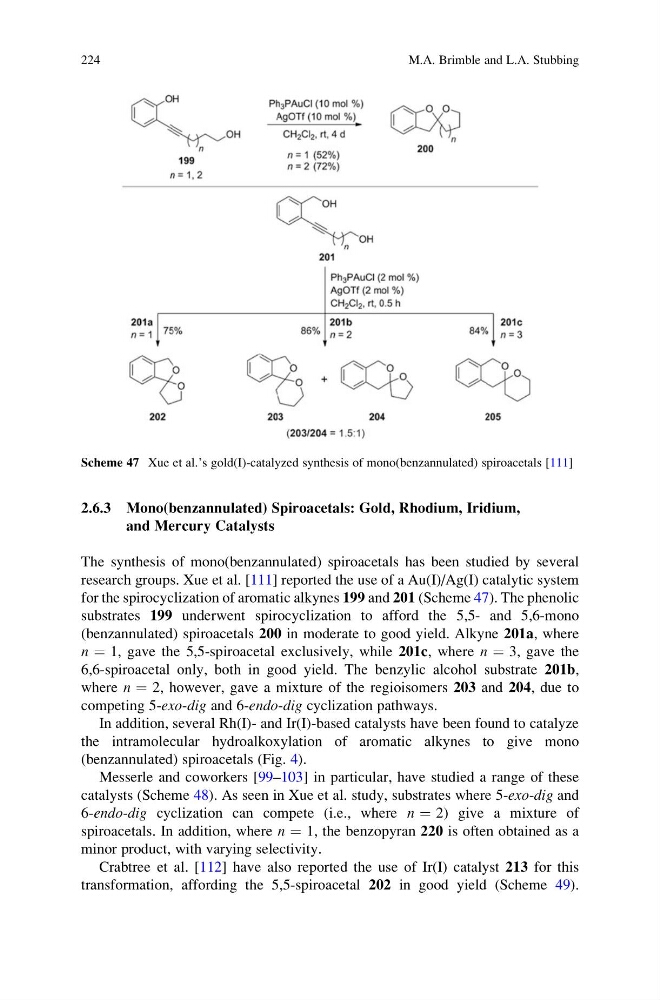
research groups. Xue et al. [111] reported the use of a Au(I)/Ag(I) catalytic system
for the spirocyclization of aromatic alkynes 199 and 201 (Scheme 47). The phenolic
substrates 199 underwent spirocyclization to afford the 5,5- and 5,6-mono
(benzannulated) spiroacetals 200 in moderate to good yield. Alkyne 201a, where
n ¼ 1, gave the 5,5-spiroacetal exclusively, while 201c, where n ¼ 3, gave the
6,6-spiroacetal only, both in good yield. The benzylic alcohol substrate 201b,
where n ¼ 2, however, gave a mixture of the regioisomers 203 and 204, due to
competing 5-exo-dig and 6-endo-dig cyclization pathways.
In addition, several Rh(I)- and Ir(I)-based catalysts have been found to catalyze
the intramolecular hydroalkoxylation of aromatic alkynes to give mono
(benzannulated) spiroacetals (Fig. 4).
Messerle and coworkers [99–103] in particular, have studied a range of these
catalysts (Scheme 48). As seen in Xue et al. study, substrates where 5-exo-dig and
6-endo-dig cyclization can compete (i.e., where n ¼ 2) give a mixture of
spiroacetals. In addition, where n ¼ 1, the benzopyran 220 is often obtained as a
minor product, with varying selectivity.
Crabtree et al. [112] have also reported the use of Ir(I) catalyst 213 for this
transformation, affording the 5,5-spiroacetal 202 in good yield (Scheme 49).
Scheme 47 Xue et al.’s gold(I)-catalyzed synthesis of mono(benzannulated) spiroacetals [111]
224
M.A. Brimble and L.A. Stubbing
and Mercury Catalysts
The synthesis of mono(benzannulated) spiroacetals has been studied by several
research groups. Xue et al. [111] reported the use of a Au(I)/Ag(I) catalytic system
for the spirocyclization of aromatic alkynes 199 and 201 (Scheme 47). The phenolic
substrates 199 underwent spirocyclization to afford the 5,5- and 5,6-mono
(benzannulated) spiroacetals 200 in moderate to good yield. Alkyne 201a, where
n ¼ 1, gave the 5,5-spiroacetal exclusively, while 201c, where n ¼ 3, gave the
6,6-spiroacetal only, both in good yield. The benzylic alcohol substrate 201b,
where n ¼ 2, however, gave a mixture of the regioisomers 203 and 204, due to
competing 5-exo-dig and 6-endo-dig cyclization pathways.
In addition, several Rh(I)- and Ir(I)-based catalysts have been found to catalyze
the intramolecular hydroalkoxylation of aromatic alkynes to give mono
(benzannulated) spiroacetals (Fig. 4).
Messerle and coworkers [99–103] in particular, have studied a range of these
catalysts (Scheme 48). As seen in Xue et al. study, substrates where 5-exo-dig and
6-endo-dig cyclization can compete (i.e., where n ¼ 2) give a mixture of
spiroacetals. In addition, where n ¼ 1, the benzopyran 220 is often obtained as a
minor product, with varying selectivity.
Crabtree et al. [112] have also reported the use of Ir(I) catalyst 213 for this
transformation, affording the 5,5-spiroacetal 202 in good yield (Scheme 49).
Scheme 47 Xue et al.’s gold(I)-catalyzed synthesis of mono(benzannulated) spiroacetals [111]
224
M.A. Brimble and L.A. Stubbing