

Mercury(II) triflate has emerged as an effective catalyst for a variety of cyclizations [108]. Its use in the hydroalkoxylation of alkynediols has been investigated
by Deslongchamps and coworkers [109] (Scheme 45).
Treatment of the alkynes 190 with Hg(OTf) 2 in acetonitrile afforded the
spiroacetals 191 in excellent yield. In cases where both 5-exo-dig and 6-exo-dig
cyclization was possible (m ¼ 2, n ¼ 2), 6-exo-dig was favored, giving only
6,6-spiroacetals as the product. However, in substrates where both 6-exo-dig and
5-endo-dig cyclizations were possible (m ¼ 1, n ¼ 1, 2), 5-endo-dig was favored.
The unsaturated spiroacetals 193 could be accessed from triol alkynes 192 in
similarly excellent yield via a cyclization/elimination sequence upon treatment
with Hg(OTf) 2 . Deslongchamps et al. [105] had also used this method in their
synthesis of hippuristanol, where treatment of 194 with Hg(OTf) 2 afforded 195 in
excellent yield.
2.6.2 Aliphatic bis(spiroacetals)
Lee et al. [110] have reported the synthesis of bis(spiroacetals) using an intramolecular alkyne hydroalkoxylation strategy (Scheme 46). Treatment of diynes 196
with catalytic Ph 3 PAuCl/AgOTf under microwave irradiation afforded the bis
(spiroacetals) 197–198 in moderate to good yield, generally favoring the trans-bis
(spiroacetal) 197.
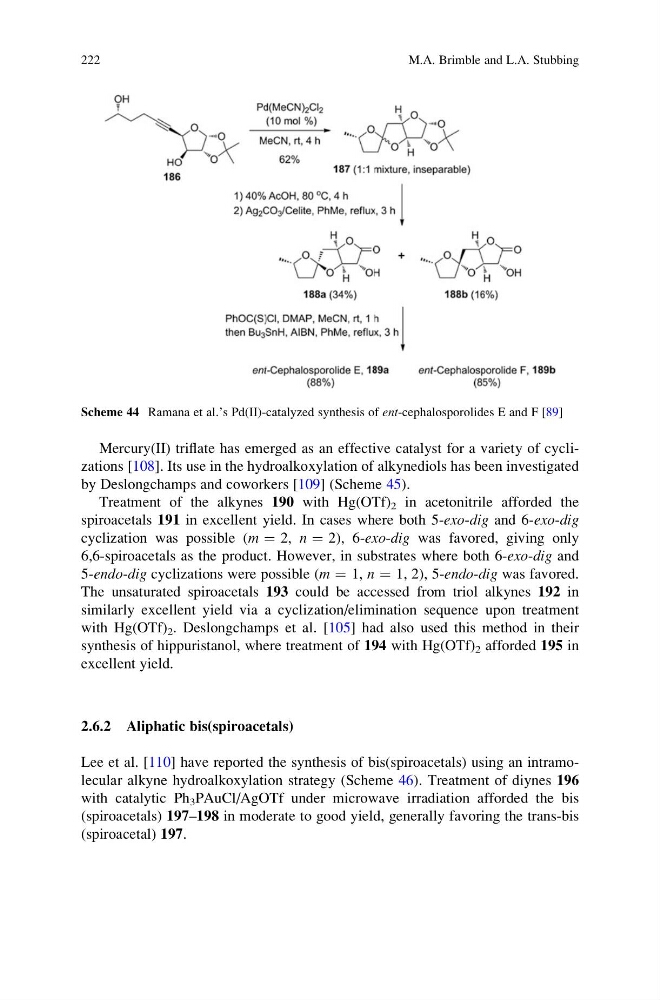
Scheme 44 Ramana et al.’s Pd(II)-catalyzed synthesis of ent-cephalosporolides E and F [89]
222
M.A. Brimble and L.A. Stubbing
by Deslongchamps and coworkers [109] (Scheme 45).
Treatment of the alkynes 190 with Hg(OTf) 2 in acetonitrile afforded the
spiroacetals 191 in excellent yield. In cases where both 5-exo-dig and 6-exo-dig
cyclization was possible (m ¼ 2, n ¼ 2), 6-exo-dig was favored, giving only
6,6-spiroacetals as the product. However, in substrates where both 6-exo-dig and
5-endo-dig cyclizations were possible (m ¼ 1, n ¼ 1, 2), 5-endo-dig was favored.
The unsaturated spiroacetals 193 could be accessed from triol alkynes 192 in
similarly excellent yield via a cyclization/elimination sequence upon treatment
with Hg(OTf) 2 . Deslongchamps et al. [105] had also used this method in their
synthesis of hippuristanol, where treatment of 194 with Hg(OTf) 2 afforded 195 in
excellent yield.
2.6.2 Aliphatic bis(spiroacetals)
Lee et al. [110] have reported the synthesis of bis(spiroacetals) using an intramolecular alkyne hydroalkoxylation strategy (Scheme 46). Treatment of diynes 196
with catalytic Ph 3 PAuCl/AgOTf under microwave irradiation afforded the bis
(spiroacetals) 197–198 in moderate to good yield, generally favoring the trans-bis
(spiroacetal) 197.
Scheme 44 Ramana et al.’s Pd(II)-catalyzed synthesis of ent-cephalosporolides E and F [89]
222
M.A. Brimble and L.A. Stubbing