

transition metal complexes may be used to affect the spirocyclization, and both
aliphatic and benzannulated spiroacetals may be accessed via this method (Scheme 38).
The hydroalkoxylation of an internal alkyne to afford a spiroacetal was first
described by Utimoto in 1983 [85]. Using PdCl 2 or PdCl 2 (PhCN) 2 as catalyst, the
spiroacetals 158 were obtained in high yield (Scheme 39). The method was not
adopted as a general tool for the synthesis of spiroacetals for some time, with only a
few reports exploiting the approach [86, 87]. Recent applications of palladiumcatalyzed intramolecular alkyne hydroalkoxylation include syntheses of spirolaxine
methyl ether [88] and enantiomers of the natural cephalosporolides [89].
There was an explosion of work described on gold(I) and gold(III) catalysis in
the early 2000s, and its application in the hydroalkoxylation of alkynes was no
exception [90, 91]. Beginning with studies toward Au(I)- or Au(III)-catalyzed
synthesis of bridged acetals [92], these catalysts were soon applied to the synthesis
of spiroacetals [93, 94]. This method has been widely embraced by the synthetic
community and used in the syntheses of a variety of complex spiroacetal natural
products, including the cephalosporolides [95], okadaic acid [96], and ushikulide
A [97].
Iridium complexes have also been shown to catalyze the tandem cycloisomerization/hydroalkoxylation of bis-homopropargylic alcohols to give furanyl and
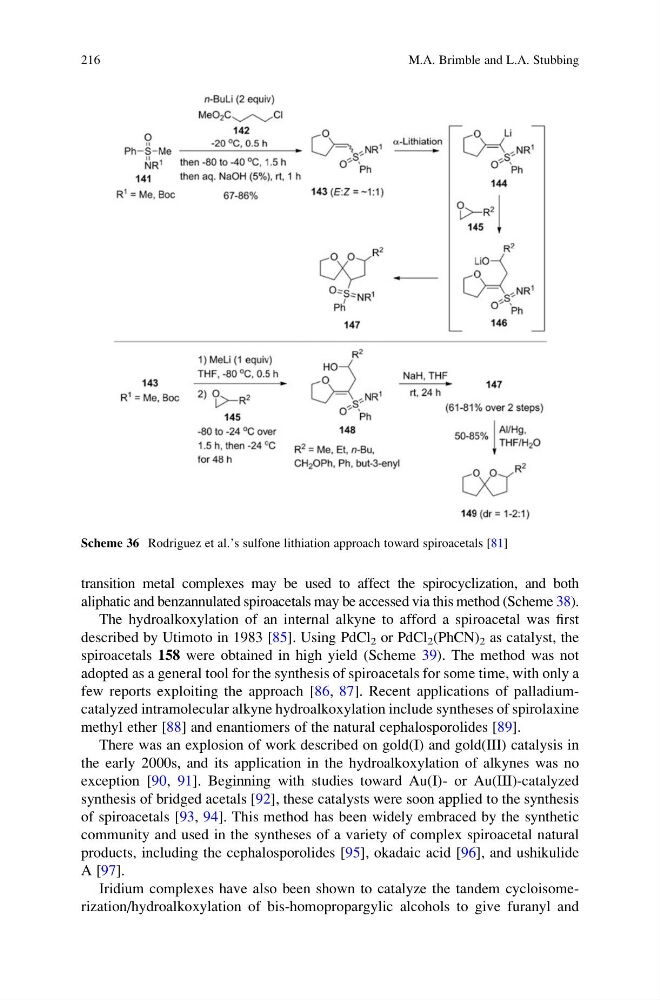
Scheme 36 Rodriguez et al.’s sulfone lithiation approach toward spiroacetals [81]
216
M.A. Brimble and L.A. Stubbing
aliphatic and benzannulated spiroacetals may be accessed via this method (Scheme 38).
The hydroalkoxylation of an internal alkyne to afford a spiroacetal was first
described by Utimoto in 1983 [85]. Using PdCl 2 or PdCl 2 (PhCN) 2 as catalyst, the
spiroacetals 158 were obtained in high yield (Scheme 39). The method was not
adopted as a general tool for the synthesis of spiroacetals for some time, with only a
few reports exploiting the approach [86, 87]. Recent applications of palladiumcatalyzed intramolecular alkyne hydroalkoxylation include syntheses of spirolaxine
methyl ether [88] and enantiomers of the natural cephalosporolides [89].
There was an explosion of work described on gold(I) and gold(III) catalysis in
the early 2000s, and its application in the hydroalkoxylation of alkynes was no
exception [90, 91]. Beginning with studies toward Au(I)- or Au(III)-catalyzed
synthesis of bridged acetals [92], these catalysts were soon applied to the synthesis
of spiroacetals [93, 94]. This method has been widely embraced by the synthetic
community and used in the syntheses of a variety of complex spiroacetal natural
products, including the cephalosporolides [95], okadaic acid [96], and ushikulide
A [97].
Iridium complexes have also been shown to catalyze the tandem cycloisomerization/hydroalkoxylation of bis-homopropargylic alcohols to give furanyl and
Scheme 36 Rodriguez et al.’s sulfone lithiation approach toward spiroacetals [81]
216
M.A. Brimble and L.A. Stubbing