

2.4.3 Intramolecular Oxymercuration
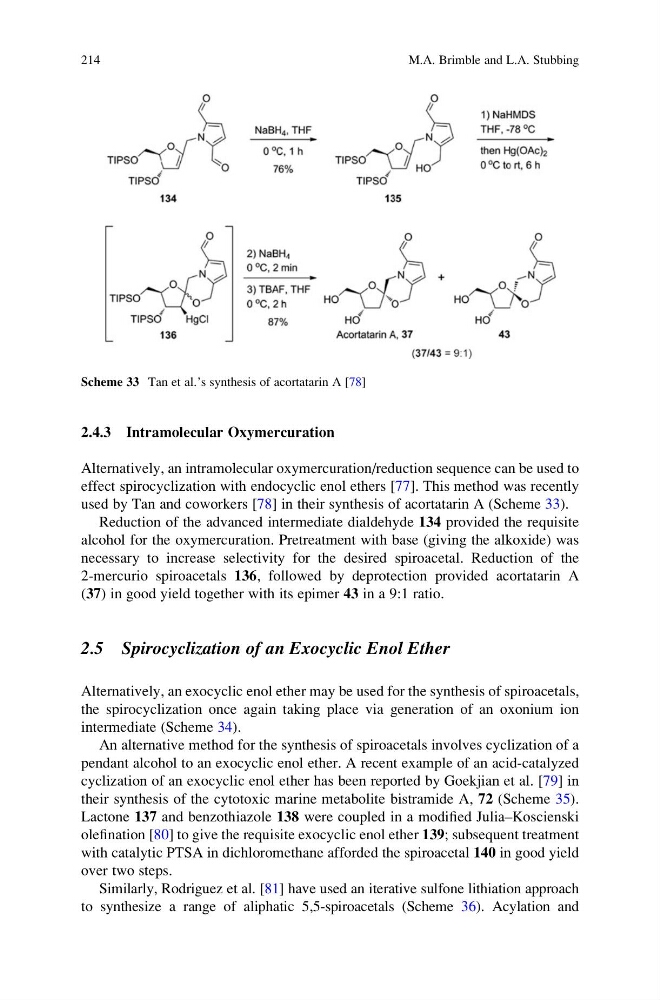
Alternatively, an intramolecular oxymercuration/reduction sequence can be used to
effect spirocyclization with endocyclic enol ethers [77]. This method was recently
used by Tan and coworkers [78] in their synthesis of acortatarin A (Scheme 33).
Reduction of the advanced intermediate dialdehyde 134 provided the requisite
alcohol for the oxymercuration. Pretreatment with base (giving the alkoxide) was
necessary to increase selectivity for the desired spiroacetal. Reduction of the
2-mercurio spiroacetals 136, followed by deprotection provided acortatarin A
(37) in good yield together with its epimer 43 in a 9:1 ratio.
2.5 Spirocyclization of an Exocyclic Enol Ether
Alternatively, an exocyclic enol ether may be used for the synthesis of spiroacetals,
the spirocyclization once again taking place via generation of an oxonium ion
intermediate (Scheme 34).
An alternative method for the synthesis of spiroacetals involves cyclization of a
pendant alcohol to an exocyclic enol ether. A recent example of an acid-catalyzed
cyclization of an exocyclic enol ether has been reported by Goekjian et al. [79] in
their synthesis of the cytotoxic marine metabolite bistramide A, 72 (Scheme 35).
Lactone 137 and benzothiazole 138 were coupled in a modified Julia–Koscienski
olefination [80] to give the requisite exocyclic enol ether 139; subsequent treatment
with catalytic PTSA in dichloromethane afforded the spiroacetal 140 in good yield
over two steps.
Similarly, Rodriguez et al. [81] have used an iterative sulfone lithiation approach
to synthesize a range of aliphatic 5,5-spiroacetals (Scheme 36). Acylation and
Scheme 33 Tan et al.’s synthesis of acortatarin A [78]
214
M.A. Brimble and L.A. Stubbing
Alternatively, an intramolecular oxymercuration/reduction sequence can be used to
effect spirocyclization with endocyclic enol ethers [77]. This method was recently
used by Tan and coworkers [78] in their synthesis of acortatarin A (Scheme 33).
Reduction of the advanced intermediate dialdehyde 134 provided the requisite
alcohol for the oxymercuration. Pretreatment with base (giving the alkoxide) was
necessary to increase selectivity for the desired spiroacetal. Reduction of the
2-mercurio spiroacetals 136, followed by deprotection provided acortatarin A
(37) in good yield together with its epimer 43 in a 9:1 ratio.
2.5 Spirocyclization of an Exocyclic Enol Ether
Alternatively, an exocyclic enol ether may be used for the synthesis of spiroacetals,
the spirocyclization once again taking place via generation of an oxonium ion
intermediate (Scheme 34).
An alternative method for the synthesis of spiroacetals involves cyclization of a
pendant alcohol to an exocyclic enol ether. A recent example of an acid-catalyzed
cyclization of an exocyclic enol ether has been reported by Goekjian et al. [79] in
their synthesis of the cytotoxic marine metabolite bistramide A, 72 (Scheme 35).
Lactone 137 and benzothiazole 138 were coupled in a modified Julia–Koscienski
olefination [80] to give the requisite exocyclic enol ether 139; subsequent treatment
with catalytic PTSA in dichloromethane afforded the spiroacetal 140 in good yield
over two steps.
Similarly, Rodriguez et al. [81] have used an iterative sulfone lithiation approach
to synthesize a range of aliphatic 5,5-spiroacetals (Scheme 36). Acylation and
Scheme 33 Tan et al.’s synthesis of acortatarin A [78]
214
M.A. Brimble and L.A. Stubbing