

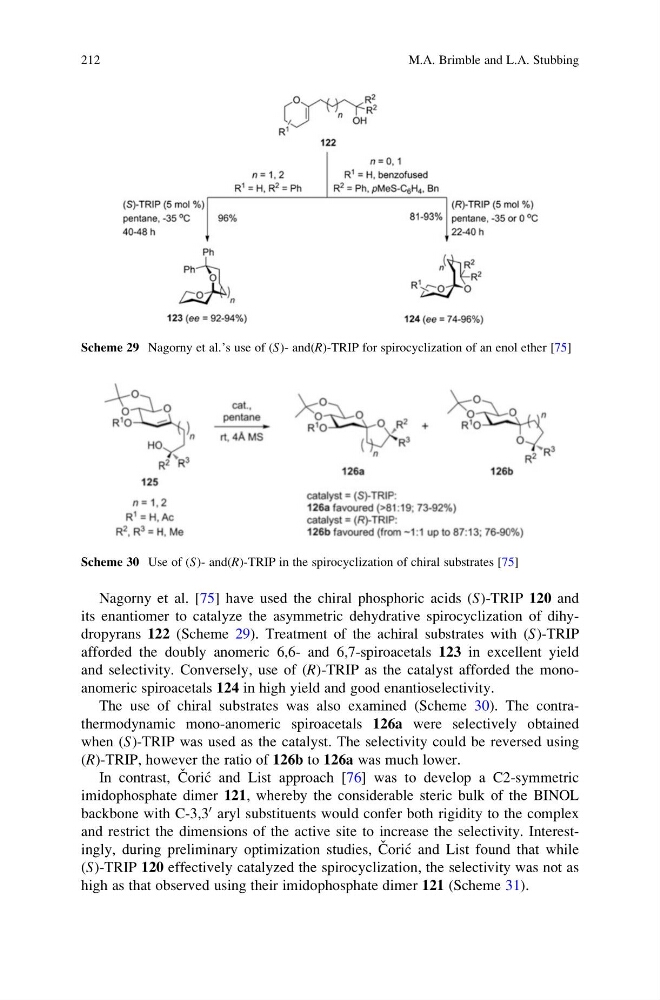
Nagorny et al. [75] have used the chiral phosphoric acids (S)-TRIP 120 and
its enantiomer to catalyze the asymmetric dehydrative spirocyclization of dihydropyrans 122 (Scheme 29). Treatment of the achiral substrates with (S)-TRIP
afforded the doubly anomeric 6,6- and 6,7-spiroacetals 123 in excellent yield
and selectivity. Conversely, use of (R)-TRIP as the catalyst afforded the monoanomeric spiroacetals 124 in high yield and good enantioselectivity.
The use of chiral substrates was also examined (Scheme 30). The contrathermodynamic mono-anomeric spiroacetals 126a were selectively obtained
when (S)-TRIP was used as the catalyst. The selectivity could be reversed using
(R)-TRIP, however the ratio of 126b to 126a was much lower.
In contrast, C ˇ oric ´ and List approach [76] was to develop a C2-symmetric
imidophosphate dimer 121, whereby the considerable steric bulk of the BINOL
backbone with C-3,3
0 aryl substituents would confer both rigidity to the complex
and restrict the dimensions of the active site to increase the selectivity. Interestingly, during preliminary optimization studies, C ˇ oric ´ and List found that while
(S)-TRIP 120 effectively catalyzed the spirocyclization, the selectivity was not as
high as that observed using their imidophosphate dimer 121 (Scheme 31).
Scheme 29 Nagorny et al.’s use of (S)- and(R)-TRIP for spirocyclization of an enol ether [75]
Scheme 30 Use of (S)- and(R)-TRIP in the spirocyclization of chiral substrates [75]
212
M.A. Brimble and L.A. Stubbing
its enantiomer to catalyze the asymmetric dehydrative spirocyclization of dihydropyrans 122 (Scheme 29). Treatment of the achiral substrates with (S)-TRIP
afforded the doubly anomeric 6,6- and 6,7-spiroacetals 123 in excellent yield
and selectivity. Conversely, use of (R)-TRIP as the catalyst afforded the monoanomeric spiroacetals 124 in high yield and good enantioselectivity.
The use of chiral substrates was also examined (Scheme 30). The contrathermodynamic mono-anomeric spiroacetals 126a were selectively obtained
when (S)-TRIP was used as the catalyst. The selectivity could be reversed using
(R)-TRIP, however the ratio of 126b to 126a was much lower.
In contrast, C ˇ oric ´ and List approach [76] was to develop a C2-symmetric
imidophosphate dimer 121, whereby the considerable steric bulk of the BINOL
backbone with C-3,3
0 aryl substituents would confer both rigidity to the complex
and restrict the dimensions of the active site to increase the selectivity. Interestingly, during preliminary optimization studies, C ˇ oric ´ and List found that while
(S)-TRIP 120 effectively catalyzed the spirocyclization, the selectivity was not as
high as that observed using their imidophosphate dimer 121 (Scheme 31).
Scheme 29 Nagorny et al.’s use of (S)- and(R)-TRIP for spirocyclization of an enol ether [75]
Scheme 30 Use of (S)- and(R)-TRIP in the spirocyclization of chiral substrates [75]
212
M.A. Brimble and L.A. Stubbing