

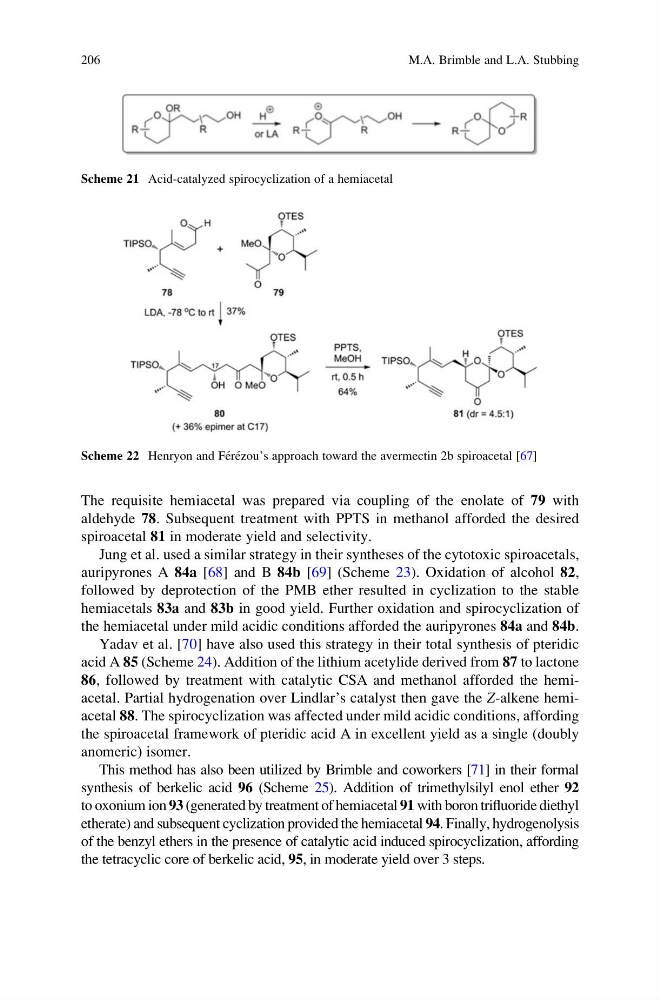
The requisite hemiacetal was prepared via coupling of the enolate of 79 with
aldehyde 78. Subsequent treatment with PPTS in methanol afforded the desired
spiroacetal 81 in moderate yield and selectivity.
Jung et al. used a similar strategy in their syntheses of the cytotoxic spiroacetals,
auripyrones A 84a [68] and B 84b [69] (Scheme 23). Oxidation of alcohol 82,
followed by deprotection of the PMB ether resulted in cyclization to the stable
hemiacetals 83a and 83b in good yield. Further oxidation and spirocyclization of
the hemiacetal under mild acidic conditions afforded the auripyrones 84a and 84b.
Yadav et al. [70] have also used this strategy in their total synthesis of pteridic
acid A 85 (Scheme 24). Addition of the lithium acetylide derived from 87 to lactone
86, followed by treatment with catalytic CSA and methanol afforded the hemiacetal. Partial hydrogenation over Lindlar’s catalyst then gave the Z-alkene hemiacetal 88. The spirocyclization was affected under mild acidic conditions, affording
the spiroacetal framework of pteridic acid A in excellent yield as a single (doubly
anomeric) isomer.
This method has also been utilized by Brimble and coworkers [71] in their formal
synthesis of berkelic acid 96 (Scheme 25). Addition of trimethylsilyl enol ether 92
to oxonium ion 93 (generated by treatment of hemiacetal 91 with boron trifluoride diethyl
etherate) and subsequent cyclization provided the hemiacetal 94. Finally, hydrogenolysis
of the benzyl ethers in the presence of catalytic acid induced spirocyclization, affording
the tetracyclic core of berkelic acid, 95, in moderate yield over 3 steps.
Scheme 21 Acid-catalyzed spirocyclization of a hemiacetal
Scheme 22 Henryon and Fe ´re ´zou’s approach toward the avermectin 2b spiroacetal [67]
206
M.A. Brimble and L.A. Stubbing
aldehyde 78. Subsequent treatment with PPTS in methanol afforded the desired
spiroacetal 81 in moderate yield and selectivity.
Jung et al. used a similar strategy in their syntheses of the cytotoxic spiroacetals,
auripyrones A 84a [68] and B 84b [69] (Scheme 23). Oxidation of alcohol 82,
followed by deprotection of the PMB ether resulted in cyclization to the stable
hemiacetals 83a and 83b in good yield. Further oxidation and spirocyclization of
the hemiacetal under mild acidic conditions afforded the auripyrones 84a and 84b.
Yadav et al. [70] have also used this strategy in their total synthesis of pteridic
acid A 85 (Scheme 24). Addition of the lithium acetylide derived from 87 to lactone
86, followed by treatment with catalytic CSA and methanol afforded the hemiacetal. Partial hydrogenation over Lindlar’s catalyst then gave the Z-alkene hemiacetal 88. The spirocyclization was affected under mild acidic conditions, affording
the spiroacetal framework of pteridic acid A in excellent yield as a single (doubly
anomeric) isomer.
This method has also been utilized by Brimble and coworkers [71] in their formal
synthesis of berkelic acid 96 (Scheme 25). Addition of trimethylsilyl enol ether 92
to oxonium ion 93 (generated by treatment of hemiacetal 91 with boron trifluoride diethyl
etherate) and subsequent cyclization provided the hemiacetal 94. Finally, hydrogenolysis
of the benzyl ethers in the presence of catalytic acid induced spirocyclization, affording
the tetracyclic core of berkelic acid, 95, in moderate yield over 3 steps.
Scheme 21 Acid-catalyzed spirocyclization of a hemiacetal
Scheme 22 Henryon and Fe ´re ´zou’s approach toward the avermectin 2b spiroacetal [67]
206
M.A. Brimble and L.A. Stubbing