

minimization of an unfavorable dipole–dipole interaction between the oxygen atom
of the “B” ring of the spiroacetal and the Fe(CO) 3 moiety.
2.1.2 Mono(benzannulated) Spiroacetals
Brimble and Haym have used dehydrative spirocyclization to achieve the synthesis
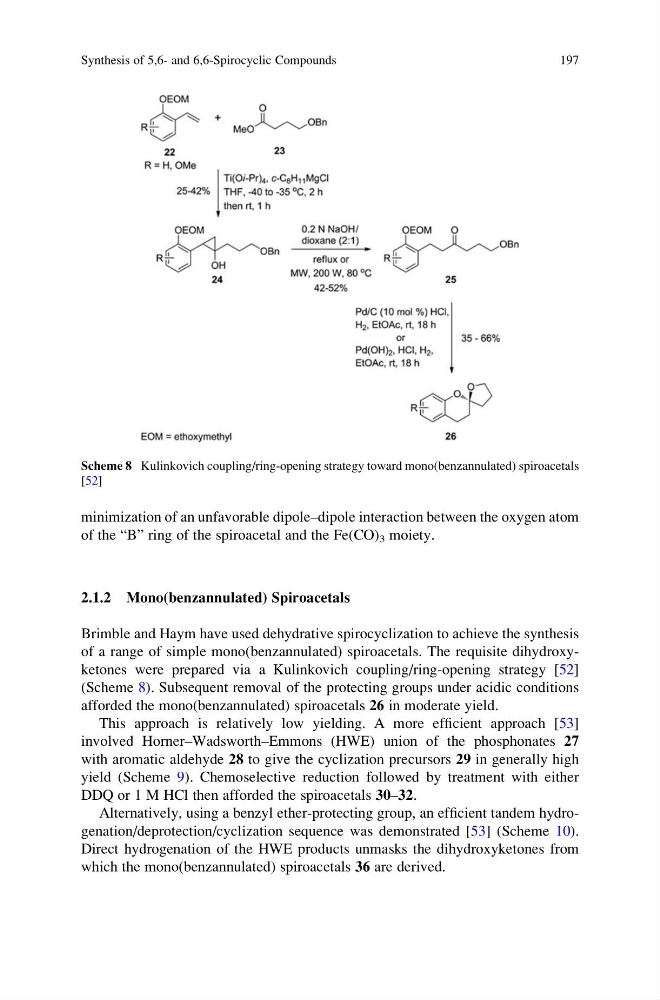
of a range of simple mono(benzannulated) spiroacetals. The requisite dihydroxyketones were prepared via a Kulinkovich coupling/ring-opening strategy [52]
(Scheme 8). Subsequent removal of the protecting groups under acidic conditions
afforded the mono(benzannulated) spiroacetals 26 in moderate yield.
This approach is relatively low yielding. A more efficient approach [53]
involved Horner–Wadsworth–Emmons (HWE) union of the phosphonates 27
with aromatic aldehyde 28 to give the cyclization precursors 29 in generally high
yield (Scheme 9). Chemoselective reduction followed by treatment with either
DDQ or 1 M HCl then afforded the spiroacetals 30–32.
Alternatively, using a benzyl ether-protecting group, an efficient tandem hydrogenation/deprotection/cyclization sequence was demonstrated [53] (Scheme 10).
Direct hydrogenation of the HWE products unmasks the dihydroxyketones from
which the mono(benzannulated) spiroacetals 36 are derived.
Scheme 8 Kulinkovich coupling/ring-opening strategy toward mono(benzannulated) spiroacetals
[52]
Synthesis of 5,6- and 6,6-Spirocyclic Compounds
197
of the “B” ring of the spiroacetal and the Fe(CO) 3 moiety.
2.1.2 Mono(benzannulated) Spiroacetals
Brimble and Haym have used dehydrative spirocyclization to achieve the synthesis
of a range of simple mono(benzannulated) spiroacetals. The requisite dihydroxyketones were prepared via a Kulinkovich coupling/ring-opening strategy [52]
(Scheme 8). Subsequent removal of the protecting groups under acidic conditions
afforded the mono(benzannulated) spiroacetals 26 in moderate yield.
This approach is relatively low yielding. A more efficient approach [53]
involved Horner–Wadsworth–Emmons (HWE) union of the phosphonates 27
with aromatic aldehyde 28 to give the cyclization precursors 29 in generally high
yield (Scheme 9). Chemoselective reduction followed by treatment with either
DDQ or 1 M HCl then afforded the spiroacetals 30–32.
Alternatively, using a benzyl ether-protecting group, an efficient tandem hydrogenation/deprotection/cyclization sequence was demonstrated [53] (Scheme 10).
Direct hydrogenation of the HWE products unmasks the dihydroxyketones from
which the mono(benzannulated) spiroacetals 36 are derived.
Scheme 8 Kulinkovich coupling/ring-opening strategy toward mono(benzannulated) spiroacetals
[52]
Synthesis of 5,6- and 6,6-Spirocyclic Compounds
197