

In cases where substitution of the spiroacetal means that there is little difference
between the relative energies of the conformations, a mixture is usually obtained.
Given that most spiroacetal-containing natural products are doubly anomerically
stabilized, this method is ideal for, and has found extensive use in, their synthesis.
The requisite dihydroxyketones are commonly assembled via iterative aldol
coupling reactions [1], but other methods including Nef reactions [17, 18], acetylide
additions [19, 20], 1,3-dipolar nitrile oxide cycloadditions [21], iterative alkylation
of dithianes [22–28], hydrazones [29], oximes [30], nitriles [31], or
dihalomethylene species [32–34], cross-metathesis/hydroboration/oxidation [35],
iterative substitution of a xanthate [36], dihydroxylation/desymmetrization of
alkenes [37], Horner–Wadsworth–Emmons olefinations [38, 39], allylmetallations
[40], and alkyne–alkyne cross-coupling [41] have also been reported.
2.1.1 Aliphatic Spiroacetals
Recent examples of the application of this strategy for the synthesis of aliphatic
natural product spiroacetals have been demonstrated by the syntheses of
spirastrellolide A [42], spirofungins A and B [43–45], cephalosporolides E and F
[46, 47], spirangien A [48, 49], and pteridic acids A and B [50].
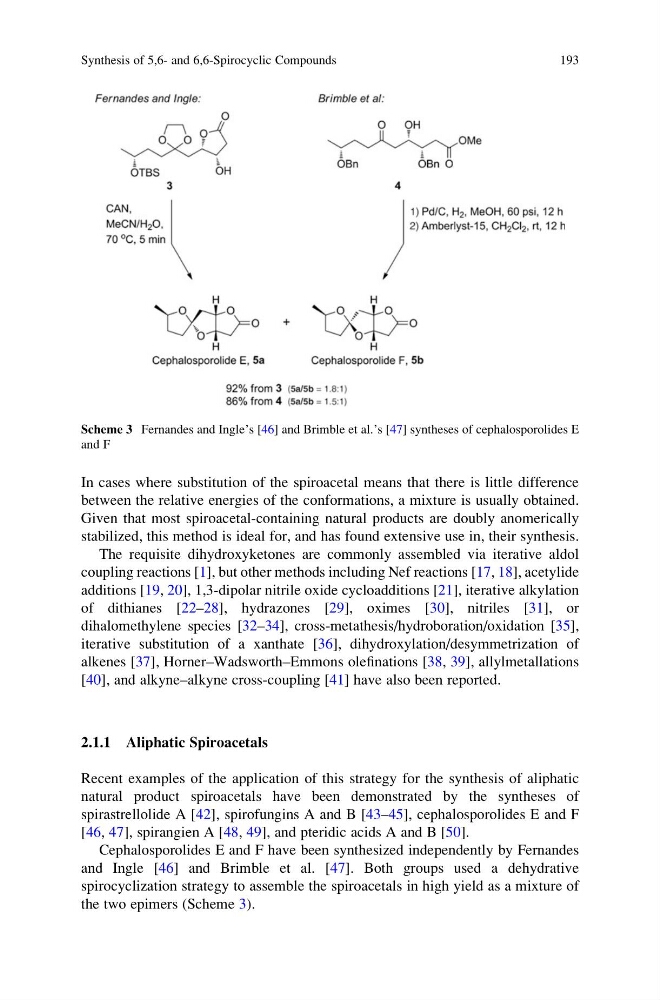
Cephalosporolides E and F have been synthesized independently by Fernandes
and Ingle [46] and Brimble et al. [47]. Both groups used a dehydrative
spirocyclization strategy to assemble the spiroacetals in high yield as a mixture of
the two epimers (Scheme 3).
Scheme 3 Fernandes and Ingle’s [46] and Brimble et al.’s [47] syntheses of cephalosporolides E
and F
Synthesis of 5,6- and 6,6-Spirocyclic Compounds
193
between the relative energies of the conformations, a mixture is usually obtained.
Given that most spiroacetal-containing natural products are doubly anomerically
stabilized, this method is ideal for, and has found extensive use in, their synthesis.
The requisite dihydroxyketones are commonly assembled via iterative aldol
coupling reactions [1], but other methods including Nef reactions [17, 18], acetylide
additions [19, 20], 1,3-dipolar nitrile oxide cycloadditions [21], iterative alkylation
of dithianes [22–28], hydrazones [29], oximes [30], nitriles [31], or
dihalomethylene species [32–34], cross-metathesis/hydroboration/oxidation [35],
iterative substitution of a xanthate [36], dihydroxylation/desymmetrization of
alkenes [37], Horner–Wadsworth–Emmons olefinations [38, 39], allylmetallations
[40], and alkyne–alkyne cross-coupling [41] have also been reported.
2.1.1 Aliphatic Spiroacetals
Recent examples of the application of this strategy for the synthesis of aliphatic
natural product spiroacetals have been demonstrated by the syntheses of
spirastrellolide A [42], spirofungins A and B [43–45], cephalosporolides E and F
[46, 47], spirangien A [48, 49], and pteridic acids A and B [50].
Cephalosporolides E and F have been synthesized independently by Fernandes
and Ingle [46] and Brimble et al. [47]. Both groups used a dehydrative
spirocyclization strategy to assemble the spiroacetals in high yield as a mixture of
the two epimers (Scheme 3).
Scheme 3 Fernandes and Ingle’s [46] and Brimble et al.’s [47] syntheses of cephalosporolides E
and F
Synthesis of 5,6- and 6,6-Spirocyclic Compounds
193