

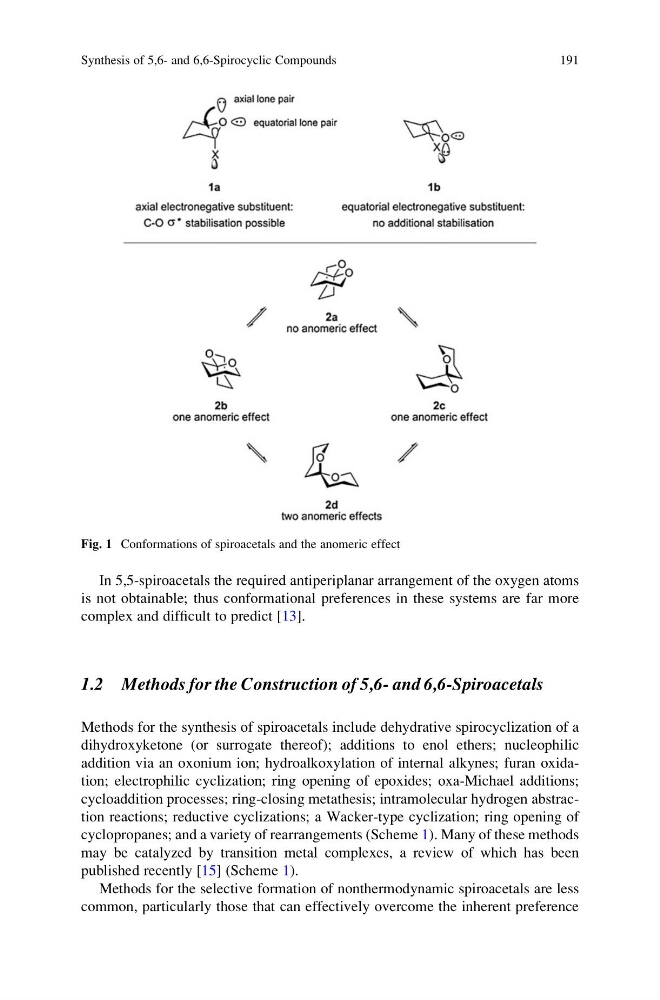
In 5,5-spiroacetals the required antiperiplanar arrangement of the oxygen atoms
is not obtainable; thus conformational preferences in these systems are far more
complex and difficult to predict [13].
1.2 Methods for the Construction of 5,6- and 6,6-Spiroacetals
Methods for the synthesis of spiroacetals include dehydrative spirocyclization of a
dihydroxyketone (or surrogate thereof); additions to enol ethers; nucleophilic
addition via an oxonium ion; hydroalkoxylation of internal alkynes; furan oxidation; electrophilic cyclization; ring opening of epoxides; oxa-Michael additions;
cycloaddition processes; ring-closing metathesis; intramolecular hydrogen abstraction reactions; reductive cyclizations; a Wacker-type cyclization; ring opening of
cyclopropanes; and a variety of rearrangements (Scheme 1). Many of these methods
may be catalyzed by transition metal complexes, a review of which has been
published recently [15] (Scheme 1).
Methods for the selective formation of nonthermodynamic spiroacetals are less
common, particularly those that can effectively overcome the inherent preference
Fig. 1 Conformations of spiroacetals and the anomeric effect
Synthesis of 5,6- and 6,6-Spirocyclic Compounds
191
is not obtainable; thus conformational preferences in these systems are far more
complex and difficult to predict [13].
1.2 Methods for the Construction of 5,6- and 6,6-Spiroacetals
Methods for the synthesis of spiroacetals include dehydrative spirocyclization of a
dihydroxyketone (or surrogate thereof); additions to enol ethers; nucleophilic
addition via an oxonium ion; hydroalkoxylation of internal alkynes; furan oxidation; electrophilic cyclization; ring opening of epoxides; oxa-Michael additions;
cycloaddition processes; ring-closing metathesis; intramolecular hydrogen abstraction reactions; reductive cyclizations; a Wacker-type cyclization; ring opening of
cyclopropanes; and a variety of rearrangements (Scheme 1). Many of these methods
may be catalyzed by transition metal complexes, a review of which has been
published recently [15] (Scheme 1).
Methods for the selective formation of nonthermodynamic spiroacetals are less
common, particularly those that can effectively overcome the inherent preference
Fig. 1 Conformations of spiroacetals and the anomeric effect
Synthesis of 5,6- and 6,6-Spirocyclic Compounds
191