

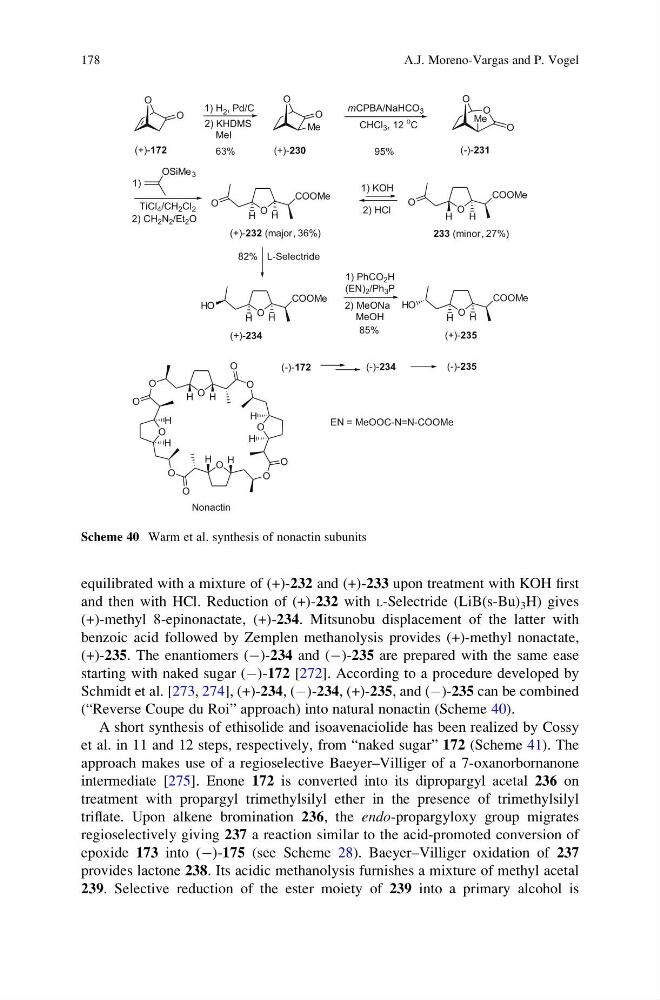
equilibrated with a mixture of (+)-232 and (+)-233 upon treatment with KOH first
and then with HCl. Reduction of (+)-232 with L-Selectride (LiB(s-Bu) 3 H) gives
(+)-methyl 8-epinonactate, (+)-234. Mitsunobu displacement of the latter with
benzoic acid followed by Zemplen methanolysis provides (+)-methyl nonactate,
(+)-235. The enantiomers (À)-234 and (À)-235 are prepared with the same ease
starting with naked sugar (À)-172 [272]. According to a procedure developed by
Schmidt et al. [273, 274], (+)-234, (À)-234, (+)-235, and (À)-235 can be combined
(“Reverse Coupe du Roi” approach) into natural nonactin (Scheme 40).
A short synthesis of ethisolide and isoavenaciolide has been realized by Cossy
et al. in 11 and 12 steps, respectively, from “naked sugar” 172 (Scheme 41). The
approach makes use of a regioselective Baeyer–Villiger of a 7-oxanorbornanone
intermediate [275]. Enone 172 is converted into its dipropargyl acetal 236 on
treatment with propargyl trimethylsilyl ether in the presence of trimethylsilyl
triflate. Upon alkene bromination 236, the endo-propargyloxy group migrates
regioselectively giving 237 a reaction similar to the acid-promoted conversion of
epoxide 173 into (À)-175 (see Scheme 28). Baeyer–Villiger oxidation of 237
provides lactone 238. Its acidic methanolysis furnishes a mixture of methyl acetal
239. Selective reduction of the ester moiety of 239 into a primary alcohol is
O
O
OSiMe 3
O
O
H
COOMe
H
O
HO
H
H
COOMe
O
O
O
O
O
O
H
H
H
H
H
H
H
H
O
O
O
O
O
O
O
O
Me
O
O
O
Me
O
O
H
H
COOMe
O
HO
H
H
COOMe
(+)-172
mCPBA/NaHCO 3
95%
(-)-231
1)
TiCl 4 /CH 2 Cl 2
(+)-232 (major, 36%)
233 (minor, 27%)
L-Selectride
(+)-234
1) PhCO 2 H
(EN) 2 /Ph 3 P
2) CH 2 N 2 /Et 2 O
Nonactin
(-)-172
(-)-234
(-)-235
(+)-230
CHCl 3 , 12
o
C
1) H 2 , Pd/C
2) KHDMS
MeI
63%
1) KOH
2) HCl
(+)-235
2) MeONa
MeOH
82%
85%
EN = MeOOC-N=N-COOMe
Scheme 40 Warm et al. synthesis of nonactin subunits
178
A.J. Moreno-Vargas and P. Vogel
and then with HCl. Reduction of (+)-232 with L-Selectride (LiB(s-Bu) 3 H) gives
(+)-methyl 8-epinonactate, (+)-234. Mitsunobu displacement of the latter with
benzoic acid followed by Zemplen methanolysis provides (+)-methyl nonactate,
(+)-235. The enantiomers (À)-234 and (À)-235 are prepared with the same ease
starting with naked sugar (À)-172 [272]. According to a procedure developed by
Schmidt et al. [273, 274], (+)-234, (À)-234, (+)-235, and (À)-235 can be combined
(“Reverse Coupe du Roi” approach) into natural nonactin (Scheme 40).
A short synthesis of ethisolide and isoavenaciolide has been realized by Cossy
et al. in 11 and 12 steps, respectively, from “naked sugar” 172 (Scheme 41). The
approach makes use of a regioselective Baeyer–Villiger of a 7-oxanorbornanone
intermediate [275]. Enone 172 is converted into its dipropargyl acetal 236 on
treatment with propargyl trimethylsilyl ether in the presence of trimethylsilyl
triflate. Upon alkene bromination 236, the endo-propargyloxy group migrates
regioselectively giving 237 a reaction similar to the acid-promoted conversion of
epoxide 173 into (À)-175 (see Scheme 28). Baeyer–Villiger oxidation of 237
provides lactone 238. Its acidic methanolysis furnishes a mixture of methyl acetal
239. Selective reduction of the ester moiety of 239 into a primary alcohol is
O
O
OSiMe 3
O
O
H
COOMe
H
O
HO
H
H
COOMe
O
O
O
O
O
O
H
H
H
H
H
H
H
H
O
O
O
O
O
O
O
O
Me
O
O
O
Me
O
O
H
H
COOMe
O
HO
H
H
COOMe
(+)-172
mCPBA/NaHCO 3
95%
(-)-231
1)
TiCl 4 /CH 2 Cl 2
(+)-232 (major, 36%)
233 (minor, 27%)
L-Selectride
(+)-234
1) PhCO 2 H
(EN) 2 /Ph 3 P
2) CH 2 N 2 /Et 2 O
Nonactin
(-)-172
(-)-234
(-)-235
(+)-230
CHCl 3 , 12
o
C
1) H 2 , Pd/C
2) KHDMS
MeI
63%
1) KOH
2) HCl
(+)-235
2) MeONa
MeOH
82%
85%
EN = MeOOC-N=N-COOMe
Scheme 40 Warm et al. synthesis of nonactin subunits
178
A.J. Moreno-Vargas and P. Vogel