

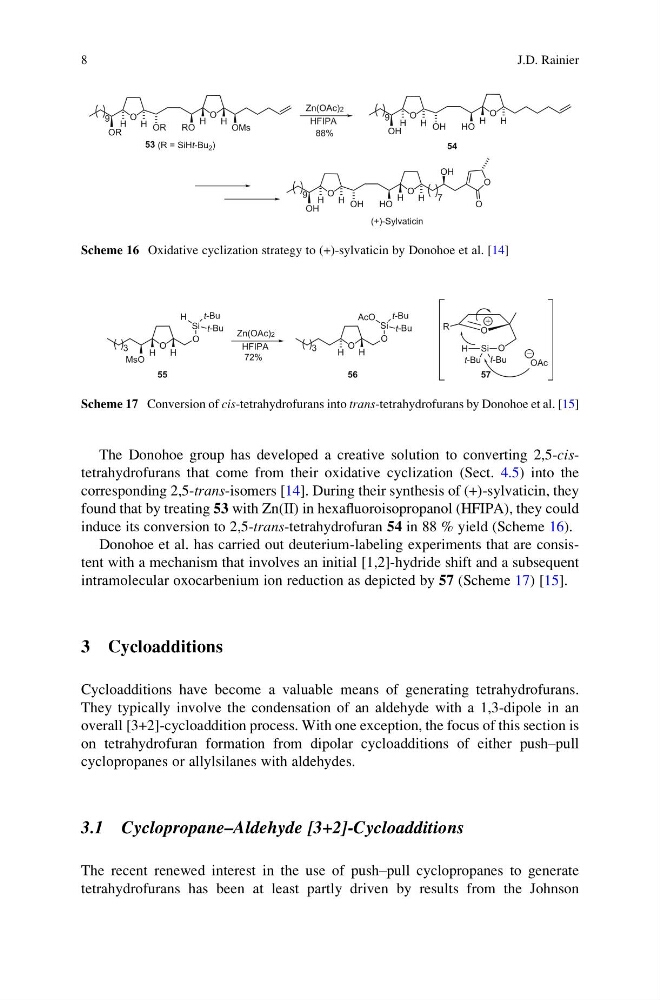
The Donohoe group has developed a creative solution to converting 2,5-cistetrahydrofurans that come from their oxidative cyclization (Sect. 4.5) into the
corresponding 2,5-trans-isomers [14]. During their synthesis of (+)-sylvaticin, they
found that by treating 53 with Zn(II) in hexafluoroisopropanol (HFIPA), they could
induce its conversion to 2,5-trans-tetrahydrofuran 54 in 88 % yield (Scheme 16).
Donohoe et al. has carried out deuterium-labeling experiments that are consistent with a mechanism that involves an initial [1,2]-hydride shift and a subsequent
intramolecular oxocarbenium ion reduction as depicted by 57 (Scheme 17) [15].
3 Cycloadditions
Cycloadditions have become a valuable means of generating tetrahydrofurans.
They typically involve the condensation of an aldehyde with a 1,3-dipole in an
overall [3+2]-cycloaddition process. With one exception, the focus of this section is
on tetrahydrofuran formation from dipolar cycloadditions of either push–pull
cyclopropanes or allylsilanes with aldehydes.
3.1 Cyclopropane–Aldehyde [3+2]-Cycloadditions
The recent renewed interest in the use of push–pull cyclopropanes to generate
tetrahydrofurans has been at least partly driven by results from the Johnson
O
O
OR
9
H
H
RO
OR
H
H
OMs
O
O
OH
9
H
H
HO
OH
H
H
O
O
OH
9
H
H
HO
OH
H
H
7
OH
O
O
(+)-Sylvaticin
HFIPA
Zn(OAc)2
53 (R = SiHt-Bu 2 )
54
88%
Scheme 16 Oxidative cyclization strategy to (+)-sylvaticin by Donohoe et al. [14]
O
O
H
H
MsO
Si
3
t-Bu
t-Bu
H
Zn(OAc)2
HFIPA
O
O
H
H
Si
3
t-Bu
t-Bu
AcO
72%
O
R
O
Si
H
t-Bu t-Bu
OAc
55
56
57
Scheme 17 Conversion of cis-tetrahydrofurans into trans-tetrahydrofurans by Donohoe et al. [15]
8
J.D. Rainier
corresponding 2,5-trans-isomers [14]. During their synthesis of (+)-sylvaticin, they
found that by treating 53 with Zn(II) in hexafluoroisopropanol (HFIPA), they could
induce its conversion to 2,5-trans-tetrahydrofuran 54 in 88 % yield (Scheme 16).
Donohoe et al. has carried out deuterium-labeling experiments that are consistent with a mechanism that involves an initial [1,2]-hydride shift and a subsequent
intramolecular oxocarbenium ion reduction as depicted by 57 (Scheme 17) [15].
3 Cycloadditions
Cycloadditions have become a valuable means of generating tetrahydrofurans.
They typically involve the condensation of an aldehyde with a 1,3-dipole in an
overall [3+2]-cycloaddition process. With one exception, the focus of this section is
on tetrahydrofuran formation from dipolar cycloadditions of either push–pull
cyclopropanes or allylsilanes with aldehydes.
3.1 Cyclopropane–Aldehyde [3+2]-Cycloadditions
The recent renewed interest in the use of push–pull cyclopropanes to generate
tetrahydrofurans has been at least partly driven by results from the Johnson
O
O
OR
9
H
H
RO
OR
H
H
OMs
O
O
OH
9
H
H
HO
OH
H
H
O
O
OH
9
H
H
HO
OH
H
H
7
OH
O
O
(+)-Sylvaticin
HFIPA
Zn(OAc)2
53 (R = SiHt-Bu 2 )
54
88%
Scheme 16 Oxidative cyclization strategy to (+)-sylvaticin by Donohoe et al. [14]
O
O
H
H
MsO
Si
3
t-Bu
t-Bu
H
Zn(OAc)2
HFIPA
O
O
H
H
Si
3
t-Bu
t-Bu
AcO
72%
O
R
O
Si
H
t-Bu t-Bu
OAc
55
56
57
Scheme 17 Conversion of cis-tetrahydrofurans into trans-tetrahydrofurans by Donohoe et al. [15]
8
J.D. Rainier