

they are enantiomerically pure like D-glucose, but unlike natural hexoses have three
unsubstituted carbon centers that can be substituted in few steps with high regioand stereoselectivity giving polysubstituted 7-oxanorbornane derivatives. The latter
can be converted readily into hexoses [220–224] and analogues, into C-glycosides
such as C-nucleosides [225–227], or into carbahexoses including conduritols
[228–230] and aminoconduritols [231–234]. Selected examples are given below.
Conversion of enone (+)-172 into its dibenzyl acetal and subsequent epoxidation
provides exo-epoxide 173. Under strongly acidic conditions (HSO 3 F), the most
strained ethereal moiety, the epoxide, is heterolyzed with the participation of the
endo-benzyloxy group, leading to the hypothetical intermediate 174 that finally
gives 175 with high regio- and stereoselectivity. Noteworthy is the fact that
pinacolic rearrangement of the 7-oxanorbonyl system (see below) is not observed
under these conditions. After etherification of the exo-alcoholic moiety as a silyl
ether and conversion of the ketone into enoxysilane 176, Mukaiyama cross-aldol
reaction with formaldehyde generates an exo-carbaldehyde that is reduced with
NaBH 4 into diol 177. On treatment with HBr in AcOH, 177 is converted into 178.
The process implies acetylation of the diol, exchange of the benzyl and silyl groups
for acetates, and displacement of the 7-oxa ethereal bridge by a bromide S N 2 attack
at the least sterically hindered bridgehead center. Final treatment with an excess of
MeONa in MeOH induces complete methanolysis of the acetates and formation of
the epoxide ring of cyclophellitol (for other syntheses of cyclophellitol, see [235]).
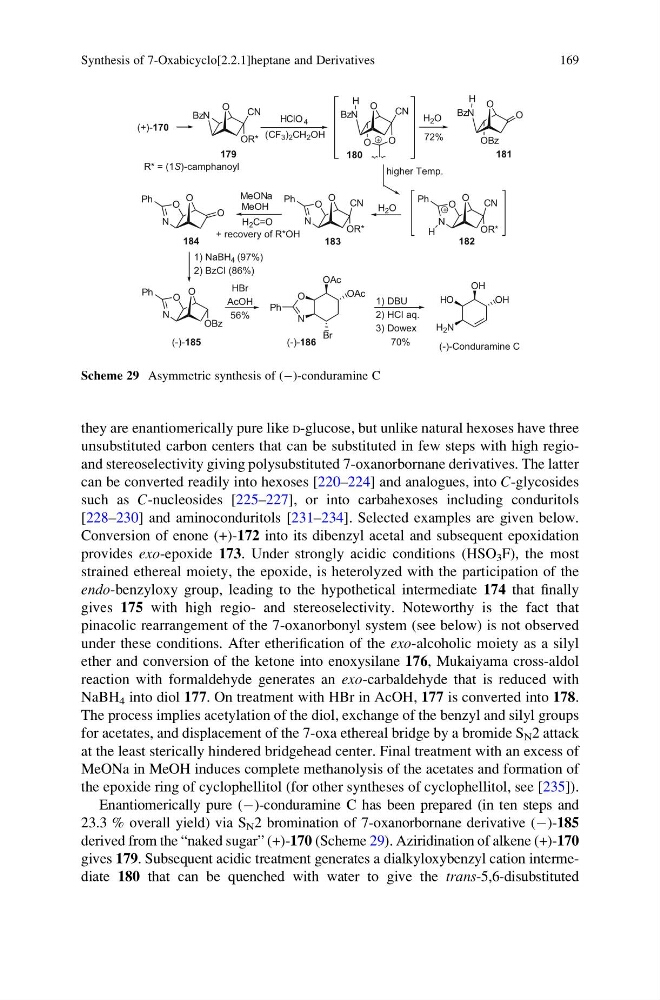
Enantiomerically pure (À)-conduramine C has been prepared (in ten steps and
23.3 % overall yield) via S N 2 bromination of 7-oxanorbornane derivative (À)-185
derived from the “naked sugar” (+)-170 (Scheme 29). Aziridination of alkene (+)-170
gives 179. Subsequent acidic treatment generates a dialkyloxybenzyl cation intermediate 180 that can be quenched with water to give the trans-5,6-disubstituted
O
BzN
OR*
CN
O
O
N
CN
Ph
H
OR*
O
O
N
Ph
O
O
O
N
OBz
Ph
O
N
OAc
OAc
Br
Ph
OH
OH
HO
H 2 N
O
O
N
CN
OR*
Ph
H 2 O
MeONa
MeOH
H 2 C=O
HClO 4
(CF 3 ) 2 CH 2 OH
O
BzN
O
CN
O
H
H 2 O
BzN
OBz
H
O
O
(+)-170
182
1) NaBH 4 (97%)
2) BzCl (86%)
HBr
AcOH
56%
1) DBU
2) HCl aq.
3) Dowex
(-)-185
(-)-186
(-)-Conduramine C
181
higher Temp.
183
184
+ recovery of R*OH
R* = (1S)-camphanoyl
179
180
72%
70%
Scheme 29 Asymmetric synthesis of (À)-conduramine C
Synthesis of 7-Oxabicyclo[2.2.1]heptane and Derivatives
169
unsubstituted carbon centers that can be substituted in few steps with high regioand stereoselectivity giving polysubstituted 7-oxanorbornane derivatives. The latter
can be converted readily into hexoses [220–224] and analogues, into C-glycosides
such as C-nucleosides [225–227], or into carbahexoses including conduritols
[228–230] and aminoconduritols [231–234]. Selected examples are given below.
Conversion of enone (+)-172 into its dibenzyl acetal and subsequent epoxidation
provides exo-epoxide 173. Under strongly acidic conditions (HSO 3 F), the most
strained ethereal moiety, the epoxide, is heterolyzed with the participation of the
endo-benzyloxy group, leading to the hypothetical intermediate 174 that finally
gives 175 with high regio- and stereoselectivity. Noteworthy is the fact that
pinacolic rearrangement of the 7-oxanorbonyl system (see below) is not observed
under these conditions. After etherification of the exo-alcoholic moiety as a silyl
ether and conversion of the ketone into enoxysilane 176, Mukaiyama cross-aldol
reaction with formaldehyde generates an exo-carbaldehyde that is reduced with
NaBH 4 into diol 177. On treatment with HBr in AcOH, 177 is converted into 178.
The process implies acetylation of the diol, exchange of the benzyl and silyl groups
for acetates, and displacement of the 7-oxa ethereal bridge by a bromide S N 2 attack
at the least sterically hindered bridgehead center. Final treatment with an excess of
MeONa in MeOH induces complete methanolysis of the acetates and formation of
the epoxide ring of cyclophellitol (for other syntheses of cyclophellitol, see [235]).
Enantiomerically pure (À)-conduramine C has been prepared (in ten steps and
23.3 % overall yield) via S N 2 bromination of 7-oxanorbornane derivative (À)-185
derived from the “naked sugar” (+)-170 (Scheme 29). Aziridination of alkene (+)-170
gives 179. Subsequent acidic treatment generates a dialkyloxybenzyl cation intermediate 180 that can be quenched with water to give the trans-5,6-disubstituted
O
BzN
OR*
CN
O
O
N
CN
Ph
H
OR*
O
O
N
Ph
O
O
O
N
OBz
Ph
O
N
OAc
OAc
Br
Ph
OH
OH
HO
H 2 N
O
O
N
CN
OR*
Ph
H 2 O
MeONa
MeOH
H 2 C=O
HClO 4
(CF 3 ) 2 CH 2 OH
O
BzN
O
CN
O
H
H 2 O
BzN
OBz
H
O
O
(+)-170
182
1) NaBH 4 (97%)
2) BzCl (86%)
HBr
AcOH
56%
1) DBU
2) HCl aq.
3) Dowex
(-)-185
(-)-186
(-)-Conduramine C
181
higher Temp.
183
184
+ recovery of R*OH
R* = (1S)-camphanoyl
179
180
72%
70%
Scheme 29 Asymmetric synthesis of (À)-conduramine C
Synthesis of 7-Oxabicyclo[2.2.1]heptane and Derivatives
169