

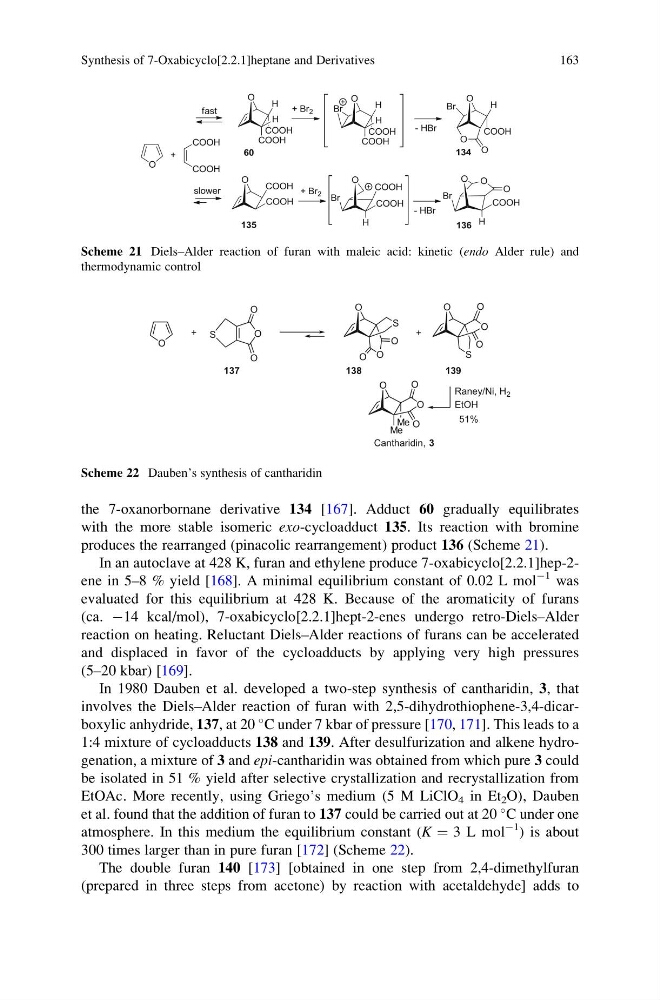
the 7-oxanorbornane derivative 134 [167]. Adduct 60 gradually equilibrates
with the more stable isomeric exo-cycloadduct 135. Its reaction with bromine
produces the rearranged (pinacolic rearrangement) product 136 (Scheme 21).
In an autoclave at 428 K, furan and ethylene produce 7-oxabicyclo[2.2.1]hep-2ene in 5–8 % yield [168]. A minimal equilibrium constant of 0.02 L mol
À1 was
evaluated for this equilibrium at 428 K. Because of the aromaticity of furans
(ca. À14 kcal/mol), 7-oxabicyclo[2.2.1]hept-2-enes undergo retro-Diels–Alder
reaction on heating. Reluctant Diels–Alder reactions of furans can be accelerated
and displaced in favor of the cycloadducts by applying very high pressures
(5–20 kbar) [169].
In 1980 Dauben et al. developed a two-step synthesis of cantharidin, 3, that
involves the Diels–Alder reaction of furan with 2,5-dihydrothiophene-3,4-dicarboxylic anhydride, 137, at 20
C under 7 kbar of pressure [170, 171]. This leads to a
1:4 mixture of cycloadducts 138 and 139. After desulfurization and alkene hydrogenation, a mixture of 3 and epi-cantharidin was obtained from which pure 3 could
be isolated in 51 % yield after selective crystallization and recrystallization from
EtOAc. More recently, using Griego’s medium (5 M LiClO 4 in Et 2 O), Dauben
et al. found that the addition of furan to 137 could be carried out at 20
C under one
atmosphere. In this medium the equilibrium constant (K ¼ 3 L mol
À1 ) is about
300 times larger than in pure furan [172] (Scheme 22).
The double furan 140 [173] [obtained in one step from 2,4-dimethylfuran
(prepared in three steps from acetone) by reaction with acetaldehyde] adds to
Scheme 21 Diels–Alder reaction of furan with maleic acid: kinetic (endo Alder rule) and
thermodynamic control
O
O
S
O
O
O
O
O
S
O
O
S
O
O
O
Me
O
O
O
O
Me
+
137
138
139
Raney/Ni, H 2
EtOH
Cantharidin, 3
+
51%
Scheme 22 Dauben’s synthesis of cantharidin
Synthesis of 7-Oxabicyclo[2.2.1]heptane and Derivatives
163
with the more stable isomeric exo-cycloadduct 135. Its reaction with bromine
produces the rearranged (pinacolic rearrangement) product 136 (Scheme 21).
In an autoclave at 428 K, furan and ethylene produce 7-oxabicyclo[2.2.1]hep-2ene in 5–8 % yield [168]. A minimal equilibrium constant of 0.02 L mol
À1 was
evaluated for this equilibrium at 428 K. Because of the aromaticity of furans
(ca. À14 kcal/mol), 7-oxabicyclo[2.2.1]hept-2-enes undergo retro-Diels–Alder
reaction on heating. Reluctant Diels–Alder reactions of furans can be accelerated
and displaced in favor of the cycloadducts by applying very high pressures
(5–20 kbar) [169].
In 1980 Dauben et al. developed a two-step synthesis of cantharidin, 3, that
involves the Diels–Alder reaction of furan with 2,5-dihydrothiophene-3,4-dicarboxylic anhydride, 137, at 20
C under 7 kbar of pressure [170, 171]. This leads to a
1:4 mixture of cycloadducts 138 and 139. After desulfurization and alkene hydrogenation, a mixture of 3 and epi-cantharidin was obtained from which pure 3 could
be isolated in 51 % yield after selective crystallization and recrystallization from
EtOAc. More recently, using Griego’s medium (5 M LiClO 4 in Et 2 O), Dauben
et al. found that the addition of furan to 137 could be carried out at 20
C under one
atmosphere. In this medium the equilibrium constant (K ¼ 3 L mol
À1 ) is about
300 times larger than in pure furan [172] (Scheme 22).
The double furan 140 [173] [obtained in one step from 2,4-dimethylfuran
(prepared in three steps from acetone) by reaction with acetaldehyde] adds to
Scheme 21 Diels–Alder reaction of furan with maleic acid: kinetic (endo Alder rule) and
thermodynamic control
O
O
S
O
O
O
O
O
S
O
O
S
O
O
O
Me
O
O
O
O
Me
+
137
138
139
Raney/Ni, H 2
EtOH
Cantharidin, 3
+
51%
Scheme 22 Dauben’s synthesis of cantharidin
Synthesis of 7-Oxabicyclo[2.2.1]heptane and Derivatives
163