

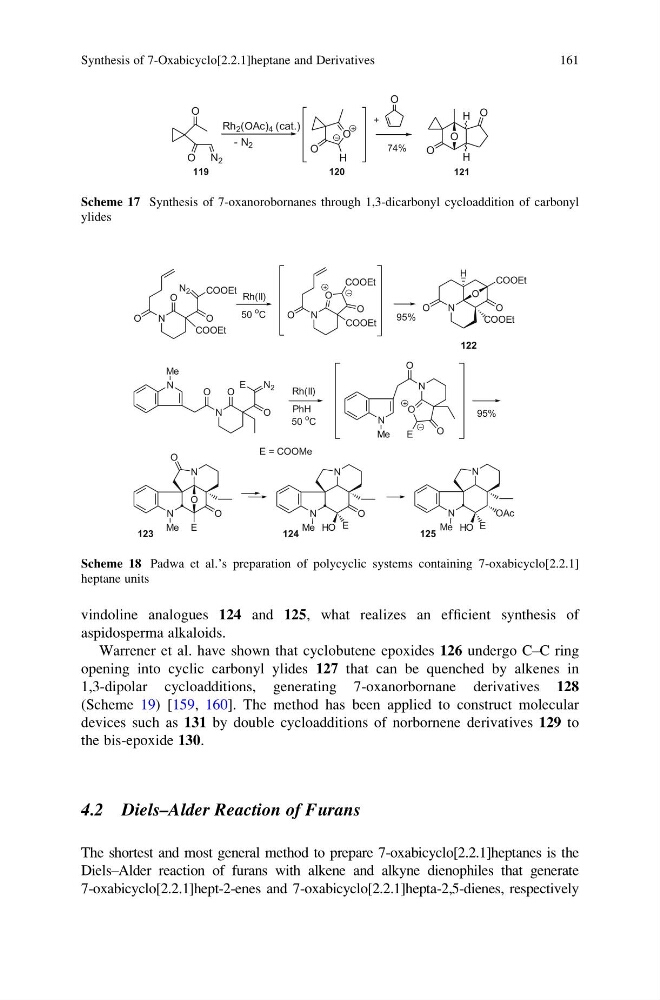
vindoline analogues 124 and 125, what realizes an efficient synthesis of
aspidosperma alkaloids.
Warrener et al. have shown that cyclobutene epoxides 126 undergo C–C ring
opening into cyclic carbonyl ylides 127 that can be quenched by alkenes in
1,3-dipolar cycloadditions, generating 7-oxanorbornane derivatives 128
(Scheme 19) [159, 160]. The method has been applied to construct molecular
devices such as 131 by double cycloadditions of norbornene derivatives 129 to
the bis-epoxide 130.
4.2 Diels–Alder Reaction of Furans
The shortest and most general method to prepare 7-oxabicyclo[2.2.1]heptanes is the
Diels–Alder reaction of furans with alkene and alkyne dienophiles that generate
7-oxabicyclo[2.2.1]hept-2-enes and 7-oxabicyclo[2.2.1]hepta-2,5-dienes, respectively
N
O
COOEt
O
O
COOEt
N
O
O
O
E
N
Me
N
N 2
O
COOEt
O
O
COOEt
N
O
O
COOEt
O
H
Rh(II)
Me
N
O
O
O
N 2
E
N
N
N
O
E
O
Me
O
N
Me
O
HO E
N
N
Me
N
OAc
HO E
Rh(II)
122
E = COOMe
123
124
125
COOEt
50
o
C
95%
PhH
50
o
C
95%
Scheme 18 Padwa et al.’s preparation of polycyclic systems containing 7-oxabicyclo[2.2.1]
heptane units
O
O
H
O
O N 2
Rh 2 (OAc) 4 (cat.)
O
O
H
H
O
O
- N 2
119
120
+
121
74%
Scheme 17 Synthesis of 7-oxanorobornanes through 1,3-dicarbonyl cycloaddition of carbonyl
ylides
Synthesis of 7-Oxabicyclo[2.2.1]heptane and Derivatives
161
aspidosperma alkaloids.
Warrener et al. have shown that cyclobutene epoxides 126 undergo C–C ring
opening into cyclic carbonyl ylides 127 that can be quenched by alkenes in
1,3-dipolar cycloadditions, generating 7-oxanorbornane derivatives 128
(Scheme 19) [159, 160]. The method has been applied to construct molecular
devices such as 131 by double cycloadditions of norbornene derivatives 129 to
the bis-epoxide 130.
4.2 Diels–Alder Reaction of Furans
The shortest and most general method to prepare 7-oxabicyclo[2.2.1]heptanes is the
Diels–Alder reaction of furans with alkene and alkyne dienophiles that generate
7-oxabicyclo[2.2.1]hept-2-enes and 7-oxabicyclo[2.2.1]hepta-2,5-dienes, respectively
N
O
COOEt
O
O
COOEt
N
O
O
O
E
N
Me
N
N 2
O
COOEt
O
O
COOEt
N
O
O
COOEt
O
H
Rh(II)
Me
N
O
O
O
N 2
E
N
N
N
O
E
O
Me
O
N
Me
O
HO E
N
N
Me
N
OAc
HO E
Rh(II)
122
E = COOMe
123
124
125
COOEt
50
o
C
95%
PhH
50
o
C
95%
Scheme 18 Padwa et al.’s preparation of polycyclic systems containing 7-oxabicyclo[2.2.1]
heptane units
O
O
H
O
O N 2
Rh 2 (OAc) 4 (cat.)
O
O
H
H
O
O
- N 2
119
120
+
121
74%
Scheme 17 Synthesis of 7-oxanorobornanes through 1,3-dicarbonyl cycloaddition of carbonyl
ylides
Synthesis of 7-Oxabicyclo[2.2.1]heptane and Derivatives
161