

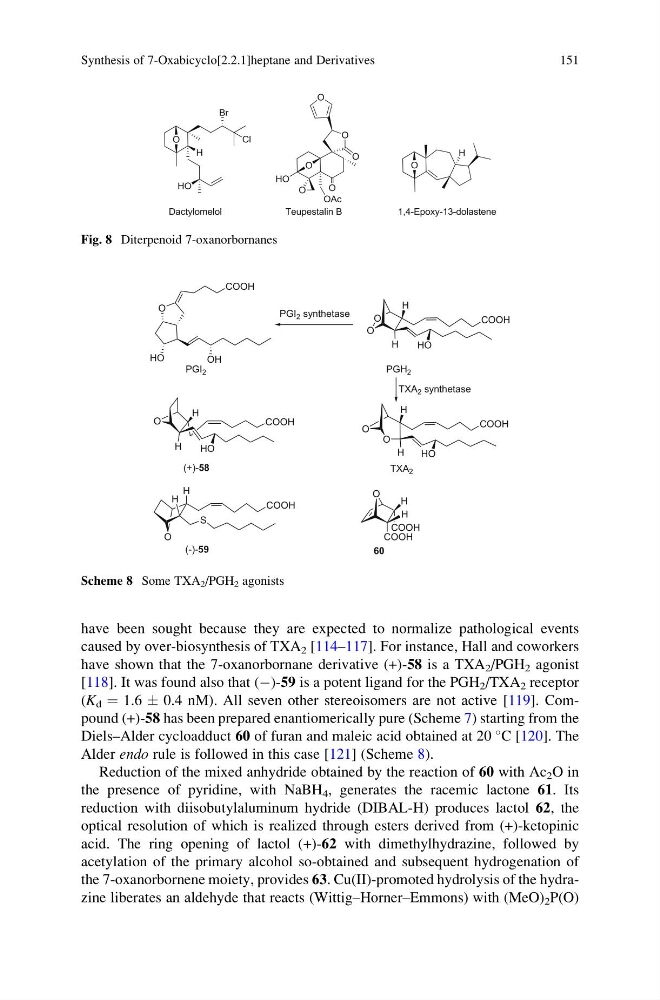
have been sought because they are expected to normalize pathological events
caused by over-biosynthesis of TXA 2 [114–117]. For instance, Hall and coworkers
have shown that the 7-oxanorbornane derivative (+)-58 is a TXA 2 /PGH 2 agonist
[118]. It was found also that (À)-59 is a potent ligand for the PGH 2 /TXA 2 receptor
(K d ¼ 1.6 Æ 0.4 nM). All seven other stereoisomers are not active [119]. Compound (+)-58 has been prepared enantiomerically pure (Scheme 7) starting from the
Diels–Alder cycloadduct 60 of furan and maleic acid obtained at 20
C [120]. The
Alder endo rule is followed in this case [121] (Scheme 8).
Reduction of the mixed anhydride obtained by the reaction of 60 with Ac 2 O in
the presence of pyridine, with NaBH 4 , generates the racemic lactone 61. Its
reduction with diisobutylaluminum hydride (DIBAL-H) produces lactol 62, the
optical resolution of which is realized through esters derived from (+)-ketopinic
acid. The ring opening of lactol (+)-62 with dimethylhydrazine, followed by
acetylation of the primary alcohol so-obtained and subsequent hydrogenation of
the 7-oxanorbornene moiety, provides 63. Cu(II)-promoted hydrolysis of the hydrazine liberates an aldehyde that reacts (Wittig–Horner–Emmons) with (MeO) 2 P(O)
O
O
COOH
HO
OH
O
O
HO
COOH
H
H
O
HO
COOH
H
H
O
HO
COOH
H
H
PGI 2 synthetase
TXA 2 synthetase
PGI 2
PGH 2
O
COOH
H
H
O
COOH
COOH
H
H
S
(+)-58
(-)-59
TXA 2
60
Scheme 8 Some TXA 2 /PGH 2 agonists
Fig. 8 Diterpenoid 7-oxanorbornanes
Synthesis of 7-Oxabicyclo[2.2.1]heptane and Derivatives
151
caused by over-biosynthesis of TXA 2 [114–117]. For instance, Hall and coworkers
have shown that the 7-oxanorbornane derivative (+)-58 is a TXA 2 /PGH 2 agonist
[118]. It was found also that (À)-59 is a potent ligand for the PGH 2 /TXA 2 receptor
(K d ¼ 1.6 Æ 0.4 nM). All seven other stereoisomers are not active [119]. Compound (+)-58 has been prepared enantiomerically pure (Scheme 7) starting from the
Diels–Alder cycloadduct 60 of furan and maleic acid obtained at 20
C [120]. The
Alder endo rule is followed in this case [121] (Scheme 8).
Reduction of the mixed anhydride obtained by the reaction of 60 with Ac 2 O in
the presence of pyridine, with NaBH 4 , generates the racemic lactone 61. Its
reduction with diisobutylaluminum hydride (DIBAL-H) produces lactol 62, the
optical resolution of which is realized through esters derived from (+)-ketopinic
acid. The ring opening of lactol (+)-62 with dimethylhydrazine, followed by
acetylation of the primary alcohol so-obtained and subsequent hydrogenation of
the 7-oxanorbornene moiety, provides 63. Cu(II)-promoted hydrolysis of the hydrazine liberates an aldehyde that reacts (Wittig–Horner–Emmons) with (MeO) 2 P(O)
O
O
COOH
HO
OH
O
O
HO
COOH
H
H
O
HO
COOH
H
H
O
HO
COOH
H
H
PGI 2 synthetase
TXA 2 synthetase
PGI 2
PGH 2
O
COOH
H
H
O
COOH
COOH
H
H
S
(+)-58
(-)-59
TXA 2
60
Scheme 8 Some TXA 2 /PGH 2 agonists
Fig. 8 Diterpenoid 7-oxanorbornanes
Synthesis of 7-Oxabicyclo[2.2.1]heptane and Derivatives
151