

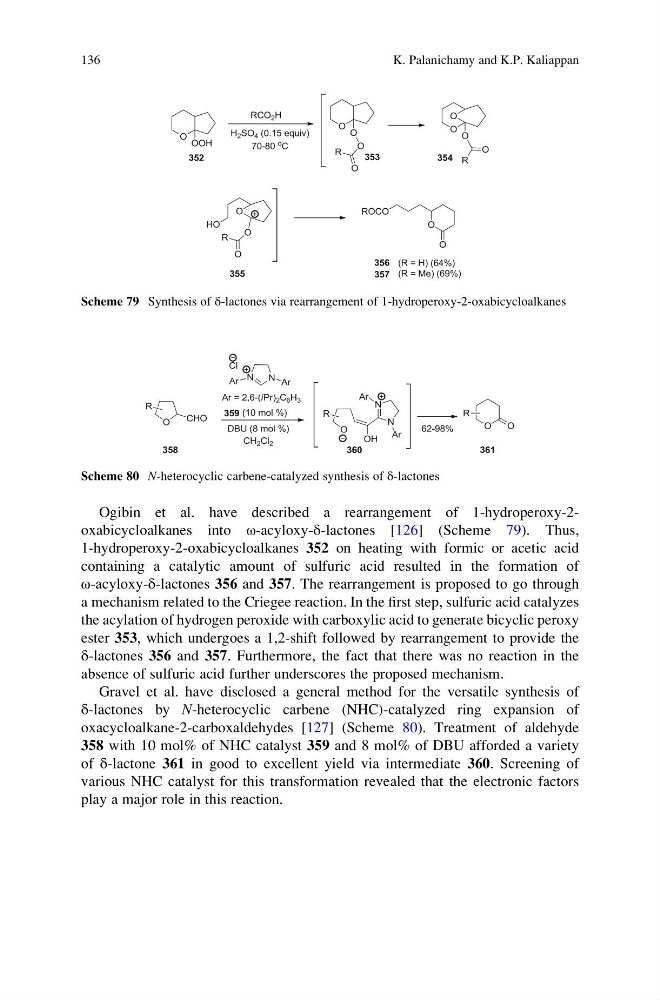
Ogibin et al. have described a rearrangement of 1-hydroperoxy-2oxabicycloalkanes into ω-acyloxy-δ-lactones [126] (Scheme 79). Thus,
1-hydroperoxy-2-oxabicycloalkanes 352 on heating with formic or acetic acid
containing a catalytic amount of sulfuric acid resulted in the formation of
ω-acyloxy-δ-lactones 356 and 357. The rearrangement is proposed to go through
a mechanism related to the Criegee reaction. In the first step, sulfuric acid catalyzes
the acylation of hydrogen peroxide with carboxylic acid to generate bicyclic peroxy
ester 353, which undergoes a 1,2-shift followed by rearrangement to provide the
δ-lactones 356 and 357. Furthermore, the fact that there was no reaction in the
absence of sulfuric acid further underscores the proposed mechanism.
Gravel et al. have disclosed a general method for the versatile synthesis of
δ-lactones by N-heterocyclic carbene (NHC)-catalyzed ring expansion of
oxacycloalkane-2-carboxaldehydes [127] (Scheme 80). Treatment of aldehyde
358 with 10 mol% of NHC catalyst 359 and 8 mol% of DBU afforded a variety
of δ-lactone 361 in good to excellent yield via intermediate 360. Screening of
various NHC catalyst for this transformation revealed that the electronic factors
play a major role in this reaction.
Scheme 79 Synthesis of δ-lactones via rearrangement of 1-hydroperoxy-2-oxabicycloalkanes
Scheme 80 N-heterocyclic carbene-catalyzed synthesis of δ-lactones
136
K. Palanichamy and K.P. Kaliappan
1-hydroperoxy-2-oxabicycloalkanes 352 on heating with formic or acetic acid
containing a catalytic amount of sulfuric acid resulted in the formation of
ω-acyloxy-δ-lactones 356 and 357. The rearrangement is proposed to go through
a mechanism related to the Criegee reaction. In the first step, sulfuric acid catalyzes
the acylation of hydrogen peroxide with carboxylic acid to generate bicyclic peroxy
ester 353, which undergoes a 1,2-shift followed by rearrangement to provide the
δ-lactones 356 and 357. Furthermore, the fact that there was no reaction in the
absence of sulfuric acid further underscores the proposed mechanism.
Gravel et al. have disclosed a general method for the versatile synthesis of
δ-lactones by N-heterocyclic carbene (NHC)-catalyzed ring expansion of
oxacycloalkane-2-carboxaldehydes [127] (Scheme 80). Treatment of aldehyde
358 with 10 mol% of NHC catalyst 359 and 8 mol% of DBU afforded a variety
of δ-lactone 361 in good to excellent yield via intermediate 360. Screening of
various NHC catalyst for this transformation revealed that the electronic factors
play a major role in this reaction.
Scheme 79 Synthesis of δ-lactones via rearrangement of 1-hydroperoxy-2-oxabicycloalkanes
Scheme 80 N-heterocyclic carbene-catalyzed synthesis of δ-lactones
136
K. Palanichamy and K.P. Kaliappan