

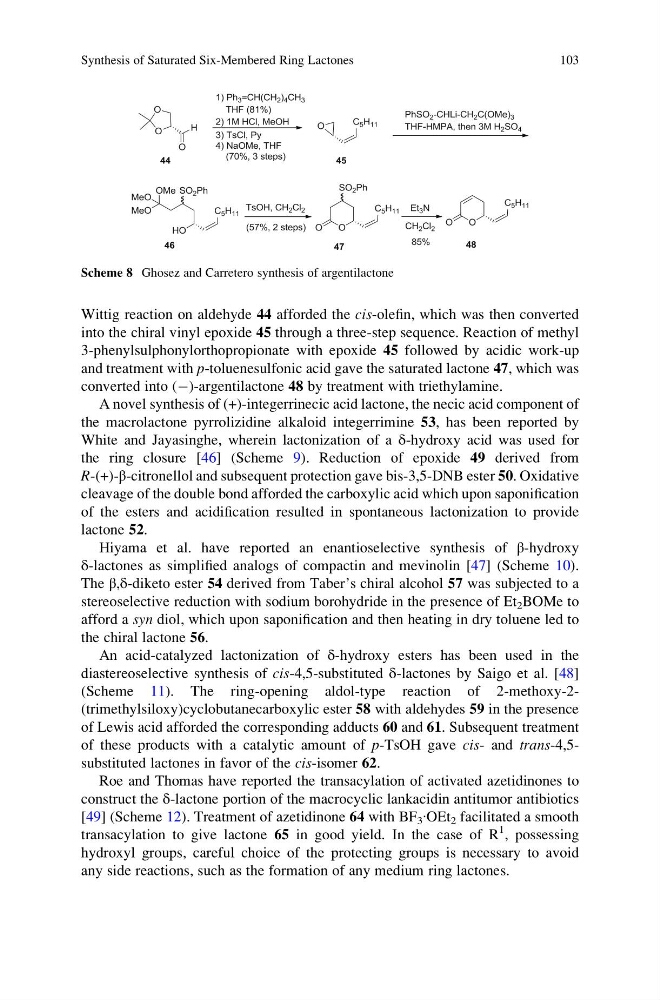
Wittig reaction on aldehyde 44 afforded the cis-olefin, which was then converted
into the chiral vinyl epoxide 45 through a three-step sequence. Reaction of methyl
3-phenylsulphonylorthopropionate with epoxide 45 followed by acidic work-up
and treatment with p-toluenesulfonic acid gave the saturated lactone 47, which was
converted into (À)-argentilactone 48 by treatment with triethylamine.
A novel synthesis of (+)-integerrinecic acid lactone, the necic acid component of
the macrolactone pyrrolizidine alkaloid integerrimine 53, has been reported by
White and Jayasinghe, wherein lactonization of a δ-hydroxy acid was used for
the ring closure [46] (Scheme 9). Reduction of epoxide 49 derived from
R-(+)-β-citronellol and subsequent protection gave bis-3,5-DNB ester 50. Oxidative
cleavage of the double bond afforded the carboxylic acid which upon saponification
of the esters and acidification resulted in spontaneous lactonization to provide
lactone 52.
Hiyama et al. have reported an enantioselective synthesis of β-hydroxy
δ-lactones as simplified analogs of compactin and mevinolin [47] (Scheme 10).
The β,δ-diketo ester 54 derived from Taber’s chiral alcohol 57 was subjected to a
stereoselective reduction with sodium borohydride in the presence of Et 2 BOMe to
afford a syn diol, which upon saponification and then heating in dry toluene led to
the chiral lactone 56.
An acid-catalyzed lactonization of δ-hydroxy esters has been used in the
diastereoselective synthesis of cis-4,5-substituted δ-lactones by Saigo et al. [48]
(Scheme 11). The ring-opening aldol-type reaction of 2-methoxy-2(trimethylsiloxy)cyclobutanecarboxylic ester 58 with aldehydes 59 in the presence
of Lewis acid afforded the corresponding adducts 60 and 61. Subsequent treatment
of these products with a catalytic amount of p-TsOH gave cis- and trans-4,5substituted lactones in favor of the cis-isomer 62.
Roe and Thomas have reported the transacylation of activated azetidinones to
construct the δ-lactone portion of the macrocyclic lankacidin antitumor antibiotics
[49] (Scheme 12). Treatment of azetidinone 64 with BF 3 ∙OEt 2 facilitated a smooth
transacylation to give lactone 65 in good yield. In the case of R
1 , possessing
hydroxyl groups, careful choice of the protecting groups is necessary to avoid
any side reactions, such as the formation of any medium ring lactones.
Scheme 8 Ghosez and Carretero synthesis of argentilactone
Synthesis of Saturated Six-Membered Ring Lactones
103
into the chiral vinyl epoxide 45 through a three-step sequence. Reaction of methyl
3-phenylsulphonylorthopropionate with epoxide 45 followed by acidic work-up
and treatment with p-toluenesulfonic acid gave the saturated lactone 47, which was
converted into (À)-argentilactone 48 by treatment with triethylamine.
A novel synthesis of (+)-integerrinecic acid lactone, the necic acid component of
the macrolactone pyrrolizidine alkaloid integerrimine 53, has been reported by
White and Jayasinghe, wherein lactonization of a δ-hydroxy acid was used for
the ring closure [46] (Scheme 9). Reduction of epoxide 49 derived from
R-(+)-β-citronellol and subsequent protection gave bis-3,5-DNB ester 50. Oxidative
cleavage of the double bond afforded the carboxylic acid which upon saponification
of the esters and acidification resulted in spontaneous lactonization to provide
lactone 52.
Hiyama et al. have reported an enantioselective synthesis of β-hydroxy
δ-lactones as simplified analogs of compactin and mevinolin [47] (Scheme 10).
The β,δ-diketo ester 54 derived from Taber’s chiral alcohol 57 was subjected to a
stereoselective reduction with sodium borohydride in the presence of Et 2 BOMe to
afford a syn diol, which upon saponification and then heating in dry toluene led to
the chiral lactone 56.
An acid-catalyzed lactonization of δ-hydroxy esters has been used in the
diastereoselective synthesis of cis-4,5-substituted δ-lactones by Saigo et al. [48]
(Scheme 11). The ring-opening aldol-type reaction of 2-methoxy-2(trimethylsiloxy)cyclobutanecarboxylic ester 58 with aldehydes 59 in the presence
of Lewis acid afforded the corresponding adducts 60 and 61. Subsequent treatment
of these products with a catalytic amount of p-TsOH gave cis- and trans-4,5substituted lactones in favor of the cis-isomer 62.
Roe and Thomas have reported the transacylation of activated azetidinones to
construct the δ-lactone portion of the macrocyclic lankacidin antitumor antibiotics
[49] (Scheme 12). Treatment of azetidinone 64 with BF 3 ∙OEt 2 facilitated a smooth
transacylation to give lactone 65 in good yield. In the case of R
1 , possessing
hydroxyl groups, careful choice of the protecting groups is necessary to avoid
any side reactions, such as the formation of any medium ring lactones.
Scheme 8 Ghosez and Carretero synthesis of argentilactone
Synthesis of Saturated Six-Membered Ring Lactones
103