

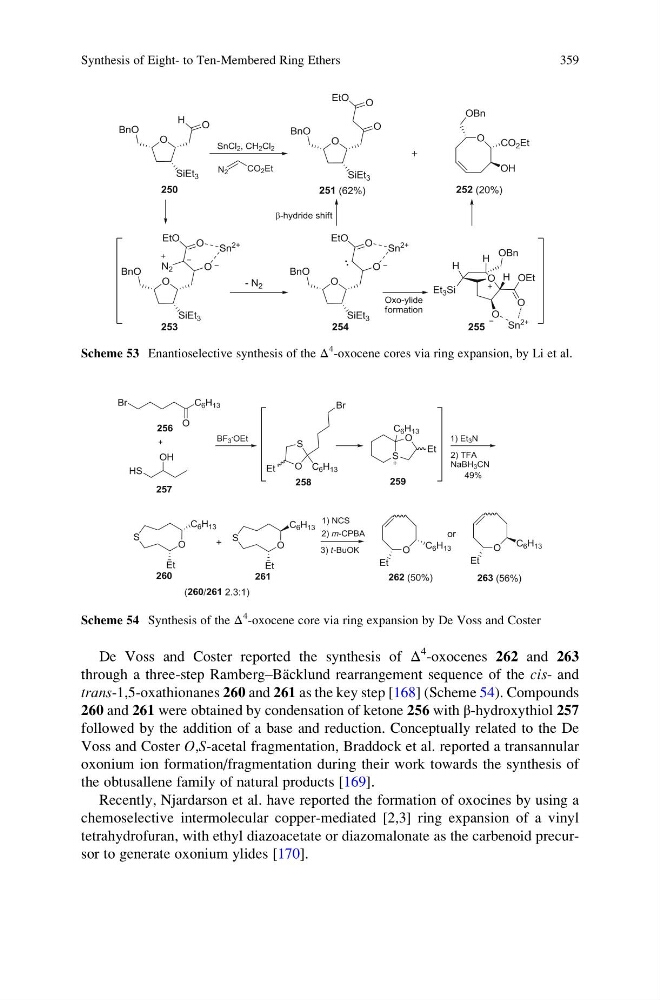
De Voss and Coster reported the synthesis of Δ
4 -oxocenes 262 and 263
through a three-step Ramberg–Ba ¨cklund rearrangement sequence of the cis- and
trans-1,5-oxathionanes 260 and 261 as the key step [168] (Scheme 54). Compounds
260 and 261 were obtained by condensation of ketone 256 with β-hydroxythiol 257
followed by the addition of a base and reduction. Conceptually related to the De
Voss and Coster O,S-acetal fragmentation, Braddock et al. reported a transannular
oxonium ion formation/fragmentation during their work towards the synthesis of
the obtusallene family of natural products [169].
Recently, Njardarson et al. have reported the formation of oxocines by using a
chemoselective intermolecular copper-mediated [2,3] ring expansion of a vinyl
tetrahydrofuran, with ethyl diazoacetate or diazomalonate as the carbenoid precursor to generate oxonium ylides [170].
Scheme 53 Enantioselective synthesis of the Δ
4
-oxocene cores via ring expansion, by Li et al.
Scheme 54 Synthesis of the Δ
4
-oxocene core via ring expansion by De Voss and Coster
Synthesis of Eight- to Ten-Membered Ring Ethers
359
4 -oxocenes 262 and 263
through a three-step Ramberg–Ba ¨cklund rearrangement sequence of the cis- and
trans-1,5-oxathionanes 260 and 261 as the key step [168] (Scheme 54). Compounds
260 and 261 were obtained by condensation of ketone 256 with β-hydroxythiol 257
followed by the addition of a base and reduction. Conceptually related to the De
Voss and Coster O,S-acetal fragmentation, Braddock et al. reported a transannular
oxonium ion formation/fragmentation during their work towards the synthesis of
the obtusallene family of natural products [169].
Recently, Njardarson et al. have reported the formation of oxocines by using a
chemoselective intermolecular copper-mediated [2,3] ring expansion of a vinyl
tetrahydrofuran, with ethyl diazoacetate or diazomalonate as the carbenoid precursor to generate oxonium ylides [170].
Scheme 53 Enantioselective synthesis of the Δ
4
-oxocene cores via ring expansion, by Li et al.
Scheme 54 Synthesis of the Δ
4
-oxocene core via ring expansion by De Voss and Coster
Synthesis of Eight- to Ten-Membered Ring Ethers
359