

from the surface of a Mexican gorgonian octocoral of the genus Pacifigorgia. The
synthesis initially relied on the preparation of chiral aldehydes 76 and 78 and
phosphonate 82, as outlined in Scheme 14. Horner–Wadsworth–Emmons reaction
applied to 78 and 82, followed by a desilylation, furnished the β-hydroxy enone 83 as
a 95:5 mixture of the E/Z-isomers. Evans–Tishchenko coupling of fragment 83 with
aldehyde 76, using a preformed samarium(III) catalyst, led to dienoic ester 84 as a
single diastereomer. A RCM applied to 84, using the second-generation Grubbs
catalyst and Ti(OiPr) 4 as Lewis acid, afforded a 1:1 mixture of the eight-membered
lactone 86 and the cyclopentene derivative 85. This latter compound was formed due
to a competitive metathesis with the trisubstituted double bond and one of the
monosubstituted double bond present in 84.
The solandelactones A–I constitute a group of eight-membered ring heterocycles
isolated in 1996 from Solanderia secunda, a dark-brown hydroid found in the shore
of Jeju island, in Korea. Some members of this family of metabolites exhibit
moderate inhibitory activity against FPT (farnesyl protein transferase) [85]. These
compounds are lactonized cyclopropyl docosanoids, being probably the first examples of marine oxylipins bearing a carbon skeleton of 22 atoms. The original
assignment of a skeleton of 11 carbon atoms of two solandelactones was
recently revised by their total synthesis [86, 87]. An approach to the synthesis
of the cyclopropyl lactone segment of solandelactones starting from
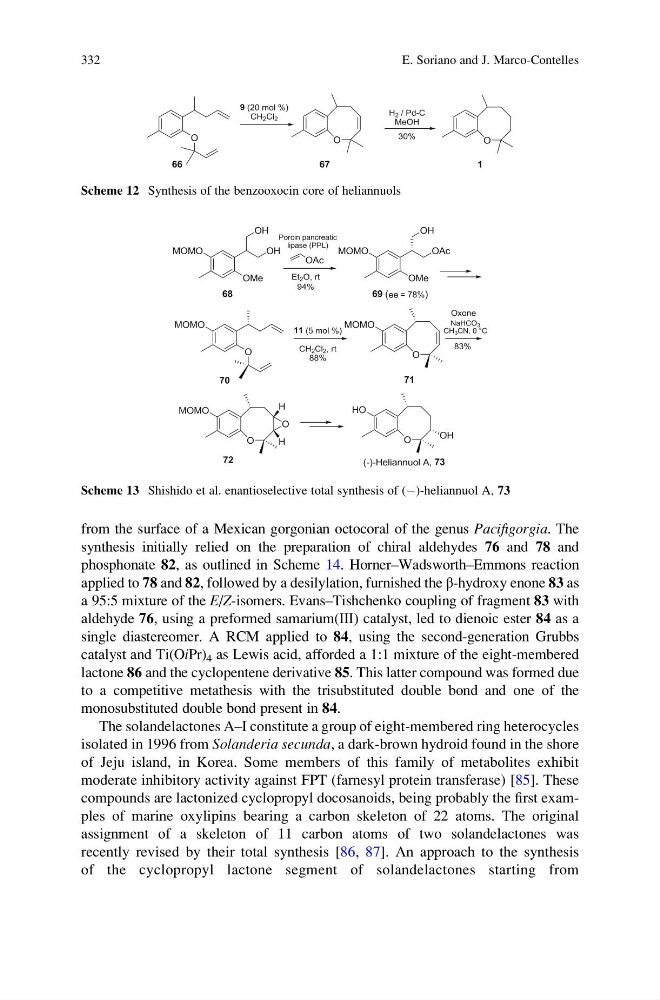
Scheme 12 Synthesis of the benzooxocin core of heliannuols
ee
Scheme 13 Shishido et al. enantioselective total synthesis of (À)-heliannuol A, 73
332
E. Soriano and J. Marco-Contelles
synthesis initially relied on the preparation of chiral aldehydes 76 and 78 and
phosphonate 82, as outlined in Scheme 14. Horner–Wadsworth–Emmons reaction
applied to 78 and 82, followed by a desilylation, furnished the β-hydroxy enone 83 as
a 95:5 mixture of the E/Z-isomers. Evans–Tishchenko coupling of fragment 83 with
aldehyde 76, using a preformed samarium(III) catalyst, led to dienoic ester 84 as a
single diastereomer. A RCM applied to 84, using the second-generation Grubbs
catalyst and Ti(OiPr) 4 as Lewis acid, afforded a 1:1 mixture of the eight-membered
lactone 86 and the cyclopentene derivative 85. This latter compound was formed due
to a competitive metathesis with the trisubstituted double bond and one of the
monosubstituted double bond present in 84.
The solandelactones A–I constitute a group of eight-membered ring heterocycles
isolated in 1996 from Solanderia secunda, a dark-brown hydroid found in the shore
of Jeju island, in Korea. Some members of this family of metabolites exhibit
moderate inhibitory activity against FPT (farnesyl protein transferase) [85]. These
compounds are lactonized cyclopropyl docosanoids, being probably the first examples of marine oxylipins bearing a carbon skeleton of 22 atoms. The original
assignment of a skeleton of 11 carbon atoms of two solandelactones was
recently revised by their total synthesis [86, 87]. An approach to the synthesis
of the cyclopropyl lactone segment of solandelactones starting from
Scheme 12 Synthesis of the benzooxocin core of heliannuols
ee
Scheme 13 Shishido et al. enantioselective total synthesis of (À)-heliannuol A, 73
332
E. Soriano and J. Marco-Contelles