

4.5.2 Radical Ring Enlargement of Cyclohexene Oxides
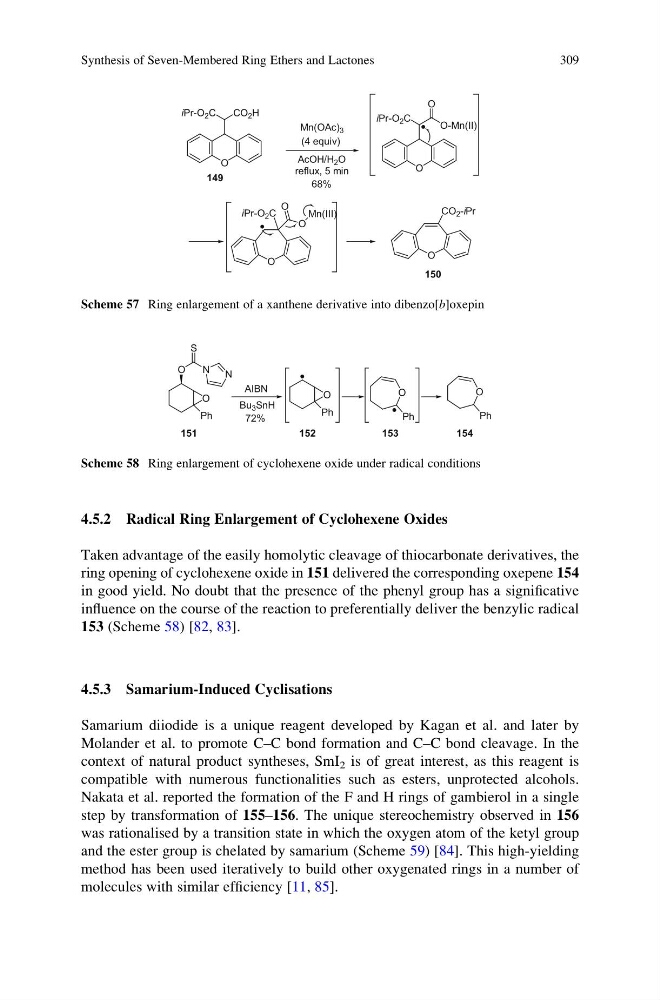
Taken advantage of the easily homolytic cleavage of thiocarbonate derivatives, the
ring opening of cyclohexene oxide in 151 delivered the corresponding oxepene 154
in good yield. No doubt that the presence of the phenyl group has a significative
influence on the course of the reaction to preferentially deliver the benzylic radical
153 (Scheme 58) [82, 83].
4.5.3 Samarium-Induced Cyclisations
Samarium diiodide is a unique reagent developed by Kagan et al. and later by
Molander et al. to promote C–C bond formation and C–C bond cleavage. In the
context of natural product syntheses, SmI 2 is of great interest, as this reagent is
compatible with numerous functionalities such as esters, unprotected alcohols.
Nakata et al. reported the formation of the F and H rings of gambierol in a single
step by transformation of 155–156. The unique stereochemistry observed in 156
was rationalised by a transition state in which the oxygen atom of the ketyl group
and the ester group is chelated by samarium (Scheme 59) [84]. This high-yielding
method has been used iteratively to build other oxygenated rings in a number of
molecules with similar efficiency [11, 85].
O
i- Pr-O 2 C
CO 2 H
O
i- Pr-O 2 C
O
O-Mn(II)
O
i- Pr-O 2 C
O
O
Mn(III)
O
CO 2 -iPr
Mn(OAc) 3
(4 equiv)
AcOH/H 2 O
reflux, 5 min
150
149
68%
Scheme 57 Ring enlargement of a xanthene derivative into dibenzo[b]oxepin
O
O
Ph
N
N
S
O
Ph
O
Ph
O
Ph
AIBN
Bu 3 SnH
154
151
72%
152
153
Scheme 58 Ring enlargement of cyclohexene oxide under radical conditions
Synthesis of Seven-Membered Ring Ethers and Lactones
309
Taken advantage of the easily homolytic cleavage of thiocarbonate derivatives, the
ring opening of cyclohexene oxide in 151 delivered the corresponding oxepene 154
in good yield. No doubt that the presence of the phenyl group has a significative
influence on the course of the reaction to preferentially deliver the benzylic radical
153 (Scheme 58) [82, 83].
4.5.3 Samarium-Induced Cyclisations
Samarium diiodide is a unique reagent developed by Kagan et al. and later by
Molander et al. to promote C–C bond formation and C–C bond cleavage. In the
context of natural product syntheses, SmI 2 is of great interest, as this reagent is
compatible with numerous functionalities such as esters, unprotected alcohols.
Nakata et al. reported the formation of the F and H rings of gambierol in a single
step by transformation of 155–156. The unique stereochemistry observed in 156
was rationalised by a transition state in which the oxygen atom of the ketyl group
and the ester group is chelated by samarium (Scheme 59) [84]. This high-yielding
method has been used iteratively to build other oxygenated rings in a number of
molecules with similar efficiency [11, 85].
O
i- Pr-O 2 C
CO 2 H
O
i- Pr-O 2 C
O
O-Mn(II)
O
i- Pr-O 2 C
O
O
Mn(III)
O
CO 2 -iPr
Mn(OAc) 3
(4 equiv)
AcOH/H 2 O
reflux, 5 min
150
149
68%
Scheme 57 Ring enlargement of a xanthene derivative into dibenzo[b]oxepin
O
O
Ph
N
N
S
O
Ph
O
Ph
O
Ph
AIBN
Bu 3 SnH
154
151
72%
152
153
Scheme 58 Ring enlargement of cyclohexene oxide under radical conditions
Synthesis of Seven-Membered Ring Ethers and Lactones
309