

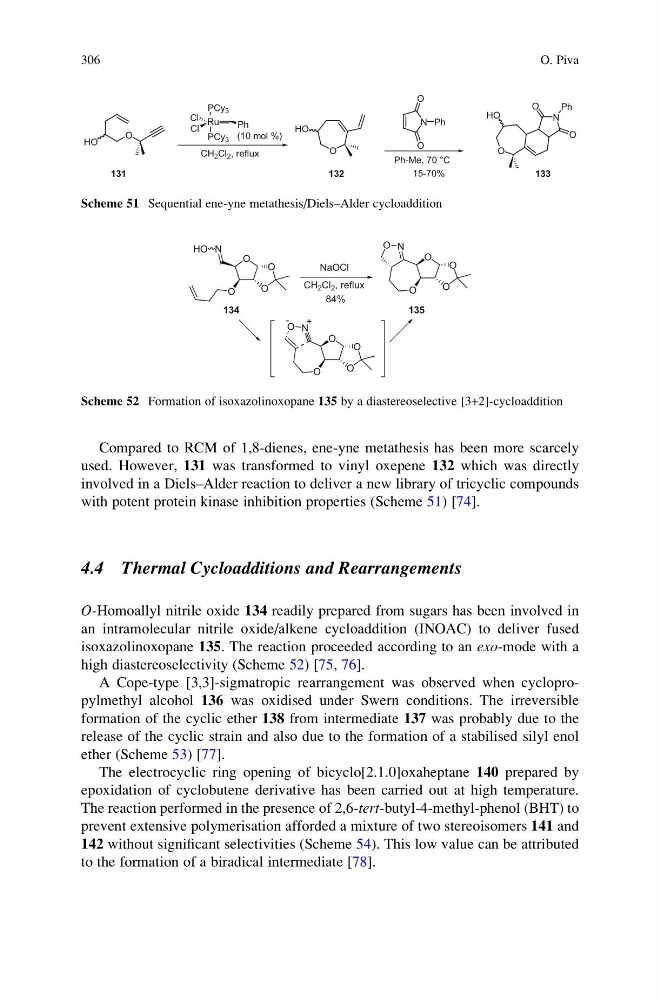
Compared to RCM of 1,8-dienes, ene-yne metathesis has been more scarcely
used. However, 131 was transformed to vinyl oxepene 132 which was directly
involved in a Diels–Alder reaction to deliver a new library of tricyclic compounds
with potent protein kinase inhibition properties (Scheme 51) [74].
4.4 Thermal Cycloadditions and Rearrangements
O-Homoallyl nitrile oxide 134 readily prepared from sugars has been involved in
an intramolecular nitrile oxide/alkene cycloaddition (INOAC) to deliver fused
isoxazolinoxopane 135. The reaction proceeded according to an exo-mode with a
high diastereoselectivity (Scheme 52) [75, 76].
A Cope-type [3,3]-sigmatropic rearrangement was observed when cyclopropylmethyl alcohol 136 was oxidised under Swern conditions. The irreversible
formation of the cyclic ether 138 from intermediate 137 was probably due to the
release of the cyclic strain and also due to the formation of a stabilised silyl enol
ether (Scheme 53) [77].
The electrocyclic ring opening of bicyclo[2.1.0]oxaheptane 140 prepared by
epoxidation of cyclobutene derivative has been carried out at high temperature.
The reaction performed in the presence of 2,6-tert-butyl-4-methyl-phenol (BHT) to
prevent extensive polymerisation afforded a mixture of two stereoisomers 141 and
142 without significant selectivities (Scheme 54). This low value can be attributed
to the formation of a biradical intermediate [78].
CH 2 Cl 2 , reflux
HO
O
Ru
Ph
PCy 3
Cl
Cl
(10 mol %)
O
HO
PCy 3
132
131
N Ph
O
O
O
HO
N
O
O
Ph
Ph-Me, 70 °C
15-70%
133
Scheme 51 Sequential ene-yne metathesis/Diels–Alder cycloaddition
O
O
O
O
N
HO
NaOCl
CH 2 Cl 2 , reflux
O
O
O
O
N
O
135
134
84%
O
O
O
O
N
O
+
-
Scheme 52 Formation of isoxazolinoxopane 135 by a diastereoselective [3+2]-cycloaddition
306
O. Piva
used. However, 131 was transformed to vinyl oxepene 132 which was directly
involved in a Diels–Alder reaction to deliver a new library of tricyclic compounds
with potent protein kinase inhibition properties (Scheme 51) [74].
4.4 Thermal Cycloadditions and Rearrangements
O-Homoallyl nitrile oxide 134 readily prepared from sugars has been involved in
an intramolecular nitrile oxide/alkene cycloaddition (INOAC) to deliver fused
isoxazolinoxopane 135. The reaction proceeded according to an exo-mode with a
high diastereoselectivity (Scheme 52) [75, 76].
A Cope-type [3,3]-sigmatropic rearrangement was observed when cyclopropylmethyl alcohol 136 was oxidised under Swern conditions. The irreversible
formation of the cyclic ether 138 from intermediate 137 was probably due to the
release of the cyclic strain and also due to the formation of a stabilised silyl enol
ether (Scheme 53) [77].
The electrocyclic ring opening of bicyclo[2.1.0]oxaheptane 140 prepared by
epoxidation of cyclobutene derivative has been carried out at high temperature.
The reaction performed in the presence of 2,6-tert-butyl-4-methyl-phenol (BHT) to
prevent extensive polymerisation afforded a mixture of two stereoisomers 141 and
142 without significant selectivities (Scheme 54). This low value can be attributed
to the formation of a biradical intermediate [78].
CH 2 Cl 2 , reflux
HO
O
Ru
Ph
PCy 3
Cl
Cl
(10 mol %)
O
HO
PCy 3
132
131
N Ph
O
O
O
HO
N
O
O
Ph
Ph-Me, 70 °C
15-70%
133
Scheme 51 Sequential ene-yne metathesis/Diels–Alder cycloaddition
O
O
O
O
N
HO
NaOCl
CH 2 Cl 2 , reflux
O
O
O
O
N
O
135
134
84%
O
O
O
O
N
O
+
-
Scheme 52 Formation of isoxazolinoxopane 135 by a diastereoselective [3+2]-cycloaddition
306
O. Piva