

18.4 14-Membered Macrocyclic Lactones
18.4.1 Hypothemycin
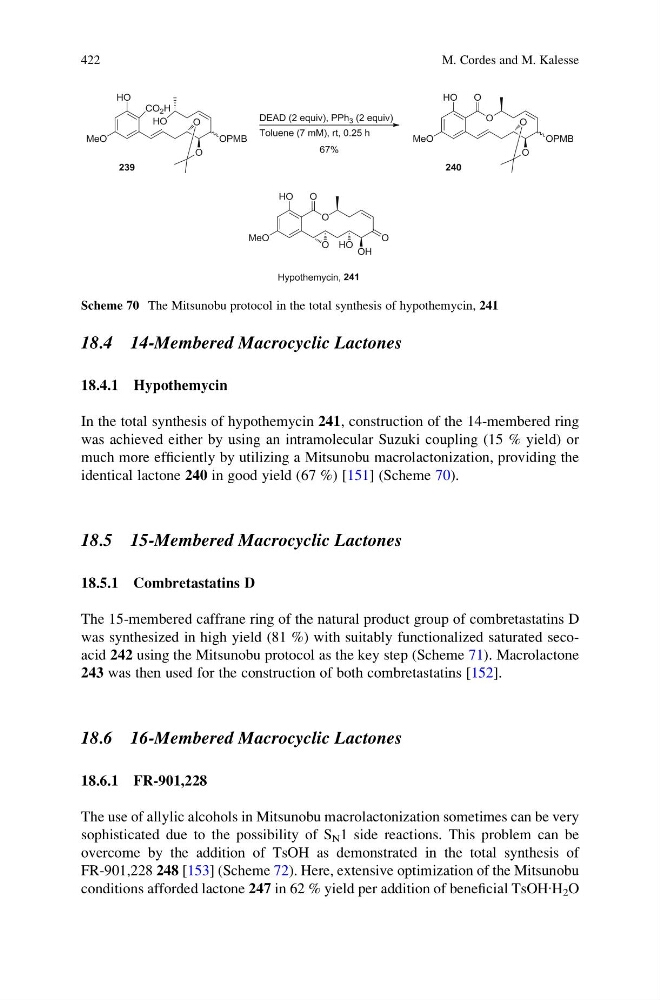
In the total synthesis of hypothemycin 241, construction of the 14-membered ring
was achieved either by using an intramolecular Suzuki coupling (15 % yield) or
much more efficiently by utilizing a Mitsunobu macrolactonization, providing the
identical lactone 240 in good yield (67 %) [151] (Scheme 70).
18.5 15-Membered Macrocyclic Lactones
18.5.1 Combretastatins D
The 15-membered caffrane ring of the natural product group of combretastatins D
was synthesized in high yield (81 %) with suitably functionalized saturated secoacid 242 using the Mitsunobu protocol as the key step (Scheme 71). Macrolactone
243 was then used for the construction of both combretastatins [152].
18.6 16-Membered Macrocyclic Lactones
18.6.1 FR-901,228
The use of allylic alcohols in Mitsunobu macrolactonization sometimes can be very
sophisticated due to the possibility of S N 1 side reactions. This problem can be
overcome by the addition of TsOH as demonstrated in the total synthesis of
FR-901,228 248 [153] (Scheme 72). Here, extensive optimization of the Mitsunobu
conditions afforded lactone 247 in 62 % yield per addition of beneficial TsOH∙H 2 O
Scheme 70 The Mitsunobu protocol in the total synthesis of hypothemycin, 241
422
M. Cordes and M. Kalesse
18.4.1 Hypothemycin
In the total synthesis of hypothemycin 241, construction of the 14-membered ring
was achieved either by using an intramolecular Suzuki coupling (15 % yield) or
much more efficiently by utilizing a Mitsunobu macrolactonization, providing the
identical lactone 240 in good yield (67 %) [151] (Scheme 70).
18.5 15-Membered Macrocyclic Lactones
18.5.1 Combretastatins D
The 15-membered caffrane ring of the natural product group of combretastatins D
was synthesized in high yield (81 %) with suitably functionalized saturated secoacid 242 using the Mitsunobu protocol as the key step (Scheme 71). Macrolactone
243 was then used for the construction of both combretastatins [152].
18.6 16-Membered Macrocyclic Lactones
18.6.1 FR-901,228
The use of allylic alcohols in Mitsunobu macrolactonization sometimes can be very
sophisticated due to the possibility of S N 1 side reactions. This problem can be
overcome by the addition of TsOH as demonstrated in the total synthesis of
FR-901,228 248 [153] (Scheme 72). Here, extensive optimization of the Mitsunobu
conditions afforded lactone 247 in 62 % yield per addition of beneficial TsOH∙H 2 O
Scheme 70 The Mitsunobu protocol in the total synthesis of hypothemycin, 241
422
M. Cordes and M. Kalesse